How much does a bromeliad cost per pot on the market?
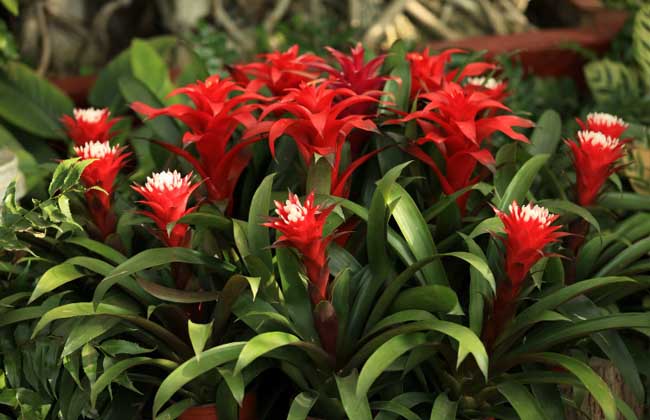
Bromeliads originate from the jungles of Mexico to southern Brazil and northern Argentina, and are today the most popular indoor foliage plants. With their unusual flowers and beautiful patterns, they leave people marveling, and they are especially suited to being grown indoors. As a home gardening ornamental they are of very high taste. Let us take a look below at the market price of bromeliads!
The market price of bromeliads
The market price of bromeliads is usually not expensive, with prices ranging from a few yuan to several tens of yuan. A plant 25 cm tall is generally 40 yuan, one 50 cm tall is around 90 yuan, and good varieties over one meter tall are generally 200 yuan or more. If bought during a major holiday, they will be more expensive than usual.
Selecting bromeliad varieties
1. Water tower plant (Billbergia nutans): The leaves of the water tower plant are narrow and long like swords, emerald green and glossy. From winter to early spring, a bright red columnar inflorescence about 30 cm tall emerges from the tender green leaf tube, bearing 6-12 small flowers at the top, with 3 petals that are pale yellow-green with blue edges, curling outward after opening. When in full bloom, strings of blue-green flowers, set off against the red bracts, look especially gorgeous and eye-catching, and the ornamental period can last up to two months.
2. Dwarf bromeliad (Cryptanthus, also called small bromeliad): The dwarf bromeliad, also known as the small bromeliad, is most suitable for potted display. Its leaves are firm and slender with wavy edges, and their color may be creamy yellow, red or purplish red, with long longitudinal stripes radiating across the leaf surface like a crab shape. The flowers are white or light green, growing among the leaf clusters to form a disc.
3. Dragonfly bromeliad (Aechmea fasciata, also called silver vase): The dragonfly bromeliad, also known as beautiful-leaf silver vase or spotted pink pineapple, has a plant made up of 10-20 leaves forming a rosette leaf cluster with a cup-shaped base. The leaf tips are bluntly rounded and turned outward, bright green, with a silvery-white coating on the surface, and the leaf surface has irregular stored color and dark green horizontal stripes and patches. Between summer and autumn, after the peach-pink columnar flowers, about 15 cm tall. The dense small flowers open blue at first and then turn rose red, like a dragonfly flying with beating wings, and the ornamental period can last several months.
4. Golden-edged bromeliad (Ananas, golden-edged pineapple): The leaves of the golden-edged bromeliad are sword-shaped, curling outward, crisp and glossy. The upper surface of the leaves is dark green with yellow-green edges, and some leaves also gradually show varying yellow-green stripes in the middle. The underside is light green with the same yellow-green hidden stripes as the upper surface. In spring and summer, the cylindrical flower bud emerging from the leaf tube is about 2.5 cm thick, and 25-30 sepals wrap from bottom to top like bamboo shoot shells into a column from deep red to pink, closely resembling a red bamboo shoot set into the leaf tube. Over two or three weeks, the columnar bud splits open, sending up a straight flower stem bearing a dozen or so small flowers, each showing three colors from bottom to top: yellow, red and purple, and it is very ornamental.
5. Painted bract bromeliad (Vriesea, also called torch): The painted bract bromeliad, also called torch, is a hybrid. The leaf edges are smooth without serrations, and a straight flower stem up to 35-40 cm long emerges from the center, with a spike inflorescence at the top, and the flower spike has 2-4 branches. The bracts are deep red, thick and glossy, and the whole inflorescence looks like a blazing torch. The flowering period can last up to three months, and it is also a favorite among ornamental bromeliads.
How to grow bromeliads
1. Soil requirements: For growing bromeliads, loose peat soil, humus soil, and a mixed potting soil of shredded tree fern residue are best. If growing at home, it is best to use leaf mold plus a small amount of garden soil, or a half-and-half mix of peat soil and perlite. Choosing suitable soil allows bromeliads to absorb water better, so the soil requirement is also very important.
2. Suitable temperature: If you want to grow bromeliads well, first of all the temperature requirement must be understood. Generally, the most suitable growth temperature for bromeliads is 20°C to 30°C. At the highest, the temperature should not exceed 35°C, and at the lowest it should not fall below about 10°C. Too high or too low a temperature will have an adverse effect on bromeliads, so the temperature requirement of bromeliads must be grasped.
3. Suitable light: Bromeliads do have a certain demand for light, which also stems from the environment in which they grow. Bromeliads are shade-loving plants, so they cannot be exposed to direct sunlight. When they are exposed to sunlight for too long, some leaves will turn yellow. At the same time, an appropriate amount of light is also needed for photosynthesis, so bromeliads are suitable for being grown in semi-shade or in a bright window or indoors.
4. Moderate water: According to the growth needs of bromeliads, their water requirement for the soil should not be too high or too low. Make sure the soil surface in the pot is slightly dry. Bromeliads have a leaf tube at the base of the leaves, and below the leaf tube there is a water tank; make sure there is always water in the tank and that it is not interrupted. At the same time, also pay attention to spraying a little misty water on the bromeliad leaves more often, which can also ensure air humidity to meet the growth needs of bromeliads.
5. Reasonable fertilizing: No matter what plant it is, the need for nutrients is indispensable. Bromeliads mainly rely on the leaf cup to absorb nutrients, so during the growth of bromeliads, apply nitrogen fertilizer once a week, and appropriately increase the application of phosphorus and potassium fertilizer before flowering to promote larger flowers and brighter colors. Proper fertilizing is also an indispensable process for growing bromeliads well, so during cultivation, more attention should also be paid to giving bromeliads an appropriate amount of fertilizer.