How much does a Money Tree cost on the market?
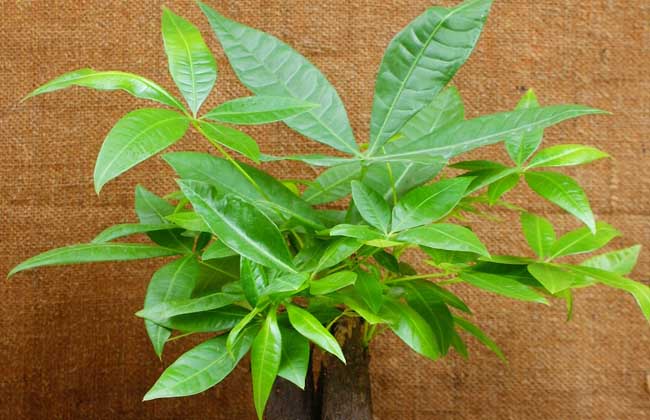
The Money Tree is deeply popular with businesses and ordinary citizens alike. It has a beautiful upright shape, bright green leaves, and a trunk shaped like a hammer. Once potted, it is suitable for indoor arrangement and beautification, which is why it has developed so quickly in China's flower market. During festivals, hotels, restaurants, businesses and citizens all rush to buy it to symbolize good fortune and wishes coming true. Let's take a look below at the market price of the Money Tree!
The market price of the Money Tree
The price of the Money Tree fluctuates quite a bit, mainly because of the variety, the number of stems, the size, the regional price level and so on. These factors all have a certain influence on the price of the Money Tree. Generally speaking, a multi-stem Money Tree is more expensive than a single-stem one. A single stem per pot costs between 100-200, two stems per pot between 200-300 yuan, and three stems per pot between 300-400 yuan, provided the branches and trunk are relatively thick. Thin, small branches and trunks are not worth much. For example, those with three stems twisted together that are still not as thick as a single stem's trunk are only for their shape and are very cheap. But some single-stem plants, where the trunk of the single stem is thicker than that of three stems, cost around six or seven hundred!
Common varieties of the Money Tree
1. Taiwan Money Tree: Upon verification, the Chinese name of the Taiwan Money Tree is Malabar Chestnut (Pachira aquatica), native to Mexico. It is most widely cultivated in Taiwan, China, and most of the plants grown in mainland China are introduced from Taiwan, China.
2. Large-leaf Money Tree: Originally named Queensland Umbrella Tree (Schefflera actinophylla), native to Australia.
3. Money Beauty Tree: This is Schefflera octophylla, belonging to the Araliaceae family, produced in Taiwan, China, Guangdong, Hong Kong, China, Fujian, Hainan Island and other places.
Its effect on the home environment
1. The Money Tree can beautify the home. The Money Tree is an evergreen tree with large flowers, lobed petals, and flower colors of red, white or pale yellow, with brilliant hues. A plant with green leaves is a treat for the eyes, and with flowers it is a fine choice for appreciation. Placing it at home to add a touch of charm to the decor is beyond doubt.
2. The Money Tree is especially good at purifying indoor air. Even under weak light or high carbon dioxide concentrations, the Money Tree can carry out photosynthesis efficiently and effectively eliminate carbon monoxide and carbon dioxide pollution in the air. In addition, the Money Tree has strong transpiration, which can effectively regulate indoor temperature and humidity, and can also resist harmful gases produced by cigarettes. If the Money Tree is combined with Buddhist Pine (Podocarpus macrophyllus), the effect will be even greater - truly a perfect pairing, unmatched in the world.
3. The Money Tree creates a low-carbon home life. Low carbon has become the hottest environmental topic today. From advocating environmental protection to reducing carbon emissions, the low-carbon lifestyle is being pursued by more and more Chinese people. Home life is an important part of low-carbon living. Using green plants as the best home decorations can serve as a good home ornament while also absorbing excess carbon dioxide and purifying the air. In daily life, just making a small change can lay a good foundation for a “low-carbon” life. A low-carbon life and trendy style are not contradictory at all. Just as accessories of different styles match clothes of different styles, plants also need to match the style of the home to make a small home even more beautiful.
Its application in feng shui
1. Placing a large-denomination banknote under the Money Tree will have the effect of using money to nourish money. The Money Tree is already an ornament full of symbolism, and with money placed beneath it, it is even more conducive to gathering wealth.
2. Placing a Money Tree in a feng shui position will make the whole family more energetic. Feng shui positions are very suitable for placing potted plants to enhance wood-element energy. The potted plant should be kept healthy and lush; avoid using dried flowers, because they accumulate negative energy. The Money Tree is the most popular choice.
3. Placing a pot of Money Tree in the southeast direction helps attract wealth and treasure. Clear away the clutter piled up in the southeast area, then move away metal-element items that disrupt wood-element energy, and you can begin planning the wealth-attracting feng shui of the southeast direction. Colors that strengthen the energy of the southeast direction include deep blue, which belongs to the water element, and green, which belongs to the wood element. The Money Tree is the best choice.
4. The meaning of the name is self-evident: to make a fortune. Because the thick leaves of the Money Tree are rich in water, it needs a lot of sunlight and very little water. In winter, the Money Tree enters a dormant state and needs even less water. Any fertilizer rich in potassium is suitable for the Money Tree. If you are lucky, the Money Tree will bloom in December or July, and at that time unexpected wealth may arrive.