What is the general price of Sichuan pepper per jin?
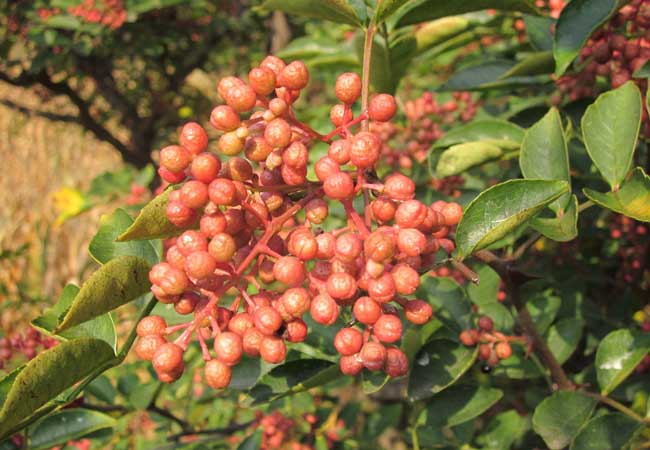
Sichuan pepper is a deciduous shrub or small tree of the genus Zanthoxylum in the family Rutaceae. It can be planted as a specimen plant or used as a defensive thorny hedge. Its fruit peel can be used as a seasoning, and aromatic oil can be extracted from it; it can also be used as medicine. The seeds are edible and can also be processed into soap. Let's take a look below at the varieties and market prices of Sichuan pepper!
Market prices of Sichuan pepper
Seedless new Sichuan pepper costs about 30 yuan per jin, while older Sichuan pepper with many seeds costs about 20 yuan per jin.
Variety classification of Sichuan pepper
The Zanthoxylum plants native to our country mainly include the following species:
1. Sichuan pepper: Also called Qin pepper, Feng pepper, or Shu pepper, abbreviated as pepper tree. It is the most widely cultivated variety in our country with the highest economic value, found in almost every part of the country. The branches have prickles, and the bases of the prickles are mostly broad and flat. The leaflets are usually 5-9 in number, ovate, ovate-oblong to ovate, with finely blunt teeth along the edges. The inflorescence is terminal. The fruit is a follicle, spherical, with densely covered wart-like glandular dots on the surface, turning light red to purplish red when mature. The flowering period is April to May, and the fruiting period is June to October.
2. Wild Sichuan pepper: It is one of the main species producing pepper peel, with uses the same as Sichuan pepper, but the taste is slightly inferior. It is mainly distributed in the shrublands south of the Yangtze River and in the mountainous areas of North China, mostly wild and rarely cultivated. The branches have prickles and white lenticels. The leaflets are usually 5-9 in number, ovate-rounded or ovate-oblong, with petioles extremely short and nearly sessile, and the edges have finely blunt teeth. The flowering period is March to May, and the fruiting period is June to August.
3. Chuan-Shaan Sichuan pepper: Also called Dajin Sichuan pepper. This species can be used as rootstock for Sichuan pepper, the fruit peel can be used to extract aromatic oil, and the seeds can also be pressed for oil. It is distributed in southern Gansu and Shaanxi provinces and northern Sichuan. The branches have prickles, and the prickles are straight and enlarged at the base. The leaflets are usually 11-17 in number, obovate or oblique-ovate, asymmetrical on both sides, with finely blunt teeth along the upper half of the edges. The inflorescence is axillary or terminal. The glandular dots on the surface of the follicle protrude, turning purplish red when mature. The flowering period is April to May, and the fruiting period is June to August.
4. Bamboo-leaf Sichuan pepper: Abbreviated as bamboo-leaf pepper. Its uses are the same as Sichuan pepper, but the peel has a stronger numbing taste and a slightly weaker aroma. It is mainly distributed in Southwest, East, Central, and North China, with a small amount cultivated in mountainous areas, or used as rootstock for Sichuan pepper. It is evergreen or semi-evergreen, and the branches have prickles that are flat at the base and slightly curved at the tip. The leaflets are 3-9 in number, lanceolate to ovate-oblong, with sparse shallow teeth or nearly entire edges. The inflorescence is axillary. The follicles are small, with obvious wart-like dots on the surface, turning red to purplish red when mature. The flowering period is April to June, and the fruiting period is July to September.
5. Green Sichuan pepper: Also called cliff pepper, wild pepper, or fragrant pepper seed, abbreviated as green pepper. Its uses are the same as Sichuan pepper. It is distributed in most provinces (autonomous regions) north and south of the Yellow River. The branches have needle-like prickles. The leaflets are 11-21 in number, lanceolate or elliptic-lanceolate. The inflorescence is broad and terminal. The tip of the follicle has a short beak, the glandular dots on the surface are not very protruding, and it turns grayish green to brownish green when mature, rarely purplish red. The flowering period is June to August, and the fruiting period is September to November.
6. Teng pepper: Also known as oil pepper or fragrant pepper seed. Its uses are the same as Sichuan pepper, but it is mainly used for making oil. It is mainly distributed in Hanyuan, Leshan City, Meishan City, Hongya, Jiuli of Emeishan City, and other places in Sichuan Province. It begins to sprout in late February and buds in early March. The timing of budding is related to soil conditions and tree vigor. Teng pepper matures and comes to market from mid-to-late July to early August, with a maturity period of about 130 days. The Teng pepper tree is three chi to nine chi tall. The tree is dark gray, mostly thorny, and hairless, with single compound leaves growing in clusters. The flowers are small and numerous. The fruit oil is mostly glossy, and its fragrance is volatile, with a fragrant and numbing taste.
Excellent varieties of Sichuan pepper
Sichuan pepper has a long cultivation history in our country, is widely distributed, has complex variation, and has diverse ecological types. Through long-term natural selection and artificial breeding, more than 60 cultivated varieties and types have been formed. At present, the representative main cultivated varieties in production include:
1. Dahongpao: Also called Dahong pepper, Lion's Head, or Geda pepper. It is the excellent variety with the widest cultivation and the broadest range. This variety's trees in full fruit period are 3-5 m tall, with vigorous tree vigor, rapid growth, small branching angle, a semi-spreading tree posture, and a semicircular crown. Current-year new shoots are red, one-year-old branches are purplish brown, and perennial branches are grayish brown. The prickles are broad and thick at the base and gradually pointed at the tip. The leaves are broadly ovate, dark green, relatively thick and glossy, with a smooth surface. The fruit matures from mid-August to early September. The mature fruit is bright red, with obvious protruding wart-like glandular dots on the surface, a short stalk, and tight clusters. The fruit grains are large, 5-6 mm in diameter, and the thousand-grain weight of fresh fruit is about 85 g. The mature fruit cracks easily, and the harvest period is relatively short. After drying in the sun, the peel is deep red, with a strong numbing taste and superior quality. Generally, 4-5 kg of fresh fruit can be sun-dried into 1 kg of dried pepper peel. Dahongpao Sichuan pepper has strong yielding ability, likes fertilizer and is drought-tolerant, but is not tolerant of waterlogging or cold, and is suitable for cultivation on terraced fields, platforms, slopes, and valley terraces in arid mountainous and hilly areas at an altitude of 300-1800 m. It is widely cultivated in Shaanxi, Gansu, Shanxi, Henan, Shandong, and other provinces, and has formed many different ecological types.
2. Dahong pepper: Also called oil pepper, Erhongpao, Erxingzi, etc. This variety's trees in full fruit period are 2.5-4.5 m tall, with a large branching angle, a spreading tree posture, moderate tree vigor, and a round-headed crown. Current-year new shoots are green, one-year-old branches are brownish green, and perennial branches are grayish brown. The prickles are broad and flat at the base and short and blunt at the tip, and often fall off from the base as the branch age increases. The leaves are relatively broad and large, ovate-oblong, lighter in color than Dahongpao, with a smooth surface. The fruit matures around mid-September and is red when mature, with a glossy oil sheen. The wart-like glandular dots on the surface are obvious. The clusters are loose, and the stalk is relatively long and thick. The fruit grains are medium and uniform in size, 4.5-5.0 mm in diameter, and the thousand-grain weight of fresh fruit is about 70 g. After drying in the sun, the peel is sauce-red, relatively thick, with a rich numbing aroma and superior quality. Generally, 3.5-4.0 kg of fresh fruit can be sun-dried into 1 kg of dried pepper peel. Dahong pepper has strong and stable yielding ability, likes fertilizer and is moisture-tolerant, with strong stress resistance, and is suitable for planting in arid mountainous areas, river-platform areas, and around homes at an altitude of 1300-1700 m. It is cultivated more in the provinces of Northwest and North China.