What is the general market price of Guizhou Three Treasures?
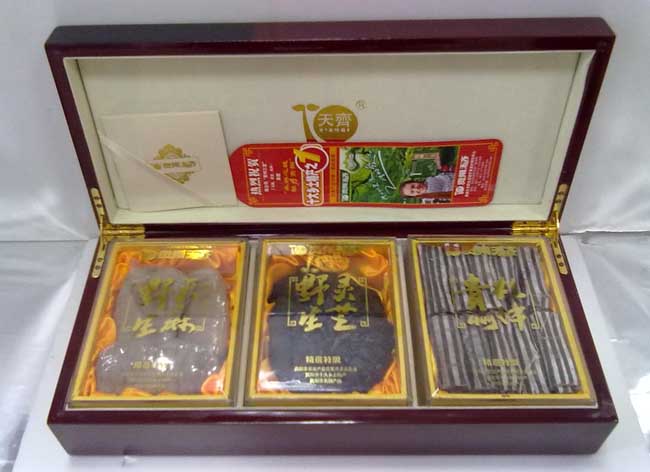
The earlier and more widely recognized Guizhou Three Treasures are Gastrodia elata, reishi mushroom, and Eucommia ulmoides. Later, there were also claims of Renhuai Moutai, Yuping bamboo flute, and Dafang lacquerware. With the development of Guizhou's economy and tourism, what the Guizhou Three Treasures refer to has varied. Now we mainly introduce the traditional Guizhou Three Treasures, namely Gastrodia elata, reishi mushroom, and Eucommia ulmoides. Let us take a look at the prices and effects of the Guizhou Three Treasures!
Reference price list of Guizhou Three Treasures
Product Category Product Specification Reference Price Guizhou Tianqi Brand Guizhou Three Treasures 330 g ¥: 88.00 yuan Guizhou Tianqi Brand Guizhou Three Treasures 500 g ¥: 200.00 yuan Guizhou Tianqi Brand Guizhou Three Treasures 328 g ¥: 145.00 yuan Guizhou Shanlimei Brand Guizhou Three Treasures 210 g ¥: 78.00 yuan Guizhou Shanlimei Brand Guizhou Three Treasures 330 g ¥: 88.00 yuan Guizhou Shanlimei Brand Guizhou Three Treasures 378 g ¥: 200.00 yuanEffects and functions of Guizhou Three Treasures
The Guizhou Three Treasures are Guizhou Gastrodia elata, Guizhou reishi mushroom, and Guizhou Eucommia ulmoides. Let us now take a look at their effects and functions!
1. Guizhou Gastrodia elata
It belongs to the genus Gastrodia in the orchid family, a perennial herbaceous plant, and its dried tuber is used medicinally. Gastrodia elata was originally wild, growing in mountain valley woodlands at altitudes above 1000 m. At present, artificial cultivation of Gastrodia elata has been successful. As a precious famous product, Gastrodia elata's status can rival that of Moutai liquor; as an authentic medicinal material, its fame is comparable to that of ginseng.
Japanese doctor of pharmacy Tsuneo Namba, in his monograph "Introduction to Kampo Medicine", asserted that “the best Gastrodia elata comes from Guizhou”. The “miraculous” nature of Gastrodia elata can be seen from its aliases. For example, the aboveground stem of the whole Gastrodia elata plant contains no chlorophyll, is single and upright, just like an arrow shaft. A medicinal proverb says: “The red arrow pierces the sky; when there is wind it does not move and can stabilize wind, when there is no wind it moves by itself and can dispel wind.” Therefore it is also called red arrow, wind-stabilizing grass, solitary sway, and divine grass. The seeds of Gastrodia elata are tiny like powder, light as down, and mature seeds mostly drift away with the wind, making them difficult to collect and plant. Therefore, medicinal farmers have the saying: “Gastrodia, Gastrodia, naturally born hemp, sown by immortals, dug by mortals.” Hence it is also called ghost supervisor and white dragon skin. Gastrodia elata is a famous Chinese medicinal material and was already used as medicine more than 2000 years ago.
According to the "Shennong Bencao Jing", Gastrodia elata (then called red arrow) is sweet in flavor and neutral in nature, and has the functions of treating convulsions, calming the liver and extinguishing wind, unconsciousness, and boosting qi and benefiting the spirit. It is good at treating dizziness and blurred vision, dim eyesight, numbness of the limbs, neurasthenia, wind-cold-damp arthralgia, infantile convulsions, epilepsy, hypertension, otogenic vertigo, and other conditions. Clinical application has proven that it has significant therapeutic effects on vascular neurogenic headache, sequelae of cerebral concussion, and other conditions. Famous Guizhou Chinese patent medicines such as “Renshen Zaizao Wan” and “Dahuoluo Dan” all use Gastrodia elata as the main ingredient. In recent years, some cigarettes and beverage wines have also used Gastrodia elata as an ingredient, and its range of use is becoming broader and broader.
Guizhou is the main producing area of Gastrodia elata in China. The Gastrodia elata produced there is large, thick, yellow-white in color, semi-transparent, plump, heavy and solid in quality, and without hollow centers, making it the best among wild varieties.
2. Guizhou reishi mushroom
Reishi mushroom is also known as “immortal grass” and “reishi grass”. It is mainly produced in the deep mountains near water on the Guizhou Plateau. Under Guizhou's uniquely favorable pristine environment, the wild reishi mushroom that grows is excellent in quality and rich in nutrients. It is the best wild reishi mushroom variety in China and enjoys a very high reputation at home and abroad.
The main components of reishi mushroom are organic germanium, high-molecular polysaccharides, triterpene ganoderic acids, mannitol, ergosterol, adenosine, various enzymes, and so on. In addition, it also contains fully matched trace elements and multiple vitamins. Reishi mushroom has effects such as resisting thrombosis, preventing arteriosclerosis, regulating blood pressure, improving hyperlipidemia, bidirectionally regulating the balance of human body functions, delaying body aging, improving one's own immunity, and promoting the normalization of the functions of all internal organs. Therefore, it has been approved by the state as a new resource food, and reishi mushroom fully deserves to be called the “crown of health foods”!
3. Guizhou Eucommia ulmoides
Eucommia ulmoides is a perennial deciduous tree plant of the genus Eucommia in the family Eucommiaceae, and its dried bark is used medicinally. In China's first pharmaceutical monograph, the "Shennong Bencao Jing", it was listed as a top-grade medicine. For more than 2000 years, it has been one of the main commonly used Chinese medicines highly praised by physicians.
Eucommia ulmoides is abundantly produced in the Loushan Mountains of Guizhou, and most areas of Guizhou produce Eucommia ulmoides. In "Differentiation of Drug Production", there is a record that "Eucommia ulmoides produced in Sichuan and Guizhou is the best". Eucommia ulmoides is sweet in flavor, slightly pungent, and warm in nature. It has many medicinal uses, especially in tonifying the liver and kidneys, strengthening tendons and bones, preventing miscarriage, and lowering blood pressure. It is specially used to treat conditions such as kidney-deficiency low back pain, weakness of the waist and knees, restless fetus, threatened miscarriage, and hypertension, and is a commonly used yang-tonifying drug.