What is the market price of a Boer goat?
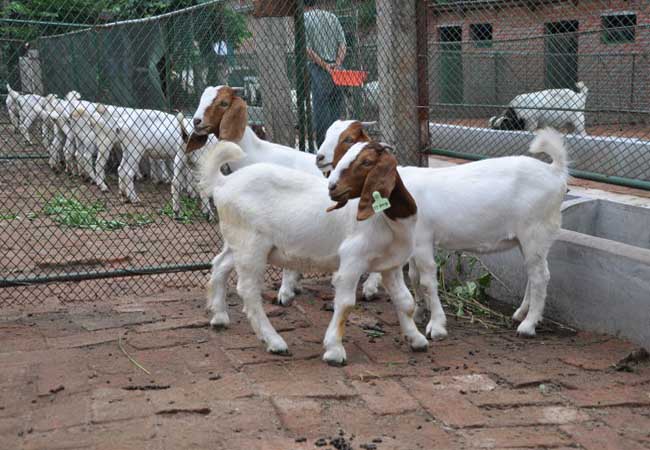
The Boer goat originated in South Africa and is known as the world's "king of meat goats". It has characteristics such as a large body size, fast growth, strong reproductive capacity, multiple lambs per litter, a high slaughter rate, high meat yield, tender meat, good palatability, tolerance of coarse feed, strong adaptability, strong disease resistance and stable heredity. Now let's take a look at the Boer goat price trends!
Distinguishing Boer Goat Generations
1. First-cross Boer goats are superior in build to local goat breeds, with relatively short hair that is mostly white. A few have yellow-brown necks, and their weight gain rate is noticeably higher than that of the dam. In addition, their ears are not upright like the dam's, but flat or slightly drooping. If the earlier external features are hard to identify, then using the ear characteristics for identification is relatively easy and absolutely necessary.
2. Second-generation Boer goats gain weight faster and are noticeably heavier than first-cross Boer goats, and their heads begin to show slightly reddish features. Their most important feature is clearly drooping ears and a rounded outline; crossbred Boer goats all have a double backbone.
3. Third-generation crossbred Boer goats have a red head, a full body, well-proportioned limbs, an upturned tail and smooth hair.
4. Fourth-generation crossbred Boer goats are already fairly close to purebred goats, with external features showing a brown or black head.
5. Fifth- and sixth-generation Boer goats have good hybrid vigor and fast growth, and their features are clearly superior to those of fourth-generation crossbred Boer goats.
The higher the generation of the Boer goat, the higher the price. The reason is simple: the higher the generation, the more Boer goat bloodline it carries, which increases its growth rate, raises its meat yield and increases its body weight.
Boer Goat Price Reference
Boer goats are classified into generations 1-2-3-4-5-6, and the price differs for each generation. First you need to know which generation a Boer goat is; for detailed reference prices, see the table below:
Breed Generation Age Height (cm) Reference Price Boer goat 1st-2nd generation lamb 2-4 months 35-40cm 350-450 yuan (each) Boer goat 1st-2nd generation lamb 4-6 months 40-45cm 450-600 yuan (each) Boer goat 1st-2nd generation young pregnant ewe 8-10 months 50-55cm 700-850 yuan (each) Boer goat 1st-2nd generation adult pregnant ewe 14-18 months 58-61cm 1000-1400 yuan (each) Boer goat 3rd-4th generation lamb 2-4 months 38-43cm 550-650 yuan (each) Boer goat 3rd-4th generation lamb 4-6 months 43-48cm 650-800 yuan (each) Boer goat 3rd-4th generation young pregnant ewe 8-10 months 53-58cm 900-1100 yuan (each) Boer goat 3rd-4th generation adult pregnant ewe 14-18 months 61-64cm 1300-1600 yuan (each) Boer goat 5th-6th generation lamb 3-4 months 40-45cm 800-950 yuan (each) Boer goat 5th-6th generation lamb 4-6 months 45-50cm 950-1100 yuan (each) Boer goat 5th-6th generation young pregnant ewe 8-10 months 55-60cm 1200-1350 yuan (each) Boer goat 5th-6th generation adult pregnant ewe 14-18 months 63-66cm 1550-2000 yuan (each) Purebred Boer goat young breeding ram 6-9 months 60-70cm 2500-3500 yuan (each) Purebred Boer goat adult breeding ram 12-18 months 75-78cm 4000-6000 yuan (each)Morphological Characteristics of the Boer Goat
1. Head: The head is sturdy, with large brown eyes, a well-formed mouth and jaw, and a prominent forehead whose curve corresponds to the bend of the nose and horns. The nose is aquiline, and the horns are solid and medium in length. The ram's horn bases are thick and curve backward and outward, while the ewe's horns are thin and upright. There is a mane; the ears are long, large, broad and drooping.
2. Neck: The neck is sturdy and moderate in length, in proportion to the body length. The shoulders are broad and thick with flesh, and in proportion to the body's forequarters; the withers are broad and not sharply protruding, the chest is deep and wide, and the neck-chest connection is good.
3. Body and Abdomen: The forequarters are well developed with full muscles; the body is deep and broad, cylindrical in shape. The ribs are well sprung and in proportion to the loin; the back is broad and straight; the abdomen is compact; the rump is broad and long; the buttocks and legs are full of muscle; the tail is straight, with a thick base and upturned.
4. Limbs: The limbs are well-proportioned, short and sturdy; the joints of the pasterns are firm; the hooves are solid and black; the forelimbs are moderate in length and symmetrical.
5. Skin and Coat: The skin over the whole body is soft and loose, with obvious wrinkles on the neck and chest, especially in rams. The eyelids and hairless parts have pigmented spots. The whole body's hair is fine and short, glossy, with a small amount of down. The head, neck and ears are reddish-brown. The head, neck and forequarters are reddish-brown, brown is permitted, and there is a white band from the tip of the forehead to the tip of the lips. The body, chest, abdomen and forelegs are white, with reddish-brown spots permitted. The tail is reddish-brown, permitted to extend onto the buttocks.
6. Sexual Organs: The ewe has a pair of well-formed udders. The ram has a pendulous scrotum with two evenly sized, well-formed and relatively large testicles.