How much does a pot of Guzmania cost?
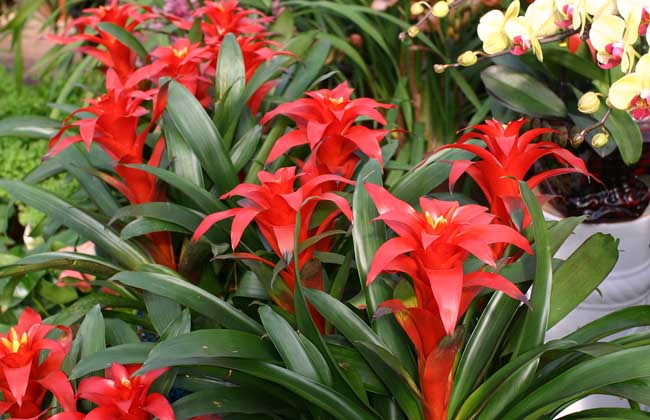
Guzmania, also known as cone-shaped Guzmania, torch bromeliad, painted bract bromeliad, etc., is a perennial evergreen herbaceous plant of the Bromeliaceae family with extremely high ornamental value. Because of its beautiful and varied flower forms and long ornamental period, it has always been regarded as a symbol of good fortune and prosperity. In Guangdong, Shanghai and other parts of China, greenhouses are used for its growth and cultivation. Now let us take a look at how much a pot of Guzmania costs!
How much does a pot of Guzmania cost?
The market price of Guzmania is mainly determined by quality. In Beijing, the cost generally comes to about 160 yuan per pot including the pot, and it sells for about 200 yuan at flower markets. Prices in other places are relatively cheaper, but the price difference is not very large. Guzmania has bright red bracts and produces small yellow flowers. As a potted plant, it is suitable for decorating homes, hotels and office buildings, and is especially suitable for placing on tables in living rooms, studies and the like.
How to grow Guzmania
1. Light: Light plays an important role in growing Guzmania. During the cold season, it needs at least 4 to 5 hours of sunlight every day. On cloudy days, artificial light can replace sunlight. It should not be exposed to strong sun, and in summer it should be placed in a shady spot.
2. Temperature: The suitable temperature for Guzmania is 15°C to 22°C. In winter, the lowest temperature must not be below 10°C, otherwise the plant will suffer cold damage, the leaves will turn yellow, and healthy growth will be affected.
3. Soil: Guzmania is suitable for growing in loose, fertile, humus-rich soil. A culture soil can be made by mixing 2 parts peat soil with 1 part fine sand.
4. Fertilizer: Guzmania must have sufficient fertilizer during the flowering period. Usually, a dilute organic liquid fertilizer is applied once every two weeks, such as soak liquid of soybean cake or sesame paste residue; soybean soak liquid or fermented rice washing water can also be used.
5. Water: Guzmania likes a moist environment. On ordinary days, keeping the potting soil moist is enough, and generally no watering is needed on rainy days. For home cultivation, it is best to use purified water that has been left to stand, and do not water directly with tap water.
6. Pests and diseases: Guzmania is prone to pest and disease damage in environments with excessively high temperature and humidity and poor ventilation. If disease is found, carbendazim can be sprayed promptly; for pests, omethoate can be sprayed.
Precautions for Guzmania
1. Guzmania likes warmth and fears cold, prefers a moist, semi-shady environment, and avoids direct strong light. If the light is too strong, the leaves will turn yellow, develop spots and fade, losing their ornamental value. Therefore, in spring, summer and autumn, 50-60% shade should be provided. Varieties such as painted-leaf Guzmania and red-backed Guzmania like more light; under stronger sunlight their leaves are more brightly colored, so they should be placed in sunny windowsills, balconies and similar places for care. It is suitable for growing in loose soil with good aeration and water permeability.
2. The growing temperature for Guzmania is 18-30°C, the suitable temperature is 20-25°C, and the minimum temperature is above 12-15°C. In winter, it can overwinter safely only above 10-12°C; below 10°C it is prone to cold damage, and the suitable temperature is 16-20°C. If the summer temperature is too high, the leaf tips will dry out due to excessive water loss, so attention should be paid to frequently spraying the leaves to increase air humidity, and to providing appropriate shade and strengthening ventilation to lower the temperature.
3. Guzmania likes acidity and requires water with a pH value of 5.5-6.5. It does not like salts, especially calcium salts and sodium salts. If the pH value is higher than 7, the plant absorbs nutrients poorly, the leaves lose their luster, the photosynthetic capacity decreases, and it is prone to heart rot and root rot. Hard water containing too much calcium salt and magnesium salt is not suitable for use. Tap water contains a large amount of chlorine and sodium, so it is also not suitable for use. Groundwater varies greatly in composition depending on the region, so it should be used only after water quality analysis. In addition, Guzmania fears waterlogging most. If the substrate water content is too high or drainage or aeration is poor, root rot and heart rot often occur.
4. The suitable relative humidity for Guzmania is 50-75%. Above 80%, ventilation should be strengthened, otherwise disease or spindly growth is likely to occur. Below 40%, leaf tips are prone to withering, so water should be sprayed regularly to maintain moisture or a high-pressure mist humidification system should be used for humidification. During the high-temperature and high-humidity period in summer, measures should be taken to strengthen ventilation; during the low-temperature period in winter, it is not suitable to spray water frequently; during the hot and dry period in spring, more water should be sprayed.