The whole plant of the Jerusalem cherry is toxic and only suitable for ornamental use; potted red berries add even more festive cheer
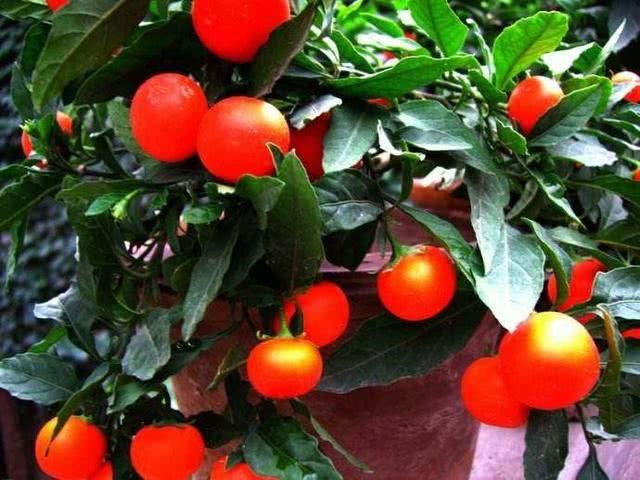
Jerusalem cherry
Jerusalem cherry is a woody plant of the genus Solanum, an evergreen small shrub with an upright form, reaching a height of up to 40 cm, smooth and hairless, with alternate, oblong leaves; the flowers are white, and the fruit turns red when ripe, spherical, with a diameter of more than 1 cm. Other names: Coral cherry, Lucky berry, Coral seed, Jade coral, Red coral, Wild chili, Wild sea pepper, Mountain red pearl.
The whole plant of the Jerusalem cherry is toxic, and the leaves are more toxic than the fruit. Symptoms of poisoning include dizziness, nausea, drowsiness, severe abdominal pain, and dilated pupils. However, as long as it is not consumed in large amounts, pure ornamental use is fine.
Morphological characteristics
Upright small shrub, much branched and forming a clump, cultivated as a 1-2 year old plant. Plant height 30-60 cm. Leaves alternate, narrowly oblong to oblanceolate. Flowers bloom in summer and autumn, small, white, axillary.
Berry: dark orange-red when ripe, spherical, diameter 1-1.5 cm. It bears fruit after flowering, and the fruit does not fall off for a long time, remaining on the branches until after the Spring Festival. A dwarf variety is cultivated, with a short, much-branched plant form. Berry, seeds small, very similar to chili seeds. Fruit shape is broadly ellipsoid, pointed at the front end.
Growing environment
Not cold-tolerant; prefers a warm, humid environment with plenty of sunlight. The soil should be loose, fertile, well-drained, slightly acidic soil, rich in phosphorus fertilizer to make the fruiting period longer. Potted plants should be pinched back to promote more branches, more flowers, and more fruit.
A plant belonging to the genus Solanum in the nightshade family, perennial woody, upright form, reaching a height of 40 cm if not controlled, smooth and hairless, leaves alternate, oblong; flowers white, fruit red when ripe, spherical, diameter more than 1 cm.
In spring in March in a greenhouse or in autumn in October in an outdoor seedbed, to prevent excessive low temperatures; the wintering temperature is about 5°C-10°C.
Propagation methods
Soil management
Deep plowing and hole expansion should be done well, and the soil should be matured. It is forbidden to plant tall-stalked plants such as corn and wheat in the orchard. Reasonable intercropping and hoeing and weeding should be done well.
Fertilizer and water management
(1) Fertilization principles: The needs of blood oranges for various nutrient elements should be fully met, and it is advocated to apply more organic fertilizer and reasonably apply inorganic fertilizer and formula fertilizer. Fertilization should also be guided according to leaf analysis results, orchard soil analysis results, and the phenological period of blood oranges.
(2) Fertilization methods: Soil fertilization is the main method, combined with foliar fertilization. Methods such as ring trench application, strip trench application, hole application, and spreading fertilizer on the soil surface are used.
(3) Fertilization for young trees: Apply frequently and lightly, mainly nitrogen fertilizer, combined with phosphorus and potassium fertilizer. Fertilize 5-6 times during the spring, summer, and autumn shoot emergence periods (March, May, June, July, September, and December, each time applying 0.4 jin of ammonium bicarbonate or 0.2 jin of urea per plant. For 1-3 year old young trees, apply 100-400 g of pure nitrogen per plant per year, and the ratio of nitrogen, phosphorus, and potassium should be 1.0:(0.4-0.5):1.0. For adult trees, apply four good fertilizations, namely bud fertilizer, fruit retention fertilizer, fruit strengthening fertilizer, and fruit harvesting fertilizer. The fertilization amount is generally 2-3 jin of chemical fertilizer and one load of manure water for bud fertilizer; 1-2 jin of phosphorus and potassium fertilizer + 1 jin of chemical fertilizer for fruit retention fertilizer; 1-2 jin of chemical fertilizer + 1-2 jin of phosphorus and potassium fertilizer for fruit strengthening fertilizer; fruit harvesting fertilizer (base fertilizer) is mainly organic fertilizer, applying 50-100 jin of organic fertilizer + 1-2 jin of chemical fertilizer per plant.
(4) Water: Irrigate when the soil is dry, and drain when there is standing water. Shaping and pruning
1. Principles. Adapt to local conditions, prune according to the tree, promote and suppress appropriately, provide ventilation and light transmission, and achieve three-dimensional fruiting.
2. Shaping (natural open-center form). Trunk height 20-40 cm, main branches (3-4 branches) distributed in a well-arranged manner on the trunk, trunk branching angle 30°-50°, and 2-3 secondary main branches are kept on each main branch. Generally, after the third main branch is formed, the central leader-like trunk is cut off and twisted to one side as a fruiting branch group.
3. Pruning.
(1) Young trees: Light pruning is the main method. After selecting the central leader-like extension branch and the extension branches of each main branch and secondary main branch, carry out moderate or even heavy heading back, and adjust the growth balance among the main branches by the degree of heading back and the direction of the pruning bud. In addition to appropriately thinning out overly dense branch groups, the inner canopy branches and weaker shoots in the middle and lower parts of the crown should generally be retained.
(2) Initial fruiting period: Continue to select and heading back the extension branches at all levels of the framework, remove summer shoots, and promote the emergence of robust autumn shoots. In autumn, for vigorously growing trees, measures such as ring cutting, root pruning, and water control are used to promote flowering.
(3) Full fruiting period: Timely retract fruiting branch groups, flower-dropping fruiting branch groups and declining branch groups, and cut off light-blocking branches, dead branches, and diseased and pest-infested branches.
Pest and disease control
Mites
(Citrus red spider mite, four-spotted yellow spider mite, rust mite). Before and after flowering (March-May) and in autumn (September-November) are the key periods for controlling red spider mites: control is needed when the population density before flowering reaches 1-2 mites/leaf, and after flowering and in autumn reaches 5-6 mites/leaf. The spring shoot emergence period, young fruit period, and fruit enlargement period are the main periods for rust mite control: when the underside of the current year's spring shoot leaves first shows rust color; when the population density on leaves or fruit reaches 2-3 mites per leaf, control should be carried out immediately. Commonly used pesticides include hexythiazox, pyridaben, propargite, bromopropylate, amitraz, etc. Attention should be paid to protecting natural enemies such as long-haired mites, blunt mites, predatory ladybugs, Japanese square-headed beetles, and lacewings.
Scale insects
(Arrowhead scale, red wax scale, cottony cushion scale, etc.). Key periods for chemical control: for arrowhead scale, the first-generation nymph stage; for red wax scale, the larval stage when large numbers climb onto shoots to cause damage (generally from early to mid-May to mid-June); for cottony cushion scale, the peak larval occurrence stage. Commonly used pesticides include buprofezin, methidathion, matrine + nicotine, chlorpyrifos, and mineral oil emulsion. Attention should be paid to improving ventilation and light transmission conditions in the orchard; protecting and utilizing natural enemies such as Japanese square-headed beetles, Chilocorus kuwanae, lacewings, golden aphid wasps, Australian ladybugs, and large red ladybugs.
Aphids
When the damage rate of new shoots reaches 25%, pesticide spraying should be carried out immediately. Commonly used pesticides include acetamiprid, dimethoate, and aldicarb. Attention should be paid to protecting seven-spotted ladybugs, large lacewings, hoverflies, aphid wasps, etc., and cutting off overwintering eggs to reduce the pest population base.
Leafminer
The key control period is the summer and autumn shoot emergence period (early to mid-July). Timely remove scattered summer and autumn shoots, and combine with fertilizer and water management to promote robust and uniform new shoots. Chemical control: spray when new shoots emerge to 1-2 cm, spray once every 7-10 days, for 2-3 consecutive times. Commonly used pesticides include abamectin, cartap, cyhalothrin, etc.
Flower bud maggot
At the bud stage, choose methamidophos powder, diazinon granules, etc., mix evenly with fine soil, and broadcast on the soil surface of the tree disk, once every 7 days, for 2-3 consecutive times; when the flower buds are 2-3 mm in diameter (when they turn white), choose parathion, trichlorfon, etc. to spray the tree crown; remove damaged flower buds as early as possible, and bury them deeply or boil them; deep plow the orchard soil in winter to eliminate some overwintering pest pupae.
Red spider mite
Control method: Spraying a liquid made from garlic juice and a small amount of soapy water onto the mites can effectively suppress them!
Cultivation techniques
Before sowing, soak the seeds in warm water for 6-8 hours, cover with about 0.4 cm of soil, and after 4 leaves grow, the seedlings can be separated. When the seedlings are 10-12 cm tall, transplant or repot them. During the growth period, water and fertilize appropriately.
Main value
Mostly used as an ornamental plant, and cultivated as a bonsai in the south. Decorative application: small and medium-sized potted plants. The fruit ripening period coincides with New Year's Day and the Spring Festival. Placing them on hall shelves or windowsills can add a festive atmosphere.