What are the effects and functions of Ardisia japonica? This article explains it in detail for you
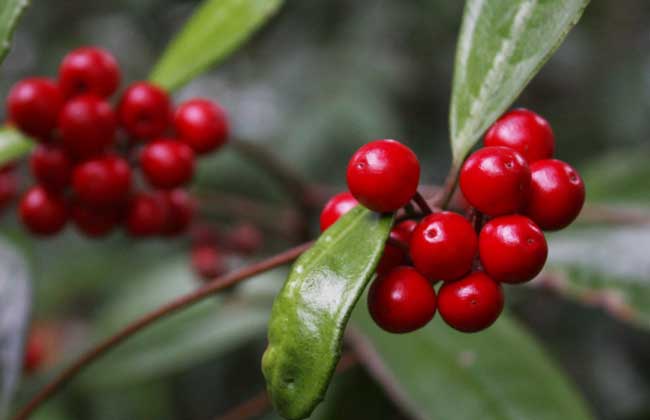
Ardisia japonica, also known as Duanjiao Sanlang, Buchulin, Liangsangai Zhenzhu, etc., is a small shrub or subshrub plant of the genus Ardisia in the family Primulaceae. Used as medicine, it has the effects of relieving cough and resolving phlegm, dispelling wind and detoxifying, and promoting blood circulation and relieving pain. It has therapeutic effects on bronchitis, lobar pneumonia, infantile pneumonia, pulmonary tuberculosis, hepatitis, dysentery, acute nephritis, urinary tract infection, promoting menstruation, traumatic injuries, rheumatic muscle and bone pain, etc. Now let us take a look at the effects and functions of Ardisia japonica!
The medicinal value of Ardisia japonica
[Nature and flavor] Bitter in taste, slightly cold in nature.
[Meridian tropism] Lung and liver meridians.
[Effects] Relieving cough and resolving phlegm, dispelling wind and detoxifying, promoting blood circulation and relieving pain. Mainly treats bronchitis, lobar pneumonia, infantile pneumonia, pulmonary tuberculosis, hepatitis, dysentery, acute nephritis, urinary tract infection, promoting menstruation, traumatic injuries, rheumatic muscle and bone pain. For external use, it treats skin itching and lacquer dermatitis.
The medicinal effects of Ardisia japonica
1. Relieving cough and resolving phlegm: When external pathogens invade the lungs, phlegm-heat accumulates in the lungs, lung qi becomes congested and fails to diffuse, the clearing and descending function is impaired, the airways are obstructed, and lung qi rebels upward, resulting in phlegm-heat cough, with symptoms including fever, cough, expectoration, yellow and sticky phlegm, or even blood-streaked phlegm, chest tightness, dry mouth, bitter taste in the mouth, sore throat, yellow greasy tongue coating, and slippery rapid pulse, etc. Ardisia japonica is neutral in nature and slightly cool, bitter and drying with a descending action. It functions to clear and transform heat-phlegm and to calm the lungs and stop cough, making it quite suitable for phlegm-heat cough syndrome.
2. Dispelling wind and unblocking obstruction: In individuals with yin deficiency, heat accumulates within the body. Wind-damp-heat pathogens take advantage of the deficiency to invade the human body, causing poor circulation of qi and blood, blockage of meridians and collaterals, and resulting in heat obstruction. Symptoms include pain in the limbs and joints, with the painful area being red, burning, and hot, and swelling and pain being severe. Tendons and vessels are tense and contracted, making them unbearable to touch, milder during the day and worse at night, accompanied by fever, thirst, restlessness, preference for cold and aversion to heat, red tongue, yellow dry coating, and slippery rapid pulse. Ardisia japonica functions to treat blood and unblock meridians, dispel wind and remove dampness while also clearing heat, thereby treating heat obstruction.
3. Cooling blood and stopping bleeding: Ardisia japonica is neutral in nature and slightly cool, and enters the blood aspect. It functions to cool blood and clear heat, and to invigorate blood and stop bleeding. It can often be used to treat hemoptysis and hematemesis.
4. Detoxifying and reducing swelling: Ardisia japonica is bitter and cold, cool in nature. It functions to clear heat and detoxify, and to invigorate blood and reduce swelling. It is suitable for treating swelling and toxicity, and dysentery.
5. Promoting diuresis and draining dampness: Ardisia japonica has the function of promoting diuresis and draining dampness. It is suitable for treating jaundice and strangury.
Related discussions on Ardisia japonica
1. Li's Herbal Secrets: Treats unilateral hernia. Pound to extract juice and take half a bowl mixed with wine.
2. Illustrated Investigation of Plant Names and Actualities: Treats swelling and toxicity, bloody dysentery, counteracts snake venom, and rescues heatstroke.
3. Convenient Formulas for Plants and Trees: Treats stubborn rheumatic obstruction and chronic cough due to lung atrophy. Applied externally for cold-toxin swelling and pain.
4. Classified Materia Medica Properties: Treats hematemesis, cough, and qi pain.
5. Modern Practical Chinese Materia Medica: It is a tonic and has hemostatic effects. Treats pulmonary tuberculosis with cough and blood-streaked sputum, taken with wine. Treats traumatic injuries and testicular swelling and pain.
The pharmacological effects of Ardisia japonica
1. Antitussive effect: The decoction and its extract Ardisin No. 1 both have obvious antitussive effects on cough induced by electrical stimulation of the superior laryngeal nerve in cats and cough induced by ammonia spray in mice. Ardisin No. 1 has a particularly significant effect and may be the main antitussive component of Ardisia japonica. Its antitussive potency, calculated by dose, is equivalent to 1/4 to 1/7 that of cocaine. Continuous administration to cats for 23 days produced no tolerance.
2. Expectorant effect: The decoction of Ardisia japonica has an obvious expectorant effect when administered by gavage to mice. The potency is comparable to an equal dosage of Platycodon grandiflorus. The effect is stronger when administered by intraperitoneal injection, and it has no obvious irritant effect on the conjunctiva of rabbit eyes, indicating that its expectorant effect may be produced through absorption. The active expectorant component may be flavonoid glycosides. Ardisin No. 1 has no expectorant effect when administered by gavage, nor does it have an obvious antiasthmatic effect.
3. Effect on trachea-lung tissue respiration: Ardisia japonica has the effect of reducing oxygen consumption in rat trachea-lung tissue. Ardisin No. 1 acts on enzyme systems containing sulfhydryl essential groups, thereby reducing tissue respiration, but the effect is not strong.
4. Antiviral effect: The water decoction of Ardisia japonica has a certain inhibitory effect on Staphylococcus aureus and influenza virus (chick embryo test). After removing tannins, it loses its antibacterial effect. Although the volatile oil and flavonoid glycosides have antibacterial effects in vitro, effective concentrations are difficult to achieve in vivo.
5. Effect on experimental bronchitis in rats: In rats with chronic bronchitis produced by daily inhalation of sulfur dioxide, oral administration of Ardisin No. 1 has a certain preventive and therapeutic effect, manifested as a reduction in goblet cells and alleviation of inflammatory cell infiltration, emphysema, and lung atrophy.
6. Spermicidal effect: In 1995, Zhou, Jiming, et al. obtained a saponin from the ethanol extract fraction of Ardisia japonica. This saponin has a spermicidal effect, showing low toxicity and minimal side effects, and it was indicated that this spermicidal preparation has already been used locally as an anesthetic, bactericide, preservative, and anti-inflammatory agent, etc.
7. Anti-aging effect: The crude preparation of Ardisia japonica shows activity in scavenging oxygen free radicals. The main component is 1,4-benzoquinone. A lotion prepared with 10.0 ethanol, 1.0 hydroxyethyl cellulose, 5.0 ethanol extract of Ardisia leaves, and 84.0 water. This lotion can inhibit wrinkle formation caused by ultraviolet radiation, and inflammation and pigmentation caused by carrageenan.