What are the effects and uses of the flower of the lily magnolia?
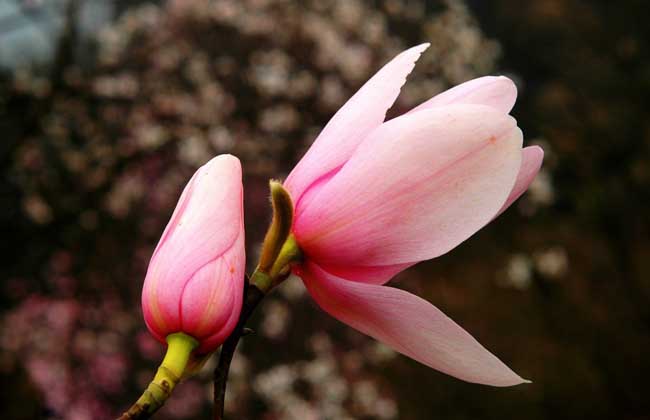
The flower of the lily magnolia, also known as Linlan, Guilan, Dulan and so on, is the flower bud of Magnolia liliflora (lily magnolia), a deciduous tree of the genus Magnolia in the family Magnoliaceae. It has fairly high medicinal value, and both internal use and external application have good therapeutic effects. It has the effects of dispelling wind-cold and unblocking the nasal passages, and it treats wind-cold headache, nasal congestion, sinusitis with turbid nasal discharge and similar conditions. Now let us take a look at the effects and uses of the flower of the lily magnolia!
The medicinal effects of the flower of the lily magnolia
[Nature and flavor] Pungent in flavor, warm in nature.
[Meridian entry] Enters the Lung and Stomach meridians.
[Effects] Dispels wind-cold and unblocks the nasal passages. It mainly treats wind-cold headache, nasal congestion, sinusitis with turbid nasal discharge and similar conditions. It is contraindicated for those with yin deficiency and hyperactive fire.
Related discussions on the flower of the lily magnolia
1. The Shennong Bencao Jing: "It governs cold and heat of the five viscera and the body, wind-induced headache, and dark facial complexion."
2. The Bielu: "It warms the middle and releases the flesh, opens the nine orifices, unblocks nasal congestion and nasal discharge, and treats facial swelling extending to toothache, and dizziness with the body feeling unsteady as if on a cart or boat. It promotes the growth of beard and hair and expels white worms."
3. The Diannan Bencao: "It treats sinusitis with brain leakage, dispels wind; roast on a new tile and grind into powder. It treats cold facial pain and stomach qi pain, taken with hot wine."
4. The Bencao Gangmu: "For sinusitis, allergic rhinitis, nasal obstruction, nasal sores, and post-smallpox nasal sores, grind them into powder, add a little musk, and dip in scallion white to insert several times."
Medicinal formulas of the flower of the lily magnolia
1. Nasal congestion: Grind the flower of the lily magnolia into powder, add a small amount of musk, and dip in scallion white to insert into the nose; effects appear after several times.
2. Sinusitis: 15 grams of the flower of the lily magnolia, 8 grams of Siberian cocklebur fruit, 30 grams of fragrant angelica root, and 1.5 grams of mint leaves, then sun-dry and grind into a fine powder. Take with scallion and clear tea after meals, 6 grams each time.
3. Rhinitis: Take an appropriate amount of the flower of the lily magnolia, grind into a fine powder, and inhale a little into the nose, three to four times daily.
4. Allergic rhinitis: Take 3 grams of the flower of the lily magnolia. If it is a case of wind-cold invading the lung, add 10 grams of ageratum; if it is a case of wind-heat congestion, add 20 grams of sophora flower. Put into a cup, pour boiling water over it, cover and steep for about 5 minutes, and drink frequently, one to two times daily.
5. Nasal leakage, with a lump growing in the nostril: 120 grams each of the flower of the lily magnolia (with hairs removed) and white mulberry root bark (honey-roasted), 31 grams of gardenia fruit, and 60 grams each of bitter orange, balloon flower root and angelica root. Grind together into a fine powder. Take 6 grams each time, mixed with light radish soup.
6. Chronic hypertrophic rhinitis: 9 grams of the flower of the lily magnolia, 12 grams of sweetgum fruit, 9 grams each of perilla leaf and loofah leaf, and 6 grams each of safflower, acorus rhizome and fritillary. If there is much phlegm, add 9 grams each of dried tangerine peel and pinellia tuber; if there is a feeling of oppression, add 9 grams each of tangerine pith and turmeric root tuber; if the turbinate is severely swollen and stiff, add 9 to 12 grams each of cremastra and Fujian fritillary. Decoct in water and take, one dose daily.
7. Nervous headache with dry bound stool: 10 grams each of the flower of the lily magnolia, angelica root, Siberian cocklebur fruit, chrysanthemum flower, honeysuckle flower, vitex fruit, rhubarb and bitter orange, and 6 grams each of asarum, Sichuan lovage rhizome and licorice. Decoct in water three times and take in divided doses, one dose daily, usually taken continuously for five to ten doses.
8. Wind-cold type simple chronic rhinitis: 4 grams of the flower of the lily magnolia, 3 grams of black tea, and 20 grams of brown sugar. First sort out and sun-dry the flower of the lily magnolia, put it into a cup together with the black tea, pour freshly boiled hot water over it, cover and steep for 20 minutes, then add an appropriate amount of brown sugar and stir well. Drink frequently as tea. It can usually be brewed about four times, and the brown sugar can be adjusted according to the number of brewings.
9. Wind-heat type simple chronic rhinitis: 20 grams of the flower of the lily magnolia and 2 eggs. First wash the eggs, cook them in a pot of boiling water, and let them cool before removing the shells. Sort out the flower of the lily magnolia, put it into a clay pot, add clean water and soak for a moment, decoct for 20 minutes, strain and take the liquid back into the clay pot, add the cooked eggs, and simmer over low heat for 20 minutes. Take once each in the morning and evening, one dose daily.