What are the effects and uses of water banxia?
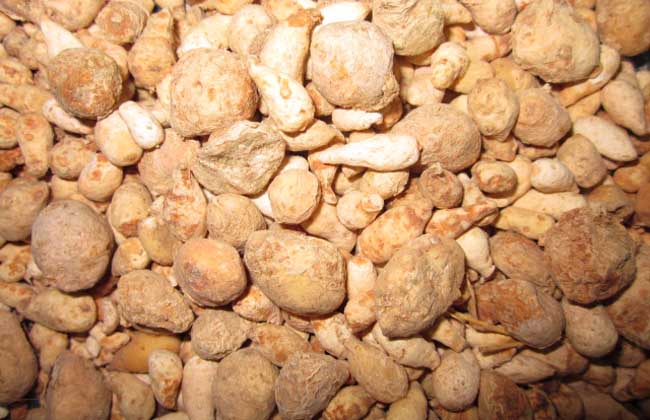
Water banxia, also known as earth banxia, field sanqi, mad dog potato, etc., is the tuber of the Araceae plant whip-rolled plough-tip. The tubers are dug in autumn and winter, the outer skin and fibrous roots are removed, washed and dried in the sun. It has the effects of drying dampness and transforming phlegm, detoxifying and reducing swelling, and stopping bleeding. It has therapeutic effects on cough with abundant phlegm, carbuncles, sores and boils, unnamed toxic swellings, poisonous insect stings, and traumatic bleeding. Let us take a look below at the effects and uses of water banxia!
The medicinal effects of water banxia
[Nature and flavor] Pungent in flavor, warm in nature, toxic.
[Meridian entry] Lung and spleen meridians.
[Effects] Dries dampness and transforms phlegm, detoxifies and reduces swelling, stops bleeding; mainly for cough with abundant phlegm, carbuncles, sores and boils, unnamed toxic swellings, poisonous insect stings, and traumatic bleeding.
[Usage] Internal use: decocted in water, 3 to 9 grams, or made into pills or powders. External use: pounded and applied, or ground into powder and mixed for application.
[Contraindications] Toxic; use with caution in cases of yin deficiency with dry cough and in pregnant women.
The pharmacological effects of water banxia
1. Antiemetic effect: A decoction of raw water banxia administered by gavage at 50 grams/kg can significantly reduce the number of vomitings induced by copper sulfate stimulation in pigeons, with a reduction rate of 50%, but it cannot reduce the number of pigeons vomiting. Its antiemetic effect and strength are similar to those of banxia. Processed products have weaker effects; the vomiting reduction rates of decoctions of products prepared by the old method and the new method (using saturated alum water for direct soaking) were 28.7% and 11.8%, respectively.
2. Antitussive effect: A 25% suspension of raw water banxia and products prepared by the old and new methods, administered to mice by gavage at 10 grams/kg, all had obvious antitussive effects on cough induced by concentrated ammonia water. The antitussive rate of the new-method product was 44.8%, while those of the raw product and the old-method product were 25.5% and 20.4%, respectively.
3. Expectorant effect: As determined by the phenol red method in mice, the alcohol extracts of raw water banxia and the new- and old-method products, administered by gavage at 300 grams/kg, all had a certain expectorant effect for the new- and old-method products, with effect strengths of 225% and 173% of the control group, respectively, while the raw product showed no obvious expectorant effect. The expectorant effect of water banxia is slightly stronger than that of banxia.
4. Antiarrhythmic effect: A decoction of water banxia administered to rats by gavage at 53 grams/kg had a counteracting effect on barium chloride-induced ventricular arrhythmia. The duration of ventricular premature beats changed from 81.54±15.73 min in the distilled water group to 24.87±5.73 minutes, and its effect strength showed no significant difference from that of banxia.
5. Central inhibitory effect: A decoction of water banxia injected intraperitoneally at 60 grams/kg had a significant inhibitory effect on spontaneous activity in mice, while the effect of the 30 grams/kg dose group was not obvious. At high doses, there was a tendency to slightly increase pentobarbital sodium sleep time and counteract electroconvulsive shock, but the difference was not statistically significant. Its central inhibitory effect is weaker than that of banxia.
6. Inhibitory effect on saliva secretion: A decoction of water banxia administered to rabbits by gavage at 60 grams/kg can inhibit pilocarpine-induced saliva secretion and can also reduce tearing and the degree of miosis. It is speculated that it may have an atropine-like effect, which may be related to its "drying dampness" effect and can similarly explain the clinical manifestation of dry mouth after taking it.
7. Other effects: The alcohol extract of water banxia has an antioxidant effect, with an inhibition rate IR (%) of 94.1% on the auto-oxidation of linoleic acid, and IR is directly proportional to antioxidant performance. A suspension of raw water banxia administered to domestic pigeons by gavage has an emetic effect, with a median effective dose for emesis of 1.22 grams/kg. At a dose of 100 grams/kg of the crude drug decoction, 60% of domestic pigeons experienced a purgative effect. The new- and old-method processed products showed no obvious emetic effect.
The differences between water banxia and dry banxia
1. The original plant of dry banxia is the dried tuber of Pinellia ternata in the Araceae family, genus Pinellia. The original plant of water banxia is the dried tuber of Typhonium flagelliforme in the Araceae family, genus Typhonium.
2. The contents of the main chemical components β-sitosterol, amino acids, oleic acid, and inorganic elements in dry banxia and water banxia are completely different.
3. The toxicity of dry banxia and water banxia is different; the toxicity of water banxia is 3.2 times that of banxia.
4. The antitussive and antiemetic effects of dry banxia are both stronger than those of water banxia, and water banxia has no antiemetic effect.