What are the effects and functions of Mahonia?
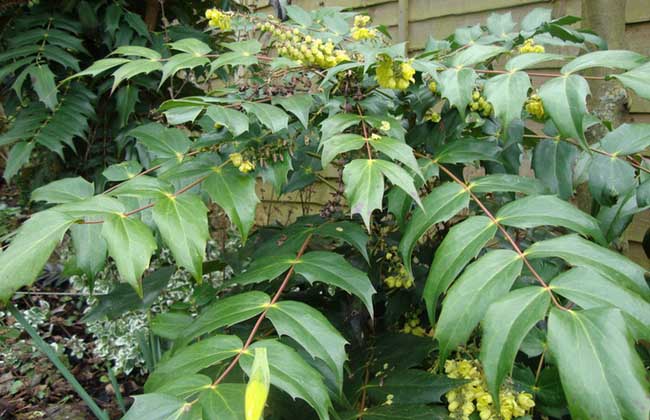
Mahonia, also known as mouse thorn, cat-thorn leaf, yellow heavenly bamboo, and earth yellow bark, is a shrub plant of the genus Mahonia in the family Berberidaceae. It is often grown in gardens and used medicinally. As a medicine, it has the effects of clearing heat and tonifying deficiency, relieving cough and resolving phlegm, and has therapeutic effects on pulmonary tuberculosis with coughing of blood, bone-steaming tidal fever, dizziness and tinnitus, soreness and weakness of the waist and legs, and restlessness with red eyes. Now let us take a look at the effects and functions of Mahonia!
The medicinal effects of Mahonia
[Nature and flavor] Bitter in flavor, cold in nature.
[Meridian entry] Liver, stomach, and large intestine meridians.
[Effects] Leaves: nourish yin and clear heat, mainly used for pulmonary tuberculosis and common cold. Roots and stems: clear heat and detoxify, mainly used for bacillary dysentery, acute gastroenteritis, infectious hepatitis, pneumonia, pulmonary tuberculosis, bronchitis, and sore swollen throat; externally used for conjunctivitis, carbuncles, boils, and swelling toxins, and burns (scalds).
Medicinal discussions of Mahonia
1. "Yinpian Xincan": Treats pulmonary tuberculosis, relieves cough and resolves phlegm, reduces deficiency heat, and kills parasites.
2. "Modern Practical Chinese Materia Medica": A cooling tonic and strengthening medicine, with effects similar to Fructus Ligustri Lucidi; suitable for tidal fever, bone-steaming, sore waist, weak knees, dizziness, tinnitus, and similar patterns.
3. "Luchuan Materia Medica": Drains fire and reduces heat; treats warm-disease fever, restlessness, diarrhea, and red eyes.
4. "Common Tibetan Chinese Herbal Medicines": Treats damp-heat dysentery, red swollen painful eyes, and carbuncle swelling and sores.
Pharmacological effects of Mahonia
1. Antibacterial effect: A 25% water decoction of broadleaf Mahonia has a mild inhibitory effect in vitro on Staphylococcus aureus, Escherichia coli, and Pseudomonas aeruginosa.
2. Excitatory effect: Alkaloids such as jatrorrhizine thiocyanate, tetrahydrojatrorrhizine-N-methylthiocyanate, and palmatine thiocyanate can promote the spontaneous movement of isolated intestinal segments at low concentrations, while at high concentrations they can cause increased tension and inhibited movement. On the isolated frog heart, jatrorrhizine first inhibits and then excites, while palmatine causes mild excitation.
3. Blood pressure-lowering effect: Intravenous injection of these alkaloids can all cause a transient or mild decrease in blood pressure, with no obvious effect on the blood vessels of the toad hindlimb. The hypotensive effect seems unrelated to the central nervous system (no blood pressure reduction when injected into the vertebral artery, and the pressor reflex caused by blocking carotid artery blood flow and occluding the trachea is unaffected), and it is also unaffected by atropine, but it can inhibit the pressor effect of adrenaline.
4. Anticancer effect: In screening tests for in vivo anticancer activity using Ehrlich ascites carcinoma, it was found that the component isotetrandrine has anticancer activity.
Medicinal selected formulas of Mahonia
1. For pulmonary tuberculosis tidal fever, bone-steaming, sore waist and weak knees, dizziness, tinnitus, and similar symptoms: dried leaves or fruit of Mahonia 9-15 grams, decocted in water, or ground into fine powder and made into pills with refined honey; 3 times daily, 3-6 grams each time.
2. For pulmonary tuberculosis cough with blood-streaked sputum: broadleaf Mahonia leaves, Fructus Ligustri Lucidi, Eclipta prostrata, and wolfberry fruit 9 grams each, decocted in water.
3. For wind-fire toothache: Mahonia leaves 9 grams, decocted in water and taken at once, 1 dose daily; for severe pain, take 2 doses.
4. For red and white vaginal discharge: Mahonia leaves, Solanum lyratum, and Agrimonia pilosa 30 grams each, decocted in water.
5. For diarrhea: Use broadleaf Mahonia leaves, stems, and roots, remove the coarse bark, grind into fine powder, put into capsules, 0.3 grams per capsule, 3 capsules each time, 4 times a day.
6. For dysentery: broadleaf Mahonia root and Euphorbia humifusa 12 grams each, decocted in water.
7. For pharyngitis and stomatitis: fresh Mahonia root and Belamcanda chinensis in equal parts, ground with rice washing water and held in the throat to be swallowed.
8. For pelvic inflammatory disease: broadleaf Mahonia root 9 grams, honeysuckle 10 grams, and Viola philippica 24 grams, decocted in water.
9. For pulmonary tuberculosis: broadleaf Mahonia root, Callicarpa formosana, Stemona japonica, dragon bone, and oyster shell 9 grams each, and Bletilla striata 6 grams, decocted in water.
10. For fire toothache: broadleaf Mahonia stem 60 grams, decocted in water, used frequently as a gargle.
11. For red swollen painful eyes: Mahonia stem and wild chrysanthemum 15 grams each, decocted in water.
12. For enteritis and dysentery: broadleaf Mahonia stem 15 grams, Rhodomyrtus tomentosa root 30 grams, and pomegranate leaf (or Pteris multifida) 15 grams, decocted in water.
13. For eczema, sores and toxins, and scald burns: fresh Mahonia stems and leaves and Sophora flavescens 60 grams each, decocted in water to wash the affected area, or burned dry and ground into powder, mixed with sesame oil or vaseline into a 20-gram ointment for external rubbing, or spread on gauze and applied to the affected area.