What are the effects and functions of Luodonia? A detailed explanation in one article
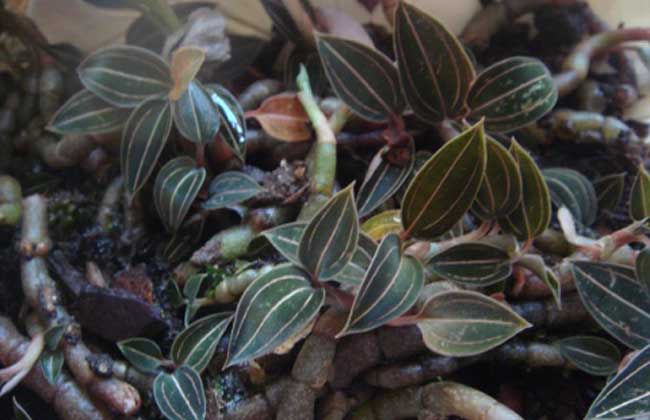
Luodonia, also known as Xueyelan, Shishang'ou, Zhenjincao, Shimianlian, etc., is the whole plant of Ludisia discolor, a plant of the genus Ludisia in the orchid family. It is distributed in Guangdong, Hong Kong, China, Hainan, Guangxi, and southern Yunnan, among other places. As a medicinal herb, it has the effects of nourishing yin, moistening the lungs, cooling the blood, and stopping bleeding, and it has therapeutic effects on hemoptysis due to pulmonary tuberculosis, neurasthenia, and other conditions. Now let us take a look at the effects and functions of Luodonia!
The medicinal effects of Luodonia
[Nature and flavor] Sweet in taste, cool in nature.
[Meridian entry] Lung and spleen meridians.
[Effects] Cools the blood, stops bleeding, nourishes yin, and moistens the lungs. It mainly treats hemoptysis due to pulmonary tuberculosis and neurasthenia.
Medicinal discussions of Luodonia
1. "Shennong Bencao Jing": Mainly treats the five types of strangury, breaks up urolithic strangury, and induces abortion. Internally it resolves knotted qi, promotes water passage, and removes heat.
2. "Bielu": Mainly treats urolithic strangury and difficult urination.
Medicinal properties of Luodonia
The whole plant of Luodonia is 10-20 cm long. The rhizome is elongated and silkworm-like, fleshy, about 3 mm in diameter, grayish-yellow on the surface, with longitudinal wrinkles and obvious nodes, where residual membranous or dried hairy leaf sheaths can be seen. The roots are short and slightly stout. The leaves are alternate, papery, mostly curled, and when flattened are ovate-elliptic, 2-5 cm long and 1-2 cm wide, grayish-green or dark red, with petioles extended into membranous sheaths that clasp the stem. Sometimes inflorescences and white flowers can be seen, and the flowering stem in the lower part of the inflorescence bears membranous bracts. The odor is faint, and the taste is bland and slightly astringent.