What are the effects and uses of the traditional Chinese medicine nutgrass?
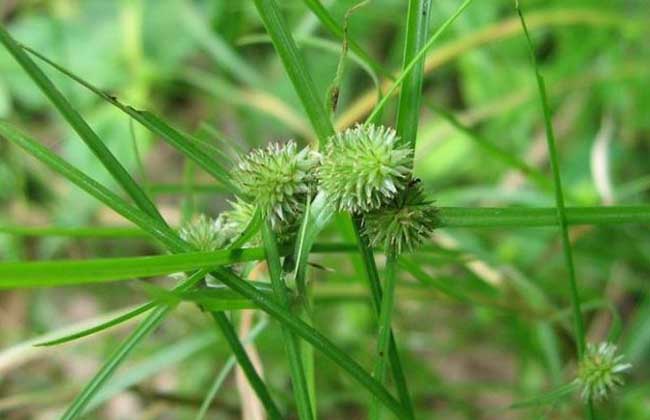
Nutgrass is a herbal medicine included in "Zhonghua Caoben" (Chinese Herbal Medicine), also known by the names Suisui, Haohou, Dimao and others. It is the stem of the sedge family plant nutgrass, and has the effects of soothing the liver and regulating qi, and regulating menstruation and relieving pain. It has a therapeutic effect on disharmony between the liver and stomach, qi stagnation and discomfort, distending pain in the chest, abdomen, ribs and hypochondrium, phlegm-fluid retention and stuffiness, irregular menstruation, metrorrhagia and leukorrhea, and other conditions. Let us now take a look at the effects and uses of nutgrass!
The medicinal value of nutgrass
[Nature and flavor] Pungent, slightly bitter and sweet in flavor, neutral in nature.
[Meridians entered] Liver and Sanjiao meridians.
[Effects] Soothing the liver and regulating qi, regulating menstruation and relieving pain. It mainly treats disharmony between the liver and stomach, qi stagnation and discomfort, distending pain in the chest, abdomen, ribs and hypochondrium, phlegm-fluid retention and stuffiness, irregular menstruation, metrorrhagia and leukorrhea.
The medicinal effects of nutgrass
1. Regulating qi and relieving depression: used for distending pain in the chest, hypochondrium and stomach and abdomen caused by liver qi stagnation. Combined with Chaihu (Bupleurum) and Qingpi (green tangerine peel) it treats chest and hypochondriac pain; combined with Gao Liangjiang (galangal) it treats stomach cold pain.
2. Regulating menstruation and relieving pain: used for irregular menstruation and lower abdominal distending pain caused by liver qi stagnation. Combined with Aiye (mugwort leaf) it treats menstrual abdominal pain due to cold congelation and qi stagnation.
The pharmacological effects of nutgrass
1. Effects on the cardiovascular system: Scholars such as those from the former Soviet Union reported that subcutaneous injection of nutgrass water or water-alcohol extract into frogs could cause the frog heart to stop in the systolic phase. At lower concentrations, it had a cardiotonic effect or a heart rate-slowing effect on isolated frog heart, as well as on in situ frog heart, rabbit heart and cat heart. The aqueous solutions of total alkaloids, glycosides, flavonoids and phenolic compounds of nutgrass also have cardiotonic and heart rate-slowing effects, and have a marked blood pressure-lowering effect.
2. Estrogen-like effect: Experiments on ovariectomized rats showed that nutgrass volatile oil has mild estrogen-like activity. With 0.2 milliliters of volatile oil, injected subcutaneously twice at an interval of 6 hours, the vaginal epithelium became completely keratinized after 48 hours. When 0.3 milliliters was administered three times, many leukocytes instead appeared among large numbers of keratinized cells. The appearance of leukocytes may be caused by the irritant effect of the volatile oil.
3. Effects on the uterus: Zhang Fachu and others reported that 5% nutgrass liquid extract had an inhibitory effect on the isolated uterus of guinea pigs, rabbits, cats, dogs and other animals, whether pregnant or non-pregnant, weakening its contractility and lowering muscle tension. The nature of its effect is quite similar to that of angelica factor, but weaker.
4. Anti-inflammatory effect: Intraperitoneal injection of 100 mg/kg of nutgrass alcohol extract had a marked inhibitory effect on rat paw swelling caused by carrageenan and formaldehyde. This effect is stronger than that of 5-10 mg/kg hydrocortisone. Research by Gupta MB proved that its anti-inflammatory component is a triterpenoid compound. Among them, component IV-B has an anti-inflammatory effect on carrageenan-induced paw swelling 8 times stronger than hydrocortisone, and its safety range is 3 times greater. It also has an inhibitory effect on formaldehyde-induced paw swelling.
5. Effects on intestinal tract: Liu Guoqing and others reported that, using isolated rabbit intestinal tract prepared by conventional methods, the effect of nutgrass volatile oil on the isolated intestinal tract was recorded with a kymograph. When the concentration of nutgrass volatile oil was 5 micrograms/milliliter, it could inhibit contraction of the intestinal tract; when the concentration was increased to 20 micrograms/milliliter, it showed a marked inhibitory effect, reducing the contraction amplitude and lowering the tension of the intestinal tract. Singh N also reported that at a concentration of 20 micrograms/milliliter, nutgrass alcohol extract had a direct inhibitory effect on isolated rabbit ileum smooth muscle.
6. Antibacterial effect: In in vitro tests, nutgrass volatile oil had an inhibitory effect on Staphylococcus aureus, but was ineffective against other bacteria. The antibacterial effects of nutgrassene I and II were stronger than those of the volatile oil, and they were also effective against Shigella sonnei. Hydrogenation did not affect their antibacterial effect. Nutgrassone was completely ineffective. Nutgrass extract also has an inhibitory effect on certain fungi.
7. Other effects: Nutgrass alcohol extract has a protective effect against guinea pig bronchospasm induced by histamine spray. The prostaglandin biosynthesis-inhibiting substance contained in nutgrass is mainly a-nutgrassone.