What are the main effects and functions of Peucedanum praeruptorum?
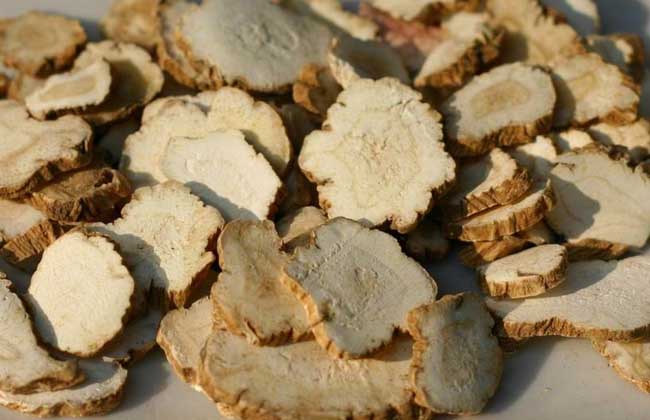
Peucedanum praeruptorum, also known as white-flowered Peucedanum praeruptorum, chicken-foot Peucedanum praeruptorum, mountain Angelica pubescens, etc., is the dried root of the perennial herbaceous plant white-flowered Peucedanum praeruptorum of the genus Peucedanum in the Apiaceae family. Used as medicine, it has the effects of directing qi downward and transforming phlegm, and dispelling wind and clearing heat. It has a therapeutic effect on conditions such as phlegm-heat dyspnea and fullness, coughing of yellow and thick phlegm, and wind-heat cough with profuse phlegm. Let us take a look at the effects and functions of Peucedanum praeruptorum below!
Medicinal Effects of Peucedanum praeruptorum
[Nature and Flavor] Bitter and pungent in flavor, slightly cold in nature.
[Meridian Entry] Lung meridian.
[Effects] Directs qi downward and transforms phlegm, dispels wind and clears heat. Mainly treats phlegm-heat dyspnea and fullness, coughing of yellow and thick phlegm, and wind-heat cough with profuse phlegm.
Related Discussions on Peucedanum praeruptorum
1. "Bielu": Mainly treats phlegm fullness with stuffiness in the chest and hypochondrium, binding qi in the heart and abdomen, wind headache, removes excess phlegm, and directs qi downward. Treats cold damage with chills and fever, promotes the expulsion of the old and the taking in of the new, improves eyesight and benefits essence.
2. "Yaoxing Lun": Removes heat excess, directs qi downward, mainly treats seasonal qi with heat both internally and externally; taken as a single decoction it is excellent.
3. "Rihuazi Bencao": Treats all types of taxation, directs all qi downward, stops cough, breaks up abdominal masses, opens the stomach and promotes food intake, unblocks the five viscera, mainly treats cholera with cramps, vexation and stuffiness of the bones and joints, regurgitation, vomiting and counterflow, panting, calms the fetus, and treats all gan qi in children.
4. "Diannan Bencao": Dissolves wind damage and cold damage, an essential medicine for inducing sweating, stops cough, raises and lowers liver qi, improves eyesight and removes corneal opacity, and expels phlegm from both internally and externally.
Medicinal Selected Formulas of Peucedanum praeruptorum
1. To treat cough with thick and sticky nasal and salivary secretions, discomfort in the chest and heart, and occasional vexing heat: Peucedanum praeruptorum 1 liang (remove the reed head), Ophiopogon japonicus 1.5 liang (remove the core), Fritillaria 1 liang (roasted until slightly yellow), white mulberry root bark 1 liang (cut), apricot kernel 0.5 liang (soaked in hot water, skin and tip removed, bran-fried until slightly yellow), licorice 1 fen (roasted until slightly red, cut). Grind and sift the above medicines into a powder. Take 4 qian per dose, with one medium cup of water, add half a fen of fresh ginger, decoct until reduced to 6 fen, remove the dregs, and take warm regardless of time.
2. To treat lung heat cough, phlegm congestion, and panting with restlessness: Peucedanum praeruptorum (remove the reed head) 1.5 liang, Fritillaria (remove the core) and Baiqian 1 liang each. Ophiopogon japonicus (remove the core, roast) 1.5 liang, bitter orange (remove the pulp, bran-fry) 1 liang, peony (preferably red) and Ephedra (remove the root and node) 1.5 liang each, rhubarb (steam) 1 liang. Finely cut the above eight ingredients, like hemp beans. Take 3 qian-spoonfuls per dose, with one cup of water, decoct to obtain 7 fen, remove the dregs, and take warm after meals, twice a day.
Clinical Applications of Peucedanum praeruptorum
1. Treating chronic respiratory failure: Some people used Qianxing Zidong Tang to treat 31 cases of this disease. Peucedanum praeruptorum, Belamcanda chinensis, Pinellia ternata, tangerine peel, Aster tataricus, Tussilago farfara, and apricot kernel 10 g each, cassia twig, Ephedra, and Schisandra chinensis 6 g each, Asarum 3 g, decocted in water and taken orally in 3 divided doses, 1 dose per day, with half a month as 1 course of treatment. 30 cases were cured, and 1 case gave up treatment.
2. Treating acute bronchitis: Clinically, Qianhu San has a significant effect in treating this disease. Peucedanum praeruptorum, apricot kernel, Schizonepeta tenuifolia, Ardisia japonica, mulberry bark, and Platycodon grandiflorus 10 g each, Pinellia ternata preparata, tangerine peel, and licorice 6 g each, 1 dose per day, decocted in water 3 times and taken in divided doses. Modifications: for chronic cough with external contraction, add Polygonatum sibiricum 20 g and Bletilla striata 10 g. For blood-streaked phlegm, add Imperata cylindrica root and Platycladus orientalis leaf 10 g each; for cold body and limbs, add Ephedra herb and cassia twig 6 g each; take continuously for 3 to 6 doses.
3. Treating interstitial pneumonia in children: This disease belongs to the category of cough and panting in traditional Chinese medicine, and clinically Yujian San is commonly used with quite good effects. Peucedanum praeruptorum, Polygonatum odoratum, Lycium chinense root bark, Cynanchum atratum, and mulberry bark 8 g each, Gnaphalium affine and Baiqian 10 g each, licorice 6 g. Modifications: for chronic disease with yin deficiency and night sweats, add white ginseng 9 g, ground and mixed in. For blood-streaked phlegm, add Rehmannia raw and Rubia cordifolia 6 g each. For cough with counterflow and vomiting, add Pinellia ternata preparata 4 g and reed root 8 g. For concurrent external contraction, add Schizonepeta tenuifolia 6 g and Artemisia annua 8 g, 1 dose per day, taken continuously for 10 doses.
4. Treating chronic bronchitis with infection: Some people used Peucedanum praeruptorum, honey-fried Ephedra, honey-fried licorice, Platycodon grandiflorus, and Descurainia sophia seed 6 g each, bitter apricot kernel, honey-fried Aster tataricus, and Zhejiang Fritillaria 9 g each, decocted in water, 1 dose per day, with 13 days as 1 course of treatment. Among 128 cases in this group, 91 cases were markedly effective, 31 cases improved, and 6 cases ineffective.
5. Treating iridocyclitis after cataract surgery: Some people used Peucedanum praeruptorum and other medicines to treat 35 cases of this disease. Peucedanum praeruptorum, Angelica sinensis, Ligusticum sinense, and Saposhnikovia divaricata 10 g each, prepared Rehmannia, white peony, Plantago seed, and Leonurus japonicus seed 15 g each, Ligusticum chuanxiong and safflower 6 g each, Prunella vulgaris 12 g, raw licorice 3 g. Results: 15 cases were cured, 18 cases improved, and 2 cases ineffective, with a total effective rate of 94.29%.