Lin Wen-hsiung, President of Taiwan Herald, Lectures on "Community Reporting and Social Progress" - Hong Chun-pei Culture and Education Foundation
Lin Wen-hsiung, President of Taiwan Herald, Lectures on "Community Reporting and Social Progress" - Hong Chun-pei Culture and Education Foundation
On April 11, the Hong Chun-pei Culture and Education Foundation invited Lin Wen-hsiung, President of Taiwan Herald, to give a lecture on "Community Reporting and Social Progress." President Lin shared his insights based on his many years of experience and background in media communication and management, and the audience benefited greatly.
Opening the pages of Taiwan Herald, the biggest difference from other newspapers is that it has multiple local editions, with more local pages than any other print media in Taiwan. As "the only newspaper in the country without split editions and with the most local pages," it has still managed to hold its own in the fiercely competitive newspaper industry.
Lin Wen-hsiung, President of Taiwan Herald, also recounted his past experiences. Feeling the decline of print media, he proposed opening up the newspaper's environment and dedicating himself to discovering, promoting, and expanding the value of cities and society. He therefore increased the proportion of regional reporting, presenting rich and diverse content.
Due to Taiwan's relatively small market and the continuous proliferation of various emerging media in recent years, local newspapers are now few and far between. But there are all kinds of news, and the three major newspapers focus heavily on national news. Differences in market structure affect how newspapers perform in their local editions. Similarly, competition between the same media has a stronger effect than competition between different media. As a result, the local edition news in Taipei County and Taipei City has the highest homogeneity, creating a situation where only Taipei news counts as news.
In addition, the current media landscape is plagued by various forms of chaos. The "fatigue bombardment" of news media has been a focal point of heated response from audiences in recent years. Its extreme homogenization has indirectly caused media chaos such as unverified reporting, celebrity-making phenomena, loss of focus in media angles, and rumor controversies. Chiang Hsun once wrote in a United Daily News column titled "Taste Is Ultimately a Choice": "There is a kind of anxiety on this island, a kind of mania; it is almost a sick condition. News channels and print media bombard audiences with fatigue, repeatedly broadcasting the same news."
Addressing this issue, Lin Wen-hsiung, President of Taiwan Herald, stated that audiences also have a responsibility to choose their media. "Taiwan has now entered a democratic society. Using collective consensus to influence the media and choose the media is the best approach." This is why Taiwan Herald has made local news its main focus, conveying the affairs big and small of every county and city to its audience.
After the lifting of martial law, freedom of speech in Taiwan opened up dramatically. Articles and statements criticizing the government and the president appeared in the media every day, but twenty years ago, such a scene was simply impossible.
The news media plays the role of intermediary, with the main task of transmitting and informing audiences of "information," and has four major functions: "surveillance," "informing," "education," and "entertainment." Therefore, the positioning of news media should be "fair and objective," possessing the Fourth Estate's role of monitoring the government and following the gatekeeper theory. Journalists should uphold the spirit of civic ethics and morality, presenting truthful, unadulterated news to their audiences.
Lin Wen-hsiung, President of Taiwan Herald, believes that after the lifting of martial law in Taiwan, "many trivial matters have come to the surface, and many hidden corners of Taiwan have also come to light." Only now have we discovered that Taiwan has such a "rich, bright, and chaotic" multifaceted appearance.
Profile of Lin Wen-hsiung, President of Taiwan Herald:
President Lin Wen-hsiung previously served as Chairman of Minzhong Daily and Publisher of Lukang Times. He currently serves as President of Taiwan Herald, Chairman of the Central Taiwan Newspaper Group, and Publisher of Changhua Times.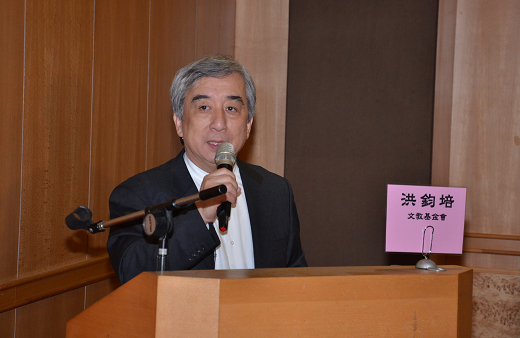
▲Lin Wen-hsiung, President of Taiwan Herald, Lectures on "Community Reporting and Social Progress" - Hong Chun-pei Culture and Education Foundation
▲Lin Wen-hsiung, President of Taiwan Herald, Lectures on "Community Reporting and Social Progress" - Hong Chun-pei Culture and Education Foundation