Legislator Chiang Nai-hsin Speaks at the Hong Chun-pei Culture and Education Foundation on "Equality and Security, Benefiting the Nation and the People"
Legislator Chiang Nai-hsin's speech on "Equality and Security, Benefiting the Nation and the People" at the Hong Chun-pei Culture and Education Foundation
On April 11, the Hong Chun-pei Culture and Education Foundation invited Legislator Chiang Nai-hsin to give a talk on "Equality and Security, Benefiting the Nation and the People." Drawing on his many years of experience as a people's representative and in social service, Legislator Chiang Nai-hsin shared his insights, and the audience benefited greatly.
In recent years, Taiwan has seen many food incidents. The actions of lawbreaking operators are mostly economically motivated adulteration, the malicious use of low-priced inferior products to seek exorbitant profits, causing raw materials unfit for consumption and chemicals not permitted for food manufacturing to appear in the food supply chain in large numbers. From several major food safety incidents, it can be deeply understood that handling food incidents cannot rely on a single ministry's supervision and investigation; it requires joint cooperation among multiple ministries, carrying out full- process management from the source of food raw materials, food manufacturing, food preservation, to food sales.
The amendments to the Act Governing Food Safety and Sanitation have been continuously disputed and have also become a battleground for both the ruling and opposition parties as well as related operators! Over the past six years, the Act Governing Food Safety and Sanitation has undergone six amendments, yet it has been unable to stop unscrupulous businessmen from knowingly breaking the law. In the past, there were even records of interest groups lobbying to delete bills that had cross-party consensus.
What exactly are the controversies surrounding the Act Governing Food Safety and Sanitation? Chiang Nai-hsin stated that among the parts currently reaching consensus, the first is commonly known as the "I-Mei clause," meaning that listed and over-the-counter companies and food companies of a certain scale must establish their own laboratories. The second is that food manufacturers must adopt electronic invoice reporting in phases so that the government can trace food sources. The third is that in the future food factories and feed factories must be separated into different plants with separate licenses and choose one to operate. The last item is to raise fines to three times the original amount.
Legislator Chiang Nai-hsin stated that food safety requires active cooperation among agencies and the joint participation of civil groups. Taiwan has experienced several major food safety incidents, and food safety-related laws and policies are largely complete; the key lies in whether they are actually implemented. If we rely on testing to de cide what can be eaten, "that is truly sad." Recently, I-Mei General Manager Kao Chih-ming also suggested that Taiwan's pesticide contamination of water, air, and soil through secondary means deserves attention, because without clean water and good air, good crops cannot be produced; the current " Act Governing Food Safety and Sanitation" should be divided into the Act Governing Food Material Safety and Sanitation, the Act Governing Food Recycling Safety and Sanitation, and the Act Governing Food Safety and Sanitation, and the competent authority should be clearly designated.
In addition, Legislator Chiang Nai-hsin also raised the issues of education and talent cultivation. He said that Taiwan's education government cannot answer a single question about them. In the past, an education that demanded standard answers produced batch after batch of people who make no mistakes, exactly what the contract manufacturing industry needed most; now, Taiwan has already reached an era of innovation and integration and needs people who dare to be different and think innovatively.
Taiwan has its own triangle: never-ending exams, cram schools, and the local learning/education culture. The three are interlinked and their relationships are hard to separate, forming a high wall that shuts modern education out. Taiwan's students clearly spend more time studying than students elsewhere: they have to take more exams, spend more time in classrooms, "digest" more textbooks, and memorize more things. By comparison, they also spend more money on learning, and their social lives revolve around school.
After these students graduate, their situation is usually like this: students have little passion for their departments or fields of study, do not know what is going on around them, have no opinions of their own on important social issues, cannot read and comprehend the content of books, and aside from school-re lated matters, have little interest in other things. They can even be said to be easy to tame and a "docile" group.
This is quite worrisome, because these students not only occupy an important place in academic achievement, but personal autonomy is also indispensable in the world's future democratization process. And we can see that Taiwan still has shortcomings in the development of these two points.
Taiwan's current education is deeply trapped in a vicious cycle. It continuously creates turmoil and causes several key elements of education to slowly disappear. Some people are corrupt, incompetent, and foolish, simply unable to be worthy of their current socioeconomic status. For them, wanting to cultivate an independent and autonomous personality and a spirit of critical thinking is simply as hard as climbing to the sky. For example: teachers habitually suppress students' independent thinking because they fear students will discover that they actually know little about what they teach.
The mistakes of Taiwan's education are the most serious disaster of the past 30 years, causing unparalleled harm to the country. If Taiwan does not return to vocational education, its economy will face severe challenges. Such an education system has imperceptibly gradually eliminated Taiwan's vocational education, and professional fields have become generalized universities, with everything focused only on degrees and not on substantive education. But in fact, vocational education has produced countless technicians of quite good quality, meeting the needs of industrial upgrading and technological improvement, directly leading to the strengthening of international economic and trade competitiveness, and indirectly promoting the rapid development of national economic construction.
Making vocational education the mainstream of society can achieve the following: 1. Lower society's unemployment rate; 2. Care for disadvantaged groups and subsidize the schooling and employment needs of disadvantaged groups; 3. Strengthen students' second foreign language so that students have an international perspective; 4. Attempt to link the knowledge students ac quire with skills in the corporate workplace, implement zero gap between education and technology, and thereby improve the quality of vocational education; 5. Take into account students' needs for further study, as vocational students can still attend university, so that students can further pursue theory at the stage of expanded education, in order to verify theory and practice.
Legislator Chiang Nai-hsin profile:
Legislator Chiang Nai-hsin holds a master's degree from the Graduate Institute of Business Administration at Tatung University. He has served as a Taipei City councilor for the 4th, 5th, 6th, 7th, 8th, 9th, and 10th terms, a legislator in the 7th term, director of the Child Care Committee of the Taipei City Family Assistance Center, honorary chairman of the parent association of Taipei Municipal Jinhua Junior High School and Jinhua Elementary School, and a director of the alumni associations of National Chengchi University and Tatung University, among other positions. He is currently a legislator in the 8th term.
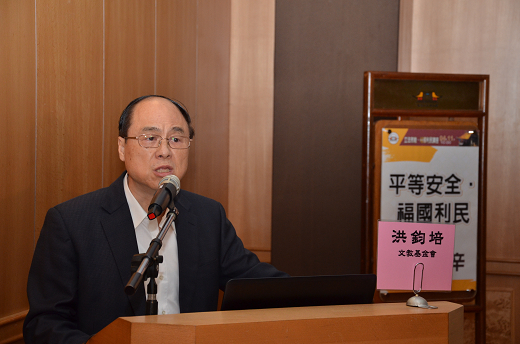
▲Legislator Chiang Nai-hsin's speech on "Equality and Security, Benefiting the Nation and the People" at the Hong Chun-pei Culture and Education Foundation