What are the benefits and effects of myrrh? Read this one article to understand
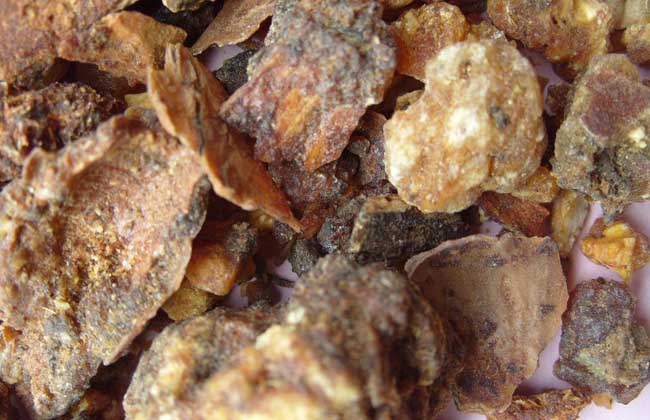
Myrrh, also known as mòyào, míngmòyào and other names, is the dried resin of the plant Commiphora myrrha or Commiphora habessinica of the Burseraceae family. Used as medicine, it has the effects of dissipating blood stasis and relieving pain, reducing swelling and promoting tissue regeneration. It has therapeutic effects on conditions such as chest impediment and heart pain, stomach duct pain, dysmenorrhea and amenorrhea, postpartum blood stasis, abdominal pain from abdominal masses, wind-damp impediment pain, traumatic injuries, and carbuncles, swellings, sores and ulcers. Now let us take a look at the benefits and effects of myrrh!
The medicinal benefits of myrrh
[Nature and flavor] Pungent and bitter in flavor, neutral in nature.
[Meridian tropism] Heart, liver and spleen meridians.
[Effects] Dissipates blood stasis and relieves pain, reduces swelling and promotes tissue regeneration. It mainly treats conditions such as chest impediment and heart pain, stomach duct pain, dysmenorrhea and amenorrhea, postpartum blood stasis, abdominal pain from abdominal masses, wind-damp impediment pain, traumatic injuries, and carbuncles, swellings, sores and ulcers.
Medicinal contraindications of myrrh
1. It must not be taken during pregnancy.
2. For pain in the bones and joints, as well as pain in the chest, abdomen, ribs and hypochondrium, it is not suitable for use when the cause is blood deficiency rather than blood stasis.
3. It is not suitable for use after childbirth when there is excessive lochia discharge and empty pain in the abdomen.
4. It is not suitable for use once carbuncles and deep-rooted sores have already ruptured.
5. For red eyes and skin opacity, it is not suitable for use unless blood heat is severe.
The pharmacological effects of myrrh
1. Blood lipid-lowering effect: The oleoresin fraction of the related plant Commiphora mukul can reduce hypercholesterolemia in male rabbits caused by feeding hydrogenated vegetable oil, and can prevent the formation of plaques on artery walls, and can also cause a slight reduction in the body weight of domestic rabbits.
2. Astringent effect: Myrrh tincture has an astringent effect on mucous membranes. It can be used in mouthwash for ulcers of the oral cavity and pharynx, and can also be used to stimulate intestinal peristalsis in cases of gastrointestinal weakness.
3. Antipyretic effect: When 500 mg/kg of the petroleum ether extract of myrrh oleoresin is given to rats by gavage, it can significantly inhibit inflammation caused by carrageenan and cotton pellet granuloma. This extract also has a clear antipyretic effect in mice.
4. Anti-inflammatory effect: An effective fraction of Commiphora mukul, given at 500 mg/kg daily for 5 consecutive months, has a swelling-reducing and anti-inflammatory effect on joint swelling (inflammation) in rats caused by intra-articular injection of inactivated fungal agent into the posterior ankle joint cavity.
5. Analgesic effect: A new pentacyclic triterpenoid compound extracted from the root of Commiphora mukul, when taken orally at 100 mg/kg, has an inhibitory effect on carrageenan-induced inflammation of the rat paw, and the writhing test proves that it has an analgesic effect.
6. Antibacterial effect: Myrrh water infusion (1:2, i.e. 50% concentration) has varying degrees of inhibitory effect in test tubes on various pathogenic fungi such as Trichophyton violaceum, Trichophyton concentricum, and Trichophyton schoenleinii.
Medicinal selected formulas of myrrh
1. To treat stroke with stiff tongue and inability to speak: myrrh (ground) and amber (ground) one fen each, and dried scorpion (whole, stir-fried) seven pieces. The above three ingredients are pounded and ground into powder. Take three qianbi per dose, with half a cup of goose pear juice, one qianbi of ground Chinese honey locust, and one ge of decocted thick soup. Mix with the pear juice and administer. After a short while, phlegm-toxin is vomited out, and the patient can speak.
2. To treat failure of qi and blood to move, heart and abdominal pain, or migrating pain, irregular menstruation, and fever with afternoon fever, all are suitable for use: safflower, myrrh, Sichuan angelica, and stir-fried corydalis tuber in equal parts, ground into powder. Take two qian per dose, administered with boys' urine and wine.
3. To treat heart and spleen qi pain: corydalis tuber, myrrh, trogopterus dung, and tsaoko fruit in equal parts. Ground into powder. Take three qian per dose, administered with warm wine.
4. To treat turbid urine resembling semen: myrrh, costus root, and angelica in equal parts. The above are ground into powder, and made into pills with the natural juice of the heart of the spina christi, the size of firmiana seeds. Take five to seven pills per dose, administered with salt soup before meals.
5. To treat various hanging syndromes in children: with opisthotonus, high chest and protruding umbilicus, use one ingredient, transparent myrrh, ground into powder, and administer one qianbi with ginger soup.
6. To treat carbuncles, deep-rooted sores and sore toxin, removing decay and promoting new growth: frankincense and myrrh in equal parts. Place on indocalamus leaves and heat over fire to remove oil, grind finely and apply, then cover with ointment. If the toxin is not yet exhausted, this medicine draws the pus out; if the toxin is already exhausted, it closes the wound.
7. To treat intestinal colic pain in children, with bent waist and dry crying: myrrh and frankincense in equal parts. Ground into powder. Grind costus root and decoct in water until boiling, then administer one qian mixed in.
8. To treat all heart and abdominal pain that is unbearable: myrrh and frankincense three qian each, stir-fried pangolin scales five qian, and Momordica cochinchinensis seeds four qian. The above are ground into powder. Take half a qian to one qian per dose, with most of a cup of wine, decoct together and take warm, without regard to time.
Medicinal material characteristics of myrrh
1. Natural myrrh: appears as irregular granular masses of varying sizes; the large ones can be more than 6 cm in diameter. The surface is yellow-brown or red-brown, the nearly translucent part is brown-black, and it is covered with yellow dust. The texture is hard and brittle, the broken surface is uneven, and it lacks luster. It has a distinctive aroma, and tastes bitter with a slight pungency.
2. Gum myrrh: appears as irregular lumps and granules, mostly clumped into masses of varying sizes; the large ones can be more than 6 cm in diameter, the surface is brown-yellow to brown, opaque, and the texture is solid or loose. It has a distinctive aroma, and tastes bitter and sticky.