What are the effects and functions of Sambucus javanica?
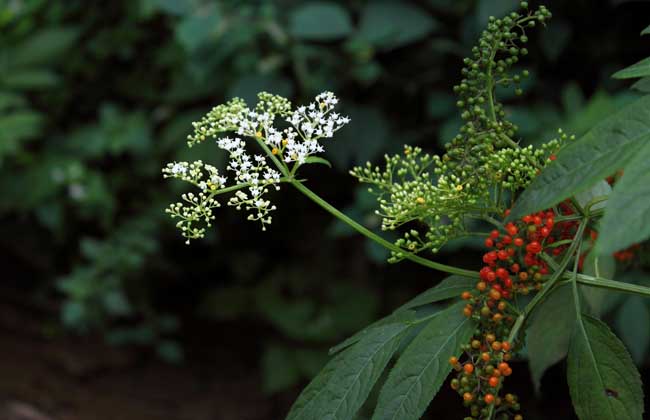
Sambucus javanica, also known as jiegucao, zoumafeng, qiyegen, etc., is a perennial shrub-like herbaceous plant of the genus Sambucus in the Caprifoliaceae family, produced in areas south of the Yangtze River. As a medicine it has the effects of invigorating blood and dissipating stasis, soothing the liver and strengthening the spleen, dispelling wind and unblocking the collaterals, and inducing sweating and diuresis. It has therapeutic effects on traumatic injuries, acute viral hepatitis, rheumatic pain, dislocations, fractures and other conditions. Let us take a look below at the effects and functions of Sambucus javanica!
The medicinal effects of Sambucus javanica
[Nature and flavor] Bitter, pungent in flavor, cold in nature, slightly toxic.
[Meridian entry] Liver and kidney meridians.
[Effects] Invigorates blood and dissipates stasis, soothes the liver and strengthens the spleen, dispels wind and unblocks the collaterals, induces sweating and diuresis. Mainly treats traumatic injuries, acute viral hepatitis, rheumatic pain, dislocations, fractures, nephritic edema, beriberi edema, and urticaria.
The pharmacological effects of Sambucus javanica
1. Analgesic effect: Sambucus javanica decoction administered by gavage at 70, 120, and 140 g/kg showed an analgesic effect in the mouse hot-plate test, and the in vivo half-life of its analgesic component is 3.9 hours.
2. Anti-liver injury: Ursolic acid, a component of Sambucus javanica, injected subcutaneously at 100 mg/kg has a protective effect on experimental liver injury in mice, reducing the triglyceride content in the liver and alleviating liver cell degeneration and necrosis.
3. Other effects: Sambucus javanica decoction administered by gavage at 5 g/kg and applied externally with added wine has the effects of invigorating blood and dissipating stasis, increasing phosphorus absorption, and promoting callus ossification in rabbits with experimental fractures.
The clinical applications of Sambucus javanica
1. Method for treating rheumatic arthritis: 15 grams each of Sambucus javanica root, Damnacanthus indicus root, and wild buckwheat root, and 6 grams of Schisandra sphenanthera root. Modifications: for hand pain add 10 grams of cassia twig and 15 grams of Acanthopanax gracilistylus bark. For pain add 10 grams each of Achyranthes bidentata root and Polygonum chinense root. One dose per day, decocted in water 3 times, each time with an appropriate amount of white liquor as a guide, with 6 days as one course of treatment.
2. For treating traumatic injuries, the formula uses 100 grams of Sambucus javanica leaves, pounded into a paste and applied externally to the injured area, and also 20 grams of Sambucus javanica root decocted in equal parts wine and water, with white sugar as a guide, one dose per day; generally it takes effect after use.
3. For treating lumbar strain, the formula uses 300 grams each of Sambucus javanica root, Sargentodoxa cuneata root, Clerodendrum bungei root, and Sophora flavescens root, and 200 grams of prepared Aconitum kusnezoffii, all washed and dried, ground together into a fine powder and made into pills with brown sugar; take 10 to 15 grams each time, twice a day, and after 3 consecutive doses the waist pain is relieved.
4. For treating early-stage cirrhosis, the formula uses 20 grams each of Sambucus javanica and Polygonum cuspidatum, 10 grams each of Bupleurum chinense, white peony root, Solanum lyratum, Sparganium stoloniferum, ginger-prepared Magnolia officinalis, and areca peel, and 5 grams of Panax notoginseng, one dose per day, decocted in water 3 times and taken. For those with obvious ascites add 20 grams of Veronicastrum axillare; for those with spider angiomas on the chest add 10 grams each of safflower and peach kernel; for those with loose stools add 10 grams each of Atractylodes macrocephala and Poria cocos.
5. For treating frozen shoulder, the formula uses 20 grams each of dried Sambucus javanica, mulberry twig, and kudzu vine, 8 grams of cassia twig, 15 grams each of turmeric and Saposhnikovia divaricata, and 10 grams each of Notopterygium incisum and Gentiana macrophylla, one dose per day, decocted in water 3 times and taken in divided doses. Externally use 100 grams of tender Sambucus javanica leaves, pounded into a paste, add half a bottle of Baiyao, add an appropriate amount of water and wine to make a paste, apply externally to the painful shoulder area, changing the dressing once a day, with 6 times as one course of treatment; among the 16 cases of frozen shoulder treated, the average treatment was 2 courses.
6. For treating renal contusion, some people used Xiaoji Yinzi to treat 23 cases of this disease: 20 grams of Sambucus javanica, 30 grams of Rehmannia root, 15 grams each of small thistle and talc, 9 grams each of Akebia stem, cattail pollen, lotus node, Lophatherum leaf, and gardenia, and 6 grams each of angelica and prepared licorice, decocted in water, one dose per day; avoid pungent, sour and greasy foods. For those with a short course of illness and relatively severe pain, remove gardenia, Akebia stem, and Lophatherum leaf, and add 10 grams each of Trogopterus dung, Corydalis yanhusuo, and Lindera aggregata; for those with gross hematuria add 6 grams of Panax notoginseng (ground into powder and swallowed); for those with a long course, pale complexion, and poor spirits, remove talc, Akebia stem, and Lophatherum leaf, and add 10 grams of ginseng (stewed separately) and 15 grams of Salvia miltiorrhiza.
7. For treating breast nodules, some people used Xiaojian San to treat 36 cases of this disease: 10 grams each of Bupleurum chinense, Atractylodes macrocephala, Sargassum, kelp, prepared pangolin scales, and Fritillaria thunbergii, 15 grams each of angelica and Poria cocos, 20 grams of white peony root, and 6 grams of Gentiana scabra. Decoct in water, one dose per day, taken in 2 divided doses in the morning and evening. It can also be refined with honey into pills, 20 grams each time, 3 times a day. Pregnant women are forbidden to take it.