Narrow the industry-academia gap: large enterprises should actively shoulder responsibility
Large enterprises have a responsibility to actively narrow the industry-academia gap
Recently, encouraging youth entrepreneurship has become a popular trend, with universities setting up incubation centers one after another to actively coach students on starting businesses. However, for young students lacking workplace experience, plunging straight into entrepreneurship after graduation is truly very difficult given Taiwan, China's entrepreneurial environment. Perhaps it would be more important for universities to first work hard to narrow the gap between what is learned on campus and what is used in industry, so that those who want to start businesses can first cultivate innovation capabilities competitive in industry.
Recently, mainland China's Jack Ma announced an investment of 10 billion to set up an entrepreneurship fund in Taiwan, China, sparking public discussion. Before that, the National Development Council promoted the Entrepreneurship Excellence Program, bringing in international venture capital, while legal affairs agencies adjusted regulations, central agencies and county and city governments stepped up by establishing entrepreneurship parks, and universities further developed incubation centers, which indeed has an inspiring effect on young people in the workplace and students on campus.
At the same time, young entrepreneurs have also done themselves proud, winning awards in international entrepreneurship competitions one after another, and quite a few teams have secured investment from international venture capital. Taiwan, China's entrepreneurial atmosphere has indeed improved recently and is worth looking forward to.
Beyond widely establishing parks, setting up venture capital funds, and schools broadly offering entrepreneurship courses, the assistance that young entrepreneurs most hope to receive may require those in charge in government to understand more deeply. At a recent forum on internet and e-commerce entrepreneurship, several seasoned young entrepreneurs mentioned that what is most lacking for entrepreneurship in Taiwan, China is the international vision to grasp industry trends, and the entrepreneurial failure experience that should have been learned earlier.
These young entrepreneurs' heartfelt words point out that Taiwan, China's entrepreneurial environment remains thin, lacking new-era role models, and lacking competition and cooperation and learning among peers. But they also drew attention to some young entrepreneurs doing fairly well, such as Armor Technology and the Kuo brothers, who happen to have Stanford University backgrounds and have fewer troubles in this regard.
Stanford University sits at the center of Silicon Valley. Many of its professors are corporate consultants or have entrepreneurial experience, students mostly accumulate rich internship experience at large companies before graduating, the school's research projects are mostly sponsored by cutting-edge Silicon Valley companies, and research results can also be combined with the direction of enterprises. Silicon Valley's venture capitalists and angel investors also spare no expense in injecting capital.
The vision Stanford University offers students is priceless, and students also accumulate failure experience from internships, research, and the entrepreneurial experience of teachers and senior schoolmates. From this it can also be seen that graduating from Stanford University does not guarantee entrepreneurial success either.
Of course, people cannot expect that universities in Taiwan, China can provide an international-level innovation and entrepreneurship environment like Stanford University. But in the past, National Chiao Tung University, National Tsing Hua University and the Hsinchu Science Park had a very good combination. Many graduates started successful businesses in the Hsinchu Science Park, further gave back to their alma maters, and also sought technical cooperation with professors, letting younger schoolmates come into contact with industry early, while also stabilizing the source of corporate talent.
University campuses in Taiwan, China very much need to rebuild a healthy industry-academia cooperative relationship. Enterprises need technology and talent and cannot demand that schools provide them in only one direction; enterprises also need to invest in schools and help cultivate talent.
In the "Human Resource Survey" released by the Directorate-General of Budget, Accounting and Statistics in February, the youth unemployment rate for Taiwan, China's 15 to 24 age group was still as high as 11.75 percent, but at the same time Taiwan, China's enterprises also suffer deeply from a lack of talent. In the "2014 Talent Shortage Survey" conducted by ManpowerGroup, 45 percent of employers in Taiwan, China faced difficulty recruiting, and the overall labor shortage situation was higher than the global average. This reflects a serious gap between learning and application in Taiwan, China's society: young people who have just graduated cannot find jobs, while enterprises cannot find talent.
Large enterprises benefit from the talent trained by schools and should have the responsibility to actively narrow the industry-academia gap. Taking Google's experience in Taiwan, China as an example, over the past few years Google has cooperated with universities on quite a few digital talent cultivation programs, sensing that enterprises urgently need internet marketing talent, but teachers and students at schools lack the relevant environment and experience. For this reason, Google recently further promoted the "Digital Mars Program", expected to train 2,000 outstanding young people, hoping to cultivate for soon-to-be graduates the practical abilities needed by industry. The program received enthusiastic support from 6,000 enterprises and has already provided more than 170 well-paid job openings for matchmaking with students participating in the training.
University campuses are facing various challenges such as a declining birthrate and students' low willingness to pursue further study, while academia is full of talent and needs enterprise support. Academia should also adjust research topics and actively connect with industry, while relevant government departments even more need to create incentives for industry-academia talent exchange, encouraging university professors to be seconded to industry, or recruiting industry experts to enter campuses. This will be a major key to implementing campus innovation and enhancing industrial competitiveness. University incubation centers should be used to narrow the gap between learning and application, letting students first be able to innovate, and then talk about starting businesses.
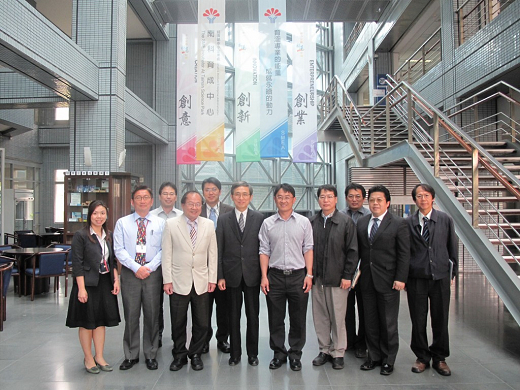
▲Large enterprises have a responsibility to actively narrow the industry-academia gap