What Kinds of Turtles Are There? A Detailed Introduction to Common Species
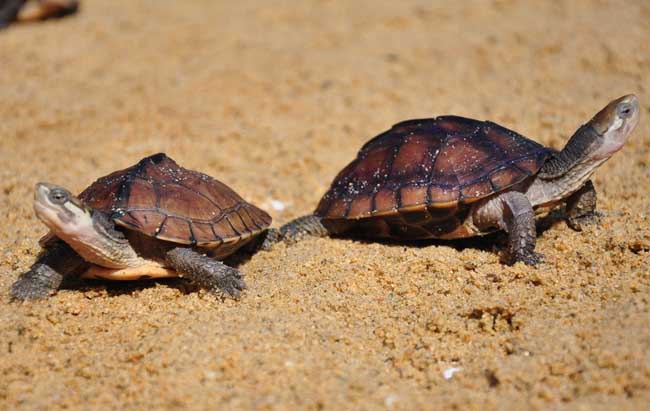
What kinds of turtles are there? Turtles are reptiles that evolved with a shell as the central feature, first appearing in the early Triassic period. Turtle types can be simply divided into three categories: aquatic turtles, tortoises, and semi-aquatic turtles. Representative species include the red-eared slider, the snapping turtle, and the Chinese pond turtle. Let's take a look at the characteristics of these turtle species below!
Red-Eared Slider
The red-eared slider is one of the subspecies of the pond slider in the family Emydidae, and is a semi-aquatic turtle. Because it has 2 thick red stripes on each side of the back of its head, it is also called the red-eared turtle, and it is an excellent variety among turtles. It is native to the Americas and has high value for food, medicine, and ornamental purposes, and is also very suitable for artificial breeding.
Snapping Turtle
The snapping turtle is the oldest surviving reptile and one of the largest freshwater turtles in the world, known as the king of freshwater animals. It is divided into two major types, commonly known as the big snapping turtle and the small snapping turtle. The big snapping turtle is also called the true snapping turtle (native to the southeastern United States in North America), while the small snapping turtle is also called the common snapping turtle and has four subspecies: North American, Florida, South American, and Central American. The North American and Florida subspecies are the most common, among which the Florida subspecies is more expensive due to some human-related reasons. Because of its large size and strong aggressiveness, it has few natural enemies apart from alligators. It once lost its habitat due to human hunting and was listed as a vulnerable species by the International Union for Conservation of Nature. Later, because of its high ornamental value and strong adaptability, it became deeply favored by domestic turtle enthusiasts.
Chinese Pond Turtle
The Chinese pond turtle is the most widely distributed and most numerous species among turtles in China. Every part of it is valuable, and it is regarded as a top-grade food and medicinal tonic in works such as the Shennong Bencao Jing and the Compendium of Materia Medica. China has traditionally regarded it as a symbol of health and longevity. In the international market, the Chinese pond turtle is very popular. The people of Japan, the Philippines, and various European and American countries regard it as a symbol of “good fortune and longevity.”
Yellow Pond Turtle
The yellow pond turtle is a reptile in the genus Mauremys of the family Geoemydidae. It is distributed in Vietnam, Japan, Taiwan, China, and the eastern, southern, and Hainan regions of mainland China, extending west to Yunnan and other places. It is commonly found in waters of mountain basins or river valleys in hilly semi-mountainous areas, and often in nearby small thickets or grass clumps.
Chinese Stripe-Necked Turtle
The Chinese stripe-necked turtle has webbed feet and is highly aquatic. The underside of the marginal scutes of juveniles has black spots resembling individual pearls. It often lives in low-altitude waters such as ponds, canals, and slow-flowing rivers. It is an omnivorous animal that eats fish, shrimp, aquatic plants, and so on. It does not belong to the same turtle species as the Chinese pond turtle or the red-eared slider. The Chinese stripe-necked turtle is gentle in temperament, does not attack or fight, and does not bite people. Its adaptability is average, and its vitality is strong. It is distributed in China, Vietnam, and other places. The type locality of this species is in China. The Chinese stripe-necked turtle can already be bred artificially in large numbers, especially with relatively large artificial breeding volumes in Taiwan, China.
Long-Necked Turtle
The long-necked turtle is the oldest surviving reptile. It is characterized by a very sturdy shell on its body, and when attacked, the turtle can retract its head, tail, and limbs into the shell. It is carnivorous, feeding on worms, snails, shrimp, small fish, and so on, and also eats the stems and leaves of plants. It belongs to the order Testudines, family Chelidae, genus Chelodina. It is also known as the snake-necked turtle. It is distributed in eastern Australia. Its body is relatively small, generally with a shell length of 15-25 cm.
Burmese Mountain Tortoise
The Burmese mountain tortoise is also called the elephant tortoise, dragon-clawed tortoise, dry tortoise, pillow tortoise, and so on, and is one of the most common tortoises on the market. In China, it is distributed in Guangxi and Yunnan. Although Burmese mountain tortoises are often sold in farmers' markets and pet markets in other provinces and cities, they are not native to those places. Most are imported from Southeast Asia and then dispersed to various places. In recent years, resource depletion has meant that almost all Burmese mountain tortoises depend on imports and smuggling by some vendors.
Sulcata Tortoise
The Sulcata tortoise, also known as the African spurred tortoise and the Sulcata tortoise, is a very active tortoise. Its carapace is highly domed, and the top of its head has symmetrical large scales. Its skull is relatively short, the squamosal does not connect with the parietal, the frontal may not enter the orbit, and the postorbital is reduced or almost absent. The posterior part of the quadrate is usually closed, completely surrounding the stapes. The maxilla almost connects with the quadratojugal, and the upper jaw chewing surface has or does not have a central ridge. The carapace and plastron are firmly connected by bony sutures through the bridge. Its limbs are thick and cylindrical. The finger and toe bones do not exceed 2 segments, have claws, and no webbing. It has no musk glands. It is herbivorous and can live in relatively arid environments. It is distributed in African countries such as Ethiopia, Sudan, Senegal, Mali, and Chad.