A Detailed Guide to Locust Farming Techniques and Management Methods
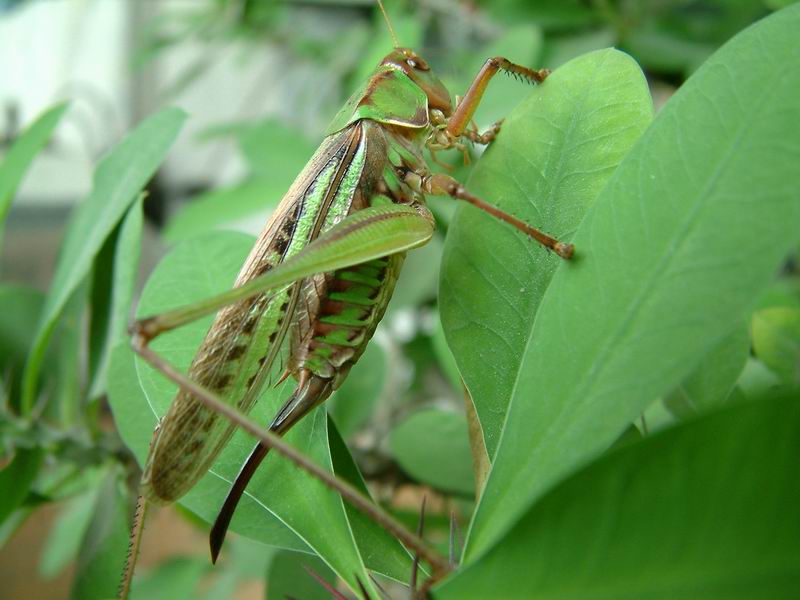
Locusts belong to the class Insecta, order Orthoptera, family Acrididae. According to statistics, the superfamily Acridoidea comprises 223 genera and 859 species. The Oriental migratory locust (Locusta migratoria manilensis) grows under natural temperature conditions and produces two generations per year: the first generation is called the summer locust, and the second is called the autumn locust. Under artificial farming, this can now be converted to 3 generations per year. Female locusts measure 39.5-51.2 mm in body length, while males measure 33.0-41.5 mm. Adults are good at jumping and flying. The Oriental migratory locust has a stout body, a wide feeding range and strong adaptability. After hatching from the egg into a nymph, it can become an adult after a 35-day rearing process, and can be sold after fattening for about 50 days, so the time is short and the returns are quick. Rearing 10,000 adult Oriental migratory locusts can reach 20 kg, and their economic benefit is considerable, and the seed stock only needs to be purchased once. They self-propagate dozens of times over: eggs hatch into locusts, locusts lay eggs, and the cycle repeats, allowing many years of rearing and continuous income from sales. A single female locust can lay 35-90 or more eggs at one time. The reason migratory locusts are favored is that their flesh is tender, fresh and nutritious. According to expert analysis and measurement, their protein content is as high as 74.88%, fat content 5.25%, carbohydrate content 4.77%, and they contain 18 kinds of amino acids and various active substances.
Farming Varieties
For insect farming varieties, the following factors generally need to be considered: growth cycle, number of generations, size, taste, feeding habits, color, dormancy, and so on. The superfamily Acridoidea has over ten thousand varieties. Theory and practice have proven that the Oriental migratory locust is one of the superior varieties among locusts and is currently the most widely farmed variety. The advantages of the Oriental migratory locust: (1) relatively large body; (2) delicious taste; (3) bright coloration; (4) more generations; (5) relatively short growth cycle; (6) herbivorous and polyphagous.
The Oriental migratory locust is the primary pest causing locust plagues in China. It is one of the three subspecies of the genus Locusta in China (explanation). The genus Locusta has only one species worldwide; due to differences in geographical distribution and differences in external morphology and related ratios of different body parts, 9-10 subspecies are known, and China has three subspecies: the Oriental migratory locust, the Asian migratory locust, and the Tibetan migratory locust.
The Oriental migratory locust is an insect with incomplete metamorphosis, and its life cycle has 3 stages, namely egg ---- locust nymph (larva) ---- adult. The Oriental migratory locust generally can produce 2-4 generations per year. The 1st generation (1-2 generations in Hainan) is customarily called the “summer locust”, and the 2nd generation (3-4 generations in Hainan) is called the “autumn locust”. Growth cycle: it can become an adult in about 35 days, and can be sold in about 50 days (approximately). Female locusts die normally after laying eggs, and male locusts die normally after mating.
Construction of Locust Farming Sheds
1. Site selection
It is advisable to choose a well-ventilated place with sufficient sunlight.
2. Eliminate natural enemies
Before building the shed, first use methods such as catching, trapping and killing, and scalding with boiling water to completely eliminate ants, mole crickets and other such creatures on the ground, because these several kinds of animals are natural enemies of locusts and can prey on locusts and destroy locust eggs, so these animals must absolutely not be allowed to exist inside the shed.
3. Ground
The ground of the shed should be 10-15 cm higher than the surrounding ground, in order to facilitate drainage during the rainy season. The soil quality is best if sandy loam is used; this soil does not easily clump, making it convenient for egg-laying and egg collection, but it must not be too soft, as locusts have very high requirements for egg-laying.
4. Density
The area of the shed depends on the number of locusts; generally 600-800 adults can be reared per square meter.
5. Building the shed
According to your own conditions, you can use wooden sticks or bamboo strips to build a shed frame. Then, according to the size of this shed frame, use gauze to make a shed cover like a mosquito net, hang it on the shed frame, bury the bottom edge underground, and leave a doorway; install a zipper on the doorway. This setup is designed to prevent locusts from escaping and to facilitate entering the shed for feeding and management. The height of the shed only needs to be 1.5-2 m. To keep warm or prevent rain, plastic sheeting can be placed over the outside of the shed. When the temperature is high and the locusts are larger (third instar and above) and not afraid of rain, the plastic sheeting can be omitted. If natural conditions are used to farm migratory locusts, the construction of the shed must be completed before the end of April.
6. There should be corn and other taller plants inside the shed for isolation.
Development, Hatching and Management of Locust Eggs
The threshold development temperature range for migratory locusts is 20-42 degrees, the suitable development temperature is 25-40 degrees, and the optimum temperature is 28-35 degrees. At a relative humidity of 85%-92% or a soil moisture content of 15-18%, the suitable development temperature is 25-32 degrees, which the natural temperature in northern China reaches in early May. After purchasing eggs, simply place the locust eggs directly into the soil and wait for them to hatch naturally. After a 10-15 day hatching process, all locust nymphs hatch out. Locust nymphs have a very small food intake and are physically weak, so attention should be paid to rain protection.
Habits of Migratory Locusts
1. Hatching
The minimum hatching temperature for seed eggs is 17 degrees Celsius, the suitable development temperature is between 26-32 degrees Celsius, and the highest hatching rate occurs at a soil moisture content of 18-22%. The entire egg pod generally takes 50-60 minutes from the start of hatching to the completion of hatching, with the most hatching occurring from 8 a.m. to 1 p.m. During the hatching process, there is also a sequence in emergence from the soil.
2. Molting
The growth of migratory locusts is completed through molting. When they grow to a certain length and need to molt, they stop eating. They hang upside down with their heads pointing downward to molt. (There must be something to attach to.) After one hour, they can resume feeding. Locust nymphs molt once every 5-7 days after emerging from the egg; strong ones molt in batches, while weak ones molt slowly, and each molt marks one instar. From hatching to adult, they need to molt five times before they can become adults.