What Kind of Animal Is the Platypus? A Detailed Guide
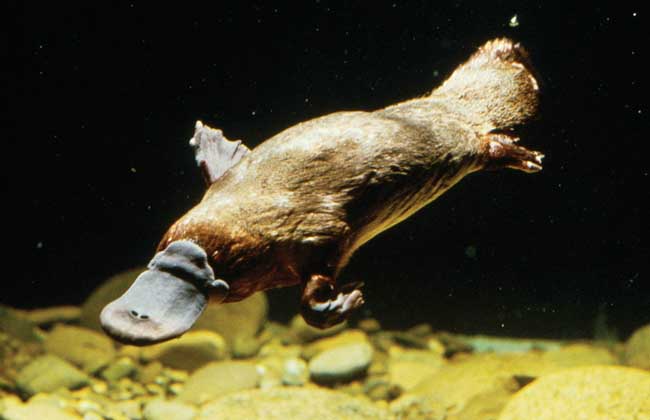
The platypus is one of the most primitive mammals, a mammal that has not fully evolved, with very few species. Within its genus there is only one animal, the platypus, and it is also one of the lowest forms of mammal. In the late 18th century, George Shaw received a platypus specimen and thought the creature was the product of a hoax, and it was later named in 1799. The platypus has a duck-like bill and feet, while its body and tail resemble those of a beaver. It appeared 25 million years ago and still lives in Australia today. Because the platypus is few in number and has a small distribution, no subspecies have been found so far.
The platypus is covered all over in soft, dense, short brown fur. Compared with the echidna, its braincase is smaller, and its brain is hemispherical, smooth and without convolutions. Its limbs are very short, with five toes bearing hooked claws, and the toes are joined by web-like webbing much like a duck's foot; when walking or digging, the webbing folds back over the palm. Its whole body is covered in soft fur, like a fine waterproof coat. Its bill is extremely broad and flat, mounted on its head like a mask and shaped like a duck's bill; it is soft in texture, rather like leather, and covered with nerves, able to receive electrical signals given off by other animals like a radar scanner. With this powerful tool, the platypus finds food and determines direction in the water. Inside the bill there are broad keratinous gums, but no teeth. The tail is large and flat, accounting for 1/4 of its body length, and acts as a rudder when swimming in the water.
The platypus is one of the very few mammals that use venom for self-defense. On the back of the knee of the male platypus there is a hollow spur, and when it stabs fiercely at an enemy with its hind limbs it releases venom. The platypus has only three toxins unique to itself; the remaining toxins are also found in other animals, such as starfish, sea anemones, spiders, snakes and lizards. These 83 different toxin genes can be classified into 13 different gene families. Different combinations of these toxins may cause symptoms such as inflammation, nerve damage, muscle contraction and blood clotting, and can kill a person. If you encounter a platypus in the wild, you must never take it lightly.
The platypus inhabits rivers and lakes, and usually prefers to live in burrows by the water. It often builds its nest on the banks of swamps or rivers, with the entrance opening underwater, including mountain streams, stagnant water or muddy rivers, lakes and ponds. It digs burrows on the bank as shelters, and the burrows connect with the adjacent water area. Apart from the nursing period, the platypus lives a solitary life throughout its life, spending most of its time in the water, and it is an excellent swimmer.
The platypus likes to eat small aquatic animals, such as insect larvae, small shrimp and worms. It usually hunts crustaceans, earthworms and other animals by the water in the early morning and at dusk. But the platypus does not have the sharp teeth of a mammal; each time it catches food in the water, it first stores it in its cheek pouches, then floats to the surface and only after clamping it up and down with the jawbones in its bill does it eat heartily. It has a large appetite, and the food it consumes each day equals its own body weight.
The platypus is of great academic importance. Through hundreds of millions of years it has neither gone extinct nor evolved much, always lingering in a "transitional stage," full of mystery. This animal, found only in Australia, saw its population decline severely because of years of excessive hunting for specimens and precious fur, and it once faced the danger of extinction. Because of its uniqueness and rarity, it has been listed as an internationally protected animal, and the Australian government has enacted protection regulations.