A Detailed Guide to Soft-shelled Turtle Breeding Techniques and Management Methods
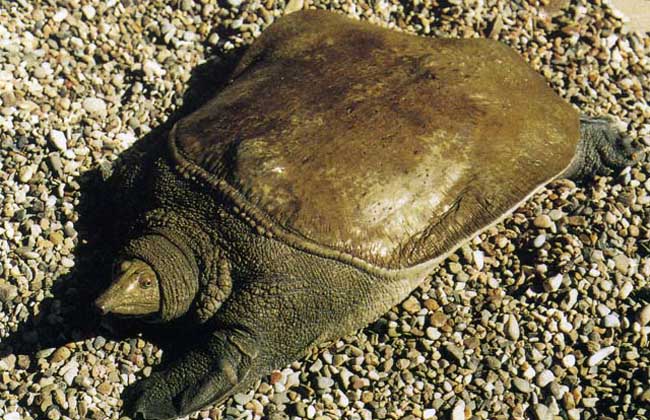
The soft-shelled turtle is also known as the Shanrui turtle, Rui fish, soft-shelled turtle, and tuan fish. It lives in mountain rivers and ponds, feeding on small aquatic animals, mollusks, crustaceans, fish and shrimp. Its shape is round and very similar to the Chinese soft-shelled turtle commonly known as "soft-shelled turtle," but it is much larger than the ordinary Chinese soft-shelled turtle. Let's take a look at the breeding techniques for the soft-shelled turtle below!
Temporary Rearing of Juvenile Soft-shelled Turtles
1. Temporary rearing container: After about 80 days, the soft-shelled turtle eggs will hatch into juveniles. Newly hatched juvenile soft-shelled turtles weigh 6-7 grams, and the yolk has not yet been fully absorbed. At this time, they should not be handled to avoid injuring the juveniles; let them crawl freely inside the incubator. After 2 days, move them to another wooden basin or plastic basin for temporary rearing. Spread 3-4 cm of sand on the bottom of the basin and add water to a depth of 2 cm so the juveniles can stick their heads out of the water to breathe. A basin with a diameter of 40 cm can hold about 20 juvenile turtles.
2. Food feeding: Newly hatched juvenile soft-shelled turtles do not need to be fed for 2 days. After 2 days, feed them once each in the morning and afternoon every day. The bait includes bloodworms, chopped earthworms, fish meat, poultry and livestock liver, etc. The feeding amount should be about 10% of the total weight of the soft-shelled turtle group. Soft-shelled turtle compound feed can also be fed.
3. Temporary rearing management: During the temporary rearing stage, because the basin is small and there is little water, the soft-shelled turtles are easily affected by air temperature and the temperature difference changes greatly, so they should be kept indoors. Pay attention to keeping them warm. Water should be changed 1-2 times a day, and the temperature difference during water changes should not exceed 5°C. After about 20 days of temporary rearing, the juvenile soft-shelled turtles can be transferred to juvenile turtle ponds for cultivation.
Stocking Techniques for Soft-shelled Turtles
1. Turtle pond construction: Juvenile turtle ponds are generally cement pond structures. The area does not need to be very large; 5-10 sq m is sufficient. The pond depth is 50-60 cm, with a water depth of 30 cm. Shade cloth needs to be stretched above the pond to lower the temperature. A resting platform should be set on one side of the pond, with an area of about 1/5-1/4 of the pond. The resting platform connects to the water surface at a 25-degree slope, making it convenient for juvenile turtles to come ashore and rest. Spread 5 cm of sand on the bottom of the pond.
2. Stocking density: After temporary rearing, juvenile soft-shelled turtles are transferred to juvenile turtle ponds for cultivation. Before entering the pond, soak them in a 10 mg/L potassium permanganate solution for disinfection for 15 minutes. The initial stocking density should be 40-50 turtles per sq m. It is best to stock some water hyacinth in the juvenile turtle pond, which can lower the water temperature and purify water quality, and can also serve as attachment.
3. Density adjustment: As the juvenile turtles grow, the breeding density should be adjusted in time according to the growth size. When they grow to 40-60 grams, stock 30-40 turtles per sq m of pond. When they grow to more than 100 grams, stock 20-30 turtles per sq m. Usually, they are thinned once every 2-3 months.
Feeding and Management of Soft-shelled Turtles
1. Bait feeding: Select bait types such as yellow mealworms, fresh poultry and livestock liver, and fresh fish meat. The bait platform is made of wooden boards and fixed at the edge of the pond to hold bait. When the water temperature is 28-30°C, feed 3 times a day, at 8 o'clock, 12 o'clock, and 17 o'clock respectively. When the water temperature is 25-28°C, feed 2 times a day, at 9 o'clock and 16 o'clock respectively. Each feeding amount should be such that the bait is eaten up after 1 hour or a little remains.
2. Water quality regulation: Rely on changing water and changing sand to regulate water quality. The water source for changing water is edible tap water, and river water, reservoir water, or well water can also be used. In spring and summer, change water twice a day; in autumn and winter, change water once a day. Each water change should preferably be after the soft-shelled turtles finish eating bait, and each water change should replace 2/3 of the original pond water. Replace the bottom sand once every two months, replacing all of it each time. Soak the new sand in a potassium permanganate solution with a concentration of 50 mg/L for disinfection for 30 minutes before putting it into the turtle pond.
3. Water temperature regulation: In winter and spring, when the water temperature is below 25°C, use artificial heating methods to regulate the water temperature and cover with plastic film to keep warm. Each breeding pond uses one 120-watt aquarium heating rod and one 60-watt light bulb to control water temperature and increase illumination, keeping the water temperature between 25-30°C, and for most of the time between 28-30°C. In summer, when the water temperature exceeds 32°C, use a Hongyun fan at the edge of the pond to blow air and lower the temperature.
4. Light regulation: In winter and spring, when sunlight is sufficient, pull open the plastic film and gather the soft-shelled turtles in Pond No. 2 on the balcony to bask their backs. Back basking is best done from 9-10 a.m., for 1-2 hours each time, to increase light exposure time, promote the conversion and absorption of calcium and vitamin D, improve the disease resistance of the soft-shelled turtles, and also play a role in disinfection and sterilization.
Breeding of Parent Soft-shelled Turtles
1. Parent turtle selection: Select physically strong soft-shelled turtles as parent turtles for artificial breeding and move them into parent turtle breeding ponds for cultivation. The parent turtle breeding pond is built with a plastic film insulation shed, with an area of 260 sq m, a brick structure, with internal plastering. Place 20 cm of yellow mud on the bottom of the pond, with a water depth of 1 m. It is equipped with a feeding platform and a back-basking platform. At one end of the pond, build a 20 sq m spawning sand area.
2. Parent turtle management: The parent soft-shelled turtle breeding pond uses a boiler for heating to maintain the pond water temperature at about 25°C. Feeding is mainly animal feed, appropriately supplemented with complete compound turtle feed and green feed. Strengthen water quality management and disease prevention, and apply photosynthetic bacteria once a month.
3. Mating and egg laying: Under artificial temperature control, parent soft-shelled turtles can mate when the water temperature is 22-25°C. After 15-20 days of mating, the female turtles begin to lay eggs. Egg laying takes place in the latter half of the night. The female turtle climbs onto the sand area, finds a good position, digs a nest, and lays eggs. After laying, she crawls over the sand to cover them.