Key Technical Points and Daily Management Methods for Big-headed Turtle Farming
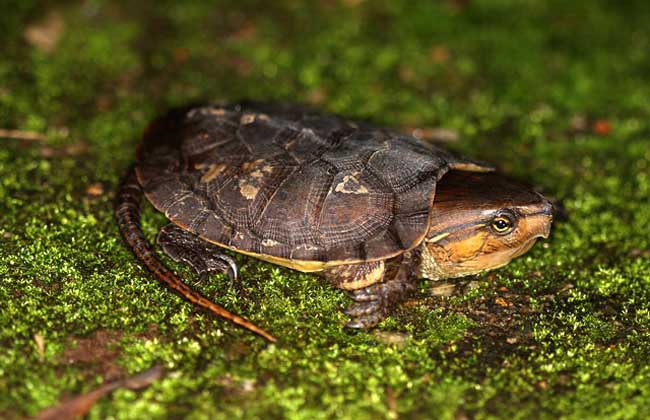
The big-headed turtle is one of the most distinctive freshwater turtles in China, also known as the eagle-beak turtle, big-head turtle, parrot turtle, etc. It is an amphibious turtle species of the genus Platysternon in the family Platysternidae, and likes to live in mountain streams full of boulders and gravel with rapid currents, foraging for snails, clams, shellfish, shrimp, fish, crabs, frogs, insects and snails, and will even eat leaves and grass roots when hungry. Let us take a look at the farming techniques for the big-headed turtle below!
Living Habits of the Big-headed Turtle
1. Habitat environment: The big-headed turtle is amphibious, mainly living in water, and often lives in mountain streams and among the grasses of lakes and marshes. It has sharp claws and a powerful tail, can easily climb over obstacles, and can even climb trees. It has a fierce temperament and likes to live in quiet mountain streams full of boulders and gravel with rapid currents.
2. Feeding habits: The big-headed turtle begins to seek food and enter estrus when the weather warms up in March and April, has the strongest appetite from May to September, and in late autumn and early winter burrows into sand, grass or dives to the bottom of the water to hibernate. Wild big-headed turtles mainly forage for snails, clams, shellfish, shrimp, fish, crabs, frogs, insects and snails, and will even eat leaves and grass roots when hungry. Under artificial rearing conditions, they can be fed animal offal, snails, frogs, fish and shrimp meat, as well as bran, bean cake, fruits or fruit peels.
Breeding Techniques for the Big-headed Turtle
1. Egg collection: Most female big-headed turtles lay eggs from July to September each year, while a few females lay eggs in February and March. Egg-laying usually occurs from dusk to dawn, and sometimes extends to around 8 o'clock the next morning. During the egg-laying period, it is best not to go to the egg-laying site at night to disturb the female turtles. The next morning, most female turtles have left the egg-laying site and entered the pond. Based on the traces of the egg-laying holes, the eggs can be dug out, gently picked out and placed flat in an egg collection box (basin), and then sent for artificial incubation.
2. Egg incubation: The egg container for the big-headed turtle should be lined with a layer of wet fine sand about 3 cm thick, and the eggs should be arranged neatly to prevent squeezing. Place the freshly collected, high-quality fertilized eggs into the incubation box. The bottom of the incubation box should be covered with fine sand about 20 cm thick that can be formed into a ball by hand. Bury the turtle eggs one by one in fine sand 2 to 3 cm deep, cover with a wet towel, sprinkle water 1 to 2 times a day, maintain humidity at 80% and temperature between 25°C and 30°C, and hatchlings can emerge after 50 to 60 days.
3. Hatchling management: Newly hatched big-headed turtle hatchlings do not need feeding for 1 to 3 days. They only need to be soaked briefly in 8.5% physiological saline for disinfection and disease prevention, and then transferred to a rearing box lined with fine sand. After 3 days, they can be fed small fish, small shrimp, earthworms and a small amount of rice and other food. After 60 days of careful rearing, they can be transferred to a rearing pond for rearing.
Construction of a Big-headed Turtle Farm
1. Site selection: For artificial farming of the big-headed turtle, natural environments such as ponds, mountain pits and streamside areas with convenient drainage and irrigation and a constant flow of water can be selected and slightly modified. Ponds can also be built by artificial excavation around ponds or paddy fields. When building the pond, a brick wall should be built around the farm 2 to 3 m from the water surface, with a wall height of about 2 m. The inner wall should be smoothed, and the wall foundation should extend 30 to 50 cm into the soil to prevent escape.
2. Site construction: For a turtle pond with an area of 100 sq m for big-headed turtles, a small island of 10 to 40 sq m should be built in the pond. The island should have a 35-degree slope, and on the east side, 30 to 50 cm thick sand and turtle nests should be provided. Dwarf, multi-branched mulberry trees, willow trees, etc. should be planted on the island, and on the west side of the island, stones should be piled and plants such as pumpkins, cowpeas and sweet potatoes should be planted, so as to provide shade, resting places and trees for the big-headed turtle to climb and forage.
3. Supporting facilities: In the big-headed turtle farm, water hyacinth should be planted on 1/3 of the water surface, and bamboo poles and wire should be set up over the pond to grow some long-vined plants such as gourds, melons and beans. Some quails, snakes, snails, earthworms, river snails, fry, etc. should be raised on the island and in the water to provide ample food for the big-headed turtle.
Farming Techniques for the Big-headed Turtle
1. Selection of turtle hatchlings: Healthy big-headed turtles have smooth body surfaces, intact skin, carapace and plastron, full muscles in the limbs, bright eyes, sensitive responses to external stimuli, strong limbs when crawling, can support the body and quickly escape, and can swim rapidly and sink to the bottom when placed in water. On the contrary, turtles with thin and weak limbs, no strength to struggle when held in the hand, slow swimming or long-term floating on the water surface after being placed in water must never be selected for rearing.
2. Stocking of turtle hatchlings: Big-headed turtles are wilder than other turtles and have difficulty adapting to artificial rearing environmental conditions. Newly introduced turtles cannot be placed in water immediately. They should be kept dry in a cool place for 3 hours, then appropriately sprinkled with water on the body surface to keep the turtle body moist. After 1 day, the turtles can be placed in water and begin to be fed live bait, such as live small fish and shrimp, tadpoles, earthworms, etc. Turtles that have started eating should be reared separately for 10 days, then placed in the turtle pond. The water depth should initially be about 20 cm, and gradually increased to about 50 cm after adaptation. After the turtles actively eat, they can be fed frozen fresh fish and other bait. The feeding order is frozen fresh fish first and then live bait, and both frozen fresh and live bait must be placed in the water.
3. Bait feeding: Under artificial rearing, big-headed turtles feed on small fish and shrimp, earthworms, frozen fresh fish and other bait. Before feeding, large pieces of bait such as fish and shrimp need to be processed into small pieces to facilitate eating by the turtles. The bait should be placed in the water to accommodate the big-headed turtle's habit of preferring to eat underwater. Each feeding amount is 2 to 3% of the turtle's body weight. Feed once a day in summer, once every 2 days in spring and autumn, and no feeding is needed when the water temperature is below 20°C. The feeding time should be basically fixed each time. Feeding at fixed times helps the turtles form conditioned reflexes and also makes it easier to observe their eating conditions.