What do cuckoo birds eat? An introduction to their common food types
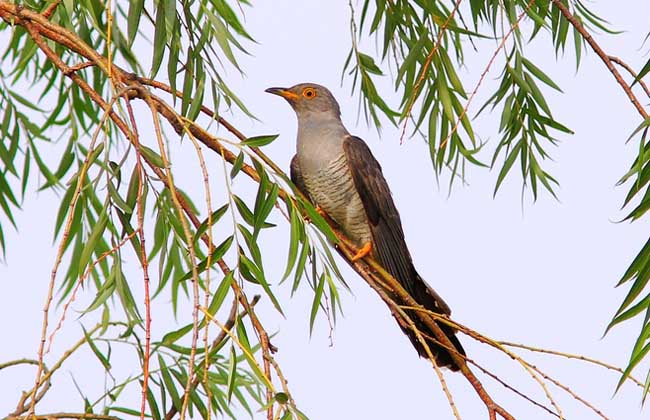
The cuckoo bird usually refers to about 60 arboreal species in the subfamilies Cuculinae and Phaenicophaeinae, also known by the alternative names Duyu, Zigui, Cuigui and others. It is a bird of the genus Cuculus in the family Cuculidae, distributed across temperate and tropical regions worldwide, with especially many tropical species in the Eastern Hemisphere. It inhabits areas with dense vegetation, is timid, and is often heard but not seen. Let us take a look below at what cuckoo birds eat!
What do cuckoo birds eat?
Most cuckoo birds are omnivorous and can help humans eliminate pests. Beetles such as scarab beetles, cabbage maggots, pine loopers and click beetles are all food for the cuckoo, and it is especially fond of eating the pine tree's great enemy——the pine caterpillar. The pine caterpillar is a pest that many birds do not like to eat, yet the cuckoo particularly enjoys its flavor. A single cuckoo can catch and eat more than 100 caterpillars per hour. In addition, the cuckoo also eats other agricultural and forestry pests, so people also call it the “forest guardian”.
The species characteristics of the cuckoo bird
The most well-known characteristic of the cuckoo is brood parasitism, a trait found in all species of the subfamily Cuculinae and in 3 species of the subfamily Phaenicophaeinae, namely laying eggs in the nests of certain bird species and relying on the foster parents to incubate and raise the chicks. The 47 species of the subfamily Cuculinae have different adaptations to increase the survival rate of the chicks, such as the cuckoo's egg resembling the host's egg (mimicry), thereby reducing the chance of the host abandoning it. Adult cuckoos will remove one or more of the host's eggs, so as not to let the host notice the increase in egg number, and also to reduce competition from the host's chicks. The cuckoo chick will push the host's eggs and chicks out of the nest. Some cuckoos resemble the genus Accipiter in appearance and behavior, and the hosts are afraid when they see them, so the cuckoo can approach the host's nest without interference. Therefore many people have given the cuckoo the label of “evil bird”.
Common species of the cuckoo bird
1. Rufous-bellied Cuckoo: The Rufous-bellied Cuckoo is a bird of the genus Cuculus in the family Cuculidae. The top of the head, hindneck, sides of the head, back and the surface of both wings are slate gray. The iris is orange to vermilion, the eye ring is yellow, the upper bill is black at the tip, green at the base and lower bill, and the feet are bright yellow. It is distributed in China's neighboring countries and as far as the Malay Archipelago, north to the former Soviet Union, east to Japan, and in eastern and southern parts of mainland China and other places. It is mostly seen in evergreen forests or dense mountain shrubs. It is alert and timid by nature, often hiding among the branches and leaves of tall trees to call.
2. Indian Cuckoo: The Indian Cuckoo often hides among the trees and is usually not easy to see. Its call is especially loud, four notes at a time, with a sound resembling “quick-quick-cuckoo”. It calls once every 2 to 3 seconds, sometimes without stopping all night. It is omnivorous, pecking at pine caterpillars, scarab beetles and other insects, and also eating plant seeds. It does not build a nest, and lays its eggs in the nests of reed warblers, black drongos and others, with the eggs resembling the host's eggs in appearance. It is found in the eastern coastal areas of China, from the northeast all the way to Hainan Province, and is widely distributed in Southeast Asia abroad.
3. Yellow-billed Cuckoo: The adult Yellow-billed Cuckoo has a body length of 26 to 30 cm and a weight of 55 to 56 g. It has a long tail, brown on top and alternating black and white underneath, with a black curved band tinged with yellow from the lower jaw to the bill. It mainly feeds on insects, especially favoring Lepidoptera larvae such as pine caterpillars, tree butterfly larvae and moths, and sometimes also eats a small amount of plant-based food such as plant seeds.
4. Plaintive Cuckoo: The Plaintive Cuckoo has a body length of 21 to 25 cm, with a laterally flattened and pointed bill. The male bird has a gray head, neck and upper breast, dark gray from the back to the tail, and the tail has white terminal spots. Below the breast it is pale brownish-chestnut, and both the upper and lower body have no horizontal bars. Its call is eight notes at a time. The female bird is overall alternating grayish-black and chestnut. It prefers open woodlands, secondary forests and agricultural areas, including towns and villages. It is often mobbed by small bird flocks, and its call is familiar to the ear, yet the bird itself is hard to see.