What do common moorhens eat? A list of common food types
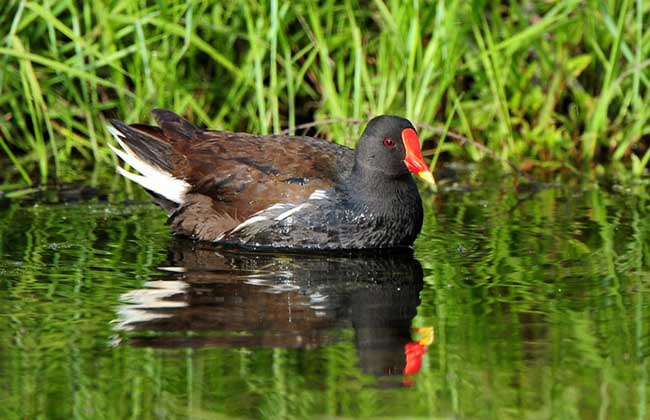
The common moorhen, also known as the moorhen, jiangji, red-knobbed coot and so on, is a bird of the genus Gallinula in the family Rallidae. It inhabits shrub thickets, cattail grass and reed beds, is good at diving, and mostly moves in pairs. When swimming, its body sits high above the water surface, with the tail tilted upward, and the two white patches behind the tail are visible from far away. It is widely distributed across the world except Oceania. Let us take a look below at what the common moorhen eats!
What do common moorhens eat?
The common moorhen mainly eats tender leaves, young shoots and rhizomes of aquatic plants, as well as aquatic insects, worms, spiders, molluscs, snails and insect larvae, among which animal-based food predominates. It is active and forages during the day, mainly swimming along the edges of aquatic plants, carefully searching for and pecking at insects on leaves and stems or insects that have fallen into the water, and sometimes it also wades in shallow water at the water's edge to feed.
The habitat environment of the common moorhen
The common moorhen inhabits freshwater wetlands, swamps, lakes, reservoirs, reed ponds, canals and rice paddies rich in reeds and emergent aquatic plants, and also appears in lakes and marshy areas at forest edges and in roadside canals and open woodlands. It is not tolerant of cold, generally does not live in salt water, likes waters sheltered by trees or emergent plants, and does not like very open places. Its vertical distribution altitude is 400 to 1740 m above sea level.
The living habits of the common moorhen
The common moorhen is partly a summer migrant and partly a resident bird; north of the Yangtze River it is mainly a summer migrant, while south of the Yangtze River it is mostly a resident bird. In spring, it migrates to northern breeding grounds in mid to late April, and in autumn it begins to leave the breeding grounds in early October, continuing until the end of October. It often moves in pairs or small groups, is good at swimming and diving, and when swimming its body floats high above the water surface, with the tail often held vertically upright and wagged frequently. Except in critical situations, it generally does not take flight, especially not over long distances; its flight speed is slow and it does not fly high, often flying close to the water surface, and after flying only a short distance it lands back on the water or in the aquatic grass.
The population status of the common moorhen
The common moorhen has a wide distribution range and is relatively common, and it does not approach the thresholds for the vulnerable endangered criteria for species survival (distribution area or fluctuation range less than 20000 square kilometers, habitat quality, population size, fragmentation of distribution area). Its population trend is stable, so it is evaluated as a species with no survival crisis. However, the common moorhen has been listed in the International Union for Conservation of Nature (IUCN) 2012 Red List of Threatened Species ver 3.1——Least Concern (LC) and in the List of Terrestrial Wildlife with Beneficial or Important Economic and Scientific Research Value under State Protection issued by China's State Forestry Administration on August 1, 2000.