What Do Hippos Eat? A Detailed Look at the Hippo's Feeding Habits
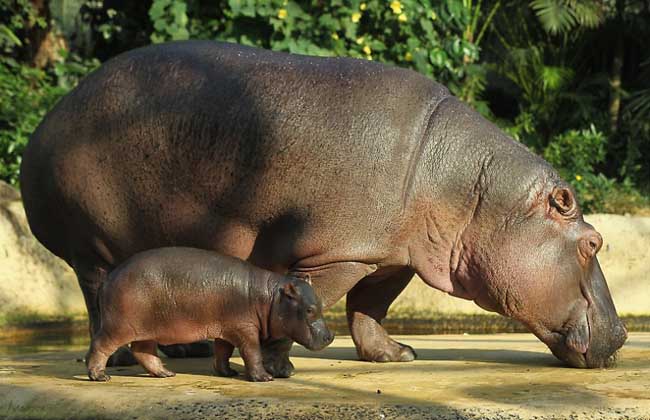
The hippo is the largest extant omnivorous mammal among freshwater species. A typical individual measures 3.3 m in body length and 1.5 m at the shoulder, with an average weight of about 1.35 tonnes, generally between 0.9 and 1.8 tonnes; the largest wild individual weighed as much as 2.66 tonnes. It lives in the tropical regions of Africa where aquatic plants are abundant. Let's take a look below at what hippos eat!
What do hippos eat?
The hippo is a herbivore, but its sparse tusks grow to ten centimeters long. A mother hippo is highly territorial and aggressive when protecting her calf. Hippos move in pairs or small groups, while older males often live alone. They spend almost the entire day sleeping or resting in or near rivers, and come out at night to feed, sometimes swimming more than 30 km downstream in search of food. They feed mainly on aquatic plants and occasionally on land crops, primarily grasses; sometimes they go into fields to eat crops. When food is scarce, they will also actively prey on other herbivorous animals. Their daily food intake is over 80 kg.
The hippo's current population status
The main threats commonly facing hippos are illegal and unrestricted hunting for their meat and teeth, along with habitat loss. Illegal hunting is considered most severe in areas of habitat affected by armed conflict; during more than 8 years of civil unrest and fighting in the Democratic Republic of the Congo, local hippo populations fell by more than 95%. Widespread poaching for meat has also been reported from Burundi and Cote d'Ivoire. In countries with a high proportion of protected areas for common hippo populations, the rate of decline is much lower, so habitat protection should be rewarded and punitive measures established against illegal hunting. The hippo has been listed on the IUCN Red List ver3.1: 2012 Mammalia Red List —— Vulnerable (VU).
The hippo's breeding habits
Female hippos mature at 7 to 9 years of age, and males between 9 and 11 years; their lifespan is about 30 to 40 years. They mate in the water, with no fixed breeding season. The female's gestation period is 210 to 255 days, and she gives birth in the water, producing 1 calf per litter. A newborn calf weighs 40 to 50 kg and can walk and swim within 5 minutes of birth. A mother hippo with a calf becomes very fierce in temperament. After the calf is born, the female carefully tends it, nursing it in the water, allowing it to move only within visible range, patiently teaching it to swim and roll, and protecting it from harm. After 4 to 6 months, the calf can eat grass. The nursing period is about 1 year, and the period of offspring care, usually borne by the female alone, can extend to 18 months.
Hippo subspecies classification
1. Hippopotamus amphibius amphibius: one of the subspecies of the hippo, distributed from Sudan in the Nile Valley, East Africa and West Africa to Gambia and Senegal.
2. East African hippo subspecies: one of the subspecies of the hippo, distributed in Kenya, Lake Naivasha and Somalia.
3. West African hippo subspecies: one of the subspecies of the hippo, distributed in Chad, Niger and Nigeria.
4. South African hippo subspecies: one of the subspecies of the hippo, distributed in Zambia, South Africa, Zimbabwe, Lesotho, Botswana and Eswatini.