What do walruses eat? Understanding walrus diet in one article
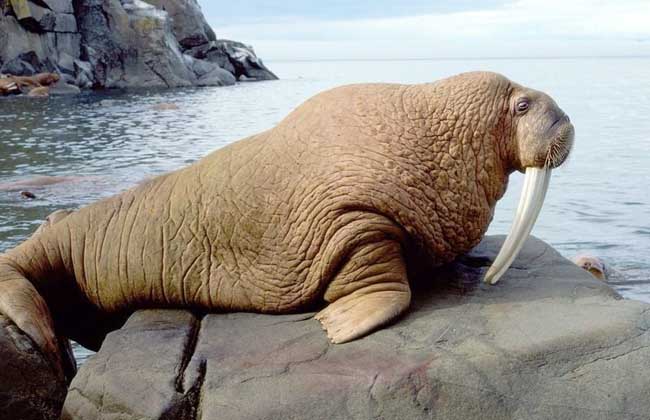
The walrus is essentially an elephant of the sea, a mammal of the genus Odobenus in the family Odobenidae. It has a massive body, thick and heavily wrinkled skin, sparse bristles, small eyes, and poor eyesight, and it grows two long tusks. Unlike the big-headed, big-eared elephants on land with their long trunks and sturdy limbs, its limbs have degenerated into flippers to adapt to life in water. Let us take a look below at what walruses eat!
What do walruses eat?
The walrus has an omnivorous diet, but it does not eat fish. It feeds mainly on bivalve mollusks, and also preys on squid, shrimp, crabs and worms, and sometimes occasionally swallows a small amount of tender aquatic plants and organic sediment from the seabed. The walrus first inserts its tusks into the seabed and swings its head to churn up the mud and sand on the seafloor, using its sensitive and flexible snout and mouth and its whiskers, which can move like antennae, to search for food. It then brings the rough inner surfaces of its forelimbs' palms together to clamp the shell and grind it, while floating up a distance, then releases the palms so that the broken shell and the shellfish meat separate, then dives again and sucks the slower-sinking shellfish meat into its mouth. It is said that it occasionally also preys on seals or narwhals, but not using its powerful tusks as a weapon; instead it holds the other animal with its forelimbs, pins it underwater until it drowns, and then slowly eats it.
The walrus's living habits
The walrus is a gregarious animal, living an amphibious life in the icy seawater and on land ice, with each group ranging from a few dozen or several hundred to tens of thousands. To recover from fatigue after long periods of swimming in the ocean, it spends most of its time on land sleeping and resting. Sometimes it uses its tusks and shorter hind limbs to walk unsteadily, appearing very clumsy and comical. But in seawater, relying on its streamlined body, well-developed muscles and powerful flippers, it moves freely and is very agile, propelling itself with its hind limbs and turning with its forelimbs, reaching a speed of 24 km per hour. It can dive to depths below 70 m and is able to carry out various activities such as feeding, courtship and mating.
The walrus's breeding habits
Each male has numerous females. In the breeding season, they establish their own territories on the beach. The best positions are occupied by the strongest males, while lower-status ones can only find a spot at the end of the beach, and some are forced to lie on the rocks in the sea. The territories have no rocks or other objects as terrain markers, and they expand and contract according to how many females a male possesses. When other males intrude, fierce fights break out, attacking each other with their tusks and powerful necks until a winner is decided, so males are often covered with wounds. Once the breeding group is formed, no major changes occur thereafter. During courtship, males often roll in the water, emitting bursts of strange yet harmonious sounds, very similar to the noisy signal sounds of whales.
The walrus's current population status
The walrus is also particularly sensitive to changes in the marine environment. Due to large-scale exploitation of oil and natural gas, many walrus habitats have been polluted, to the point that they can no longer continue to survive and have become extinct there, and their distribution range has gradually shrunk. As people's demand for walrus ivory continues to rise, the walrus hunting industry has also continued to develop, and hunting tools and methods have been continuously improved and enhanced, dealing a devastating blow to the walrus's living conditions. The population has plummeted sharply, from several million two or three centuries ago to roughly fewer than 70,000.