The Industry 4.0 Forum is co-hosted by Lunghwa University of Science and Technology and Siemens
Lunghwa University of Science and Technology and Siemens co-host the "Industry 4.0 Forum"
Lunghwa University of Science and Technology and Siemens Co., Ltd. jointly hosted the "Industry 4.0 Forum" on May 8, 104 (2015) at the International Conference Hall on the third floor of the Famin Building.
The "Industry 4.0 Forum" invited Executive Yuan Minister Without Portfolio Yen Hong-Sen, Siemens Manager Fan Hsu, Professor Chen Cheng-Hsiung of the Department of Mechanical Engineering at National Chung Hsing University, and Wu Hsiao-San, Chairman of the Chinese Association for Multiple Intelligence Development, to speak on campus about the development of Industry 4.0 and the directions for responding to it. Lunghwa University President Ge Zi-Xiang, along with 55 representatives from industry and teachers from technical and vocational colleges, totalling nearly 200 attendees, were all present at this grand event; the venue was packed with no empty seats and the atmosphere was lively.
"Industry 4.0" was first proposed in Germany in 2011 as the concept of the "Fourth Industrial Revolution," aiming to integrate industry with information technology, merging cloud computing, big data, the Internet of Things, artificial intelligence and other technologies to fully digitize and intelligentize manufacturing. When Germany promoted Industry 4.0, its focus was on cultivating vocational and technical education talent.
In response to the development trend of Industry 4.0, the Industrial Development Bureau of our country's Ministry of Economic Affairs proposed the "Productivity 4.0 Technology Development Plan," strengthening industry-academia cooperation with the Ministry of Science and Technology and jointly conducting Productivity 4.0 talent cultivation with the Ministry of Education. Therefore, Taiwan's Industry 4.0 will integrate industries including machinery, electrical and electronic engineering, information networks, management, and creative design and manufacturing, in order to cultivate interdisciplinary talent.
In his remarks, Lunghwa University of Science and Technology President Ge Zi-Xiang first welcomed the arrival of Executive Yuan Minister Without Portfolio Yen Hong-Sen and the enthusiastic participation of figures from industry and education. He expressed the hope that through horizontal integration and connection among industries, combined with vocational and technical education, interdisciplinary talent would be cultivated starting from the grassroots, so as to create another peak of economic development in the era of Industry 4.0 in the future.
The four scholars and experts who delivered keynote speeches at this "Industry 4.0 Forum" all gave incisive presentations. First, Executive Yuan Minister Without Portfolio Yen Hong-Sen, speaking on the topic "Science and Technology Policy and Productivity 4.0," first explained the blueprint for the nation's overall science and technology policy planning, stating that the Taiwan version of Industry 4.0 is the Productivity 4.0 that the government is promoting, and that the people should feel the development and implementation of future science and technology policy. At the same time, Minister Without Portfolio Yen also pointed out that the future decline of Taiwan's population is a turning point rather than a crisis, allowing everyone to consider how Taiwan should develop into a small but beautiful technological nation in the future.
Next to take the stage was Siemens Manager Fan Hsu, who shared Siemens' experience in promoting Industry 4.0, emphasizing that Industry 4.0 requires adjustments to be incorporated from design conception to after-sales service in order to strengthen corporate competitiveness.
Then, Professor Chen Cheng-Hsiung of National Chung Hsing University gave a complete exposition of how "intelligent multi-axis compound machining technology" can be transformed into smart factories under the Industry 4.0 trend, and concluded that the future development trend of factories will be digitalization and intelligentization.
Finally, Chairman Wu Hsiao-San of the Taiwan Association for Multiple Intelligence Development explained that the focus for universities of science and technology facing Industry 4.0 lies in know why; only through multiple integration and systems thinking, and by possessing competitive synergy to strengthen one's own capabilities, can difficulties be overcome. Chairman Wu particularly praised Lunghwa University of Science and Technology's order-based employment programs, which through cooperation between academia and industry cultivate relevant talent, not only narrowing the gap between learning and application but also solving employment problems; their achievements are admirable.
Under the wave of Industry 4.0, Lunghwa University of Science and Technology is also well prepared. The university has established partner industry technology R&D centers with heavyweight manufacturing companies to jointly develop forward-looking technologies, including the "Siemens CNC Machining Technology Center," specializing in promoting controller teaching and Industry 4.0 research; the "Global Transmission - Lunghwa University R&D Center," developing 3D printing technology; the Tung Tai Machining Technology and Application Center, developing five-axis machining technology; and the "Lei Li Qiang Optoelectronics - Lunghwa R&D Center," delving into atmospheric-pressure plasma technology. It also plans to launch an interdisciplinary Industry 4.0 program starting in the 104 (2015) academic year, which will include an Internet of Things program, a big data program, an embedded systems program, and an intelligent robotics program, allowing students to connect with emerging technologies in industry, while also training seed teachers, expanding industry-academia alliances, and jointly stepping into Productivity 4.0.
Lunghwa University of Science and Technology's pragmatic approach to running the school over many years has won widespread recognition. It has received awards and subsidies from the Ministry of Education's Teaching Excellence Program for eleven consecutive years, making it the private university of science and technology north of Taichung to receive the most awards and subsidies; it has also received subsidies from the Model University of Science and Technology Program for three consecutive years, making it the only private university of science and technology north of Taichung to be selected.
Lunghwa University of Science and Technology also actively cultivates students' practical skills and continues to promote cooperative education, signing "order-based employment programs" with 104 enterprises, offering 57 related programs with as many as 1,500 participating students. Through off-campus internships and the mentor system, it strengthens the effectiveness of students' internships at enterprises, simultaneously solving the problems of student employment and corporate talent demand. Through cooperation with industry, Lunghwa University of Science and Technology strives to enhance the development of Taiwan's vocational and technical education, in order to cultivate a new generation of liberal-arts technological talent with no gap between academia and industry.
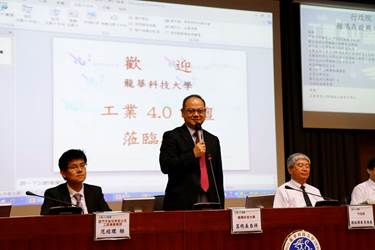
▲Lunghwa University of Science and Technology and Siemens co-host the "Industry 4.0 Forum"