How Rural Communities Can Build a High-Quality "Living, Production and Ecology" Industry
Building a High-Quality "Living, Production and Ecology" Industry in Rural Communities
Premier Mao Visits Gongrong Community in Sanzhi District, New Taipei City, to Promote the "Rural Regeneration Journey"
Showing concern for rural regeneration development, Premier Mao Zhiguo said on the 16th while visiting Gongrong Community in Sanzhi District, New Taipei City, to observe the promotion of the "Rural Regeneration Journey" that Gongrong Community is the first community in New Taipei City to pass a rural regeneration plan. By transforming the community's industry, improving quality of life, and rebuilding the ecological environment, it has achieved overall community development and is a model that makes Taiwan proud. He hoped to see more similar cases in the future, allowing community residents to express care for the land while regaining confidence in agriculture.
Premier Mao Zhiguo pointed out that for Taiwan's agriculture to transform, it needs local people to start bit by bit. Once results are achieved, they will gradually spread and move the local community, encouraging more community members to participate and creating a virtuous cycle. Community teacher Lin Yifeng is the soul figure behind Gongrong Community's transformation. The community began engaging with related plans for a prosperous rural village in Year 94 of the Republic of China and passed a rural regeneration plan in Year 100. Under Teacher Lin's leadership, over ten years, step by step, Gongrong Community has become a rural transformation case that makes Taiwan proud.
Premier Mao Zhiguo emphasized that Sanzhi District has potential for agricultural development, and in the process of rural transformation, support from the local government and local people is needed. After Teacher Lin applied to the Council of Agriculture for a rural regeneration plan, the Council of Agriculture assisted by introducing relevant resources, research manpower, and experts. Premier Mao affirmed Teacher Lin's dedication. In addition to making good use of the natural water resources of Datun Mountain, he also reused wastewater for domestic water use. In a very natural way, from filtration and water quality control to agricultural irrigation, it became a reusable water resource.
During this trip, Premier Mao Zhiguo also walked into the rice paddies, experienced farmers' field teaching, listened to community teacher Lin Yifeng explain the restoration of wetlands and fallow land, and learned on site about the "simple rural sewage purification pond." At the same time, he visited the local farmers' market and purchased agricultural products, echoing the community's advocacy of the concepts of "natural farming and local consumption." Finally, Premier Mao listened to community farmers' journeys in farming and exchanged views with volunteers. The atmosphere was harmonious and warm.
The Council of Agriculture stated that Gongrong Community began participating in "root education" in Year 94 of the Republic of China, proposed a rural regeneration plan in Year 99, and in Year 100 became the first approved rural regeneration community in New Taipei City. As of April, Year 104 of the Republic of China, Gongrong Community had a total of 152 households, including 215 men and 176 women, totaling 391 people. Most were descendants of Hakka immigrants from Tingzhou, Fujian, who came to cultivate the land in the early Qing Dynasty, and their descendants have lived there for generations. Through actions such as root education, farmers' markets, farmers' schools, and land purification, the community has built a high-quality "living, production and ecology" industry in the rural community.
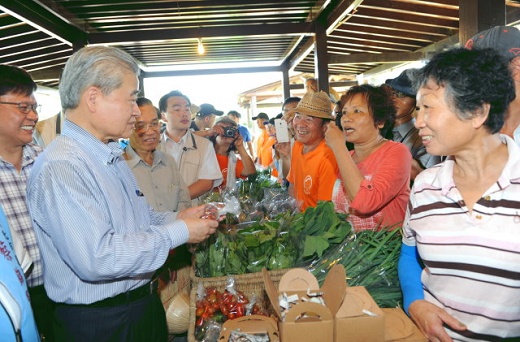
▲Building a High-Quality "Living, Production and Ecology" Industry in Rural Communities
▲Building a High-Quality "Living, Production and Ecology" Industry in Rural Communities