A Detailed Guide to Meat Donkey Farming Technology: Master Scientific Feeding and Management Methods
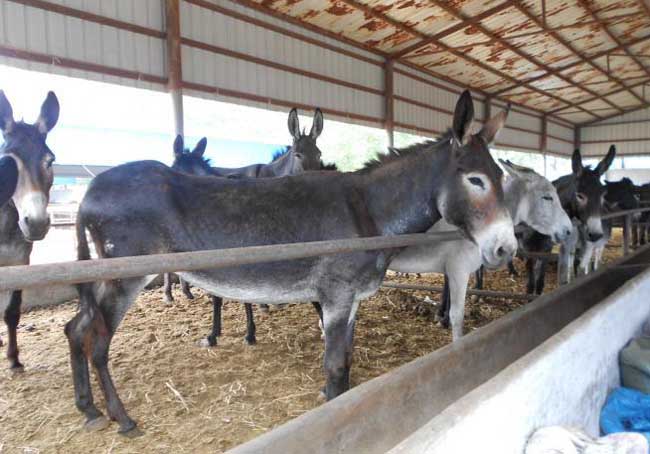
Donkeys have a gentle temperament, strong endurance, a long lifespan, and a small feed intake, and they combine the three major functions of medicine, tonic, and food in one. There are about 40 million donkeys worldwide, 47% of which are distributed in Asia. China is the country that raises the most donkeys in the world, with an annual inventory of about 10 million head. Fresh donkey meat is dark red; donkey meat has a high protein content, a lower fat content than other livestock meats, a mineral content of about 1.1%, and a relatively low cholesterol content, and it is used as a delicious dish on the dining table and for leisure because of its mild taste, deliciousness, and unique flavor.
Construction of the Farming Site
A meat donkey farming site generally includes 3-4 functional areas, namely the living area, the management area, the production area, and the manure, urine, and sewage treatment and diseased animal management area. The specific layout follows the principles below:
1. Living area: refers to the cultural and residential area for workers. It should be located upwind of the farm and on higher ground, and should maintain a distance of more than 100 m from the production area to ensure a good sanitary environment in the living area.
2. Management area: includes buildings related to business management and product processing and sales. The management area must be strictly separated from the production area, ensuring a distance of more than 50 m. Outsiders may only move about in the management area, and off-farm transport vehicles and livestock are strictly prohibited from entering the production area.
3. Production area: should be set up in a more downwind position of the farm area, and it must be able to control off-farm personnel and vehicles so that they cannot directly enter the production area, ensuring the greatest safety and quiet. A gatehouse reception room, disinfection room, changing room, and vehicle disinfection pool should be set up at the main entrance. Non-production personnel are strictly prohibited from entering and leaving the farm, and personnel and vehicles entering and leaving must undergo strict disinfection through the disinfection room or disinfection pool. The meat donkey sheds in the production area should be rationally laid out, with feeding by stage and by group. An appropriate distance should be maintained between the cattle sheds, and the layout should be neat, so as to facilitate epidemic prevention and fire prevention. However, they should also be appropriately concentrated to save water, electricity, lines, and pipelines, shorten the transport distance of forage, feed, and manure, and facilitate scientific management. The roughage warehouse is set up at the downwind, higher ground of the production area, maintaining a fire prevention distance of 60 m from other buildings. It should also take into account the two links of transport in from outside the farm and then transport to the donkey sheds. The feed warehouse, hay shed, processing workshop, and silage pit should be closer to the cattle sheds and located moderately, so as to facilitate vehicle transport of forage and reduce labor intensity. However, it must be prevented that sewage from the donkey sheds and exercise yards seeps in and contaminates the forage.
4. Manure, urine, and sewage treatment and diseased animal management area: set up downwind of the production area and on lower ground, maintaining a sanitary separation distance of 300 m from the production area. The diseased donkey area should facilitate isolation, have a separate passage, and facilitate disinfection and waste treatment. Burial wells or incinerators should be more than 300-500 m from the animal sheds. Prevent sewage, manure, urine, and waste from spreading and polluting the environment.
Meat Donkey Fattening Technology
Donkeys are herbivorous animals with strong disease resistance, are easy to raise, easy to manage, and reproduce quickly. They can be raised by grazing or in pens, and the investment is small, making them very suitable for farmers to raise on a small scale. After short-term fattening in winter, the body weight of young donkeys can reach 200——400 kg, and the body weight of adult donkeys can reach 320-400 kg. According to estimates based on current market conditions, raising one donkey can yield a profit of 600-1000 yuan.
1. Selection of fattening donkeys
Guanzhong donkeys and Dezhou donkeys are preferred. Guanzhong donkeys are mainly produced in the Guanzhong Plain area of Shaanxi Province, and after fattening their body weight can reach 250-290 kg; Dezhou donkeys are mainly produced in Dezhou City, Shandong Province, and after fattening their body weight can reach about 325 kg.
2. Deworming and stomach strengthening
Deworming and stomach strengthening can be carried out 3-5 days after the donkeys are stabilized in the pen. Use Chongkexing to expel internal parasites from donkeys. The oral dosage of its powder is 0.1-.02 g per kg of body weight, and the dosage for subcutaneous injection is 0.65 mL per kg of body weight. Stomach strengthening is usually carried out 3 days after deworming, giving each donkey 60-100 g of artificial salt orally or 450 g of Jianwei San orally.
3. Fattening and feeding of young donkeys
For young donkeys purchased from other places, training should be strengthened so that they gradually adapt to local feeding conditions. At first, corn, wheat, and other grains can be ground into powder, boiled into porridge, and a little sugar added to entice them to eat. After several days, in addition to normal grass feeding, feed 80-100 g of concentrate per day, and then gradually increase it. During the entire fattening period of young donkeys, about 480 kg of concentrate is needed in total.
4. Fattening and feeding of adult donkeys
For adult donkeys purchased from other places, first feed some green grass, bran, and other easily digestible feed, and feed less but more frequently, with each feeding to about 60-70% full, and only enter the fattening period after their grass consumption becomes normal. The mixed roughage during the fattening period is mainly high-quality hay, soybean stalk powder, and corn stalk powder, and the mixed concentrate is generally 50% soybean cake, 30% cornmeal, and 20% bran. Fattening donkeys can be fed concentrate twice during the day, and only roughage is given at night, with each feeding to about 80% full. After about two months, they can be slaughtered and sold. The concentrate and roughage used for fattening adult donkeys should be selected according to local natural resources and market conditions. For example, roughage can use cottonseed hulls, soybean stalk powder, corn stalk powder, etc., and concentrate can use peanut cake, soybean cake, cooked sorghum or soybean powder, etc. During the fattening period, the amount of exercise of the donkeys should be restricted, and the pens and environment should be kept clean and dry.
Meat Donkey Farming Techniques
1. Pens: For intensive meat donkey fattening, pen and stable raising is preferable. An ordinary pen and stable only needs to keep out rain from above and block wind from below. Feeding troughs for supplying food should be set up inside the pen, and each donkey should be allotted 60-80 cm of feeding space. Between adult donkeys, according to the distance of the feeding spaces, sturdy fences should be set up as barriers to prevent them from disturbing each other (this is even more important in pens and stables where males and females are mixed).