A Detailed Guide to Kingsnake Breeding Techniques and Methods
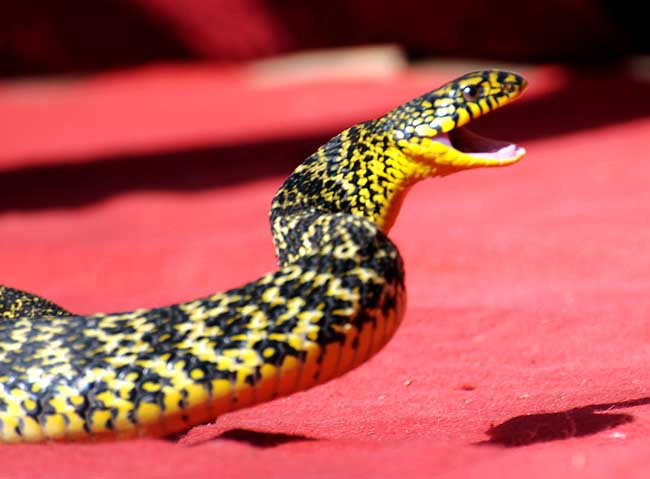
The kingsnake, scientifically named Elaphe carinata, is a large, non-venomous snake commonly found in temperate zones, relying on its strong body and powerful constriction to subdue prey. It gets its name from the king-like pattern on its head. The snake is large-bodied and offers many advantages such as cold tolerance, strong adaptability, fast growth, a short rearing cycle, and ease of keeping and hatching. Many snake farms or snake breeders, especially in the northern provinces and regions, mostly use it as their non-venomous snake breeding target. Below, the editor will share the breeding techniques for the kingsnake with everyone!
The Living Habits of the Kingsnake
The kingsnake has a broad diet, feeding on frogs, birds, rodents, and various bird eggs. When food is scarce, it will even swallow its own young or members of its own species. Because the kingsnake has the habit of eating snakes, in some places it is called the "king snake" for this reason. Although the kingsnake does not specialize in eating snakes the way the king cobra does, attention must be paid during rearing to timely separation and housing, so as to avoid the tragedy of large snakes eating small kingsnakes. In our daily management, we need to pay attention to their food, promptly adding food for the kingsnake to ensure sufficient and varied prey. This is also the main reason why artificially bred Elaphe carinata must be kept alone and cannot be mixed with other non-venomous snakes.
Snake teeth generally grow on the maxilla, palatine bone, and the dentary of the mandible; in lower snakes, teeth are also present on the premaxilla. They are generally conical in shape and serve to help grip food. Non-venomous snakes grow two or four rows of sharp, slender, solid teeth. After biting food, they can hook and hold it, and by coordinating with the rotation of the mandible, send the food toward the pharynx. All snakes lack the ability to chew and instead swallow directly. In addition to solid teeth, venomous snakes have one or several pairs of enlarged tubular or grooved fangs at the front or rear end of the maxilla. When preying, these snakes inject venom into the wound of the bitten object and slowly swallow it after the object dies from the venom.
Except for the lower burrowing snakes, most snakes possess the ability to swallow food several times larger than their own diameter or four to five times larger than their head. For example, pythons can swallow an entire piglet, lamb, or calf. This is because the snake's mandible relies on a movable quadrate bone, and the left and right mandibles are connected at the chin by ligaments. Therefore, a snake's mouth can not only open extremely wide vertically, reaching 130 degrees (a human mouth can only open 30 degrees), but can also expand the mandibles to the left and right separately. This is a special function that many other animals do not have.
Breeding Density of the Kingsnake
Appropriate rearing density is beneficial to the growth of Elaphe carinata. Newly hatched young snakes are relatively small, with a body length between 25 and 35 cm, and have poor mobility. At this time, the rearing density can be somewhat higher, with 80 to 100 snakes per square meter of snake house. After 15 days of rearing, remove 1/5 of the total number of young snakes and appropriately reduce the density to 60 to 80 snakes. After the young snakes shed their skin three times, the density can be reduced to about 45 to 55 snakes per square meter. When the young snakes grow to about 50 g, the rearing density can be further reduced to 10 snakes per square meter. For some snakes that grow very quickly, when they reach about 800 g in weight, about 5 snakes per square meter is appropriate. Under three-dimensional rearing conditions, the rearing density can be greatly increased; for example, young snakes weighing 500 g are appropriately kept at about 20 snakes per square meter.
Another point to note is that although Elaphe carinata is a non-venomous snake, it has a fierce temperament and strong combativeness and aggression. It dares to compete for food with venomous snakes such as the five-paced pit viper and the cobra. More importantly, it has the habit of cannibalizing members of its own species or other snakes. Therefore, Elaphe carinata can only be kept alone and cannot be mixed with other non-venomous snakes in the same facility. Never mix several species of snakes together simply to increase rearing density; that is not advisable.
In short, the rearing density of Elaphe carinata should be determined according to the keeper's management experience, the farm environment, and the supply of prey. Under the premise that all conditions can be met, the density can be increased somewhat to improve space utilization; if conditions are not yet suitable, the density must be lowered to prevent the tragedy of large snakes eating small snakes and strong snakes eating weak snakes, reducing breeding losses as much as possible through management measures.
III. Daily Management of Kingsnake Breeding
1. Temperature Control
This is very important for Elaphe carinata. In late autumn and early winter each year, when the outside temperature drops to around 10°C, Elaphe carinata enters hibernation. During hibernation, the temperature in the den should be kept at 5 to 10°C, with a deviation of no more than 2°C. If the temperature is too high, reaching above 10°C, it will increase the energy consumption of the snake's body, which is unfavorable for the snake's hibernation and its emergence from dormancy the following spring; if the temperature is too low, such as remaining below 3°C for a long time, snakes often freeze to death. Therefore, the focus of temperature management is to do a good job of temperature control during the hibernation period.
Because young snakes have relatively weak constitutions and are very sensitive to changes in the external environment, temperature control for the care of young snakes also requires particular attention. In general, the suitable temperature required by young snakes is basically similar to that of adult snakes, but young snakes have somewhat higher temperature requirements. After snake eggs hatch over 40 to 50 days, the young snakes emerge from their shells. This period is exactly August to September, when the surrounding natural environment temperature is 23 to 28°C, which can basically meet their requirements for living and growing. If the temperature inside the snake house is below 20°C for 3 consecutive days, warming or heating measures should be taken promptly; on the contrary, if the temperature is above 35°C or above 32°C for 3 consecutive days, shading or cooling measures should be taken.