Detailed Explanation of Cherry Planting Techniques and Management Methods
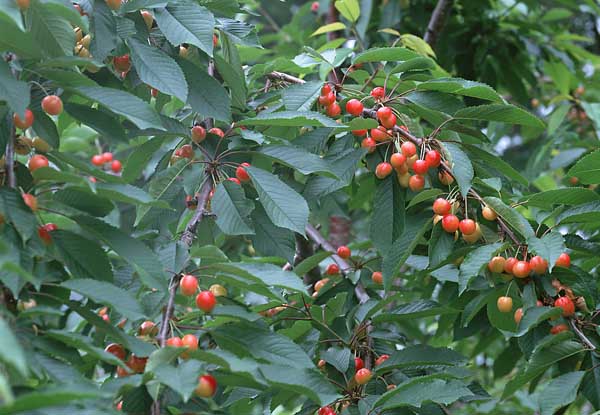
Cherries began to be planted in China in the 1990s, mainly distributed in Shandong, with small amounts also grown in Beijing, Liaoning, Shanxi and other central provinces. Qingdao's climate is particularly suitable for cherry growth, making it one of the earliest cherry-ripening regions in China, with a planting area of more than 60,000 mu, of which 70% of the cherries are large cherry varieties introduced from Europe. The United States leads the world in cherry production, with more than 70% of American cherries coming from the northwest.
Growing Environment for Cherries
Chinese cherries have weak cold resistance and prefer a warm and moist climate, suitable for cultivation in areas with an annual average temperature of 15-16°C. Sweet cherries prefer cool and dry conditions. The natural dormancy period of cherries is about 80-100 days. The chilling requirement for sweet cherries to complete dormancy is 1100-1300 hours below 7.2°C. Sour cherries require 1200-2500 hours. The dormancy period of Chinese cherries is relatively short, and they tend to sprout when temperatures warm up in late winter and early spring. If a "late spring cold" (frost or snow) occurs, the flower organs will be frozen, which can seriously affect yield, or even result in complete crop failure. Therefore, when developing orchards, attention must be paid to whether the timing of local low-temperature cold waves each spring coincides with the flowering period. Locations where adverse weather (frost, snow, strong winds) occurs during the cherry flowering period year after year should not be planted. Even in places where disastrous weather rarely occurs, suitable micro-topography should be selected when establishing an orchard.
The suitable annual rainfall for cherry growth is generally 700-1000 mm. In some southern regions, how to solve the "spring drought" problem should be fully considered when establishing an orchard. This is because drought in the early stage of fruit growth can cause serious fruit drop and affect fruit growth and development.
Cherries are a light-loving tree species. Chinese cherries are relatively shade-tolerant, but with good lighting, the fruit ripening period is early and the coloring is good.
Cherries are suitable for cultivation in fertile, loose sandy soil with deep soil layers. The soil pH is generally 6.0-7.5.
The vertical distribution of Chinese cherry roots is generally concentrated in the soil layer about 20 cm deep. Loose soil quality and good drainage and irrigation conditions are required. Heavy clay soil is not suitable for growing cherries. Since cherries do not tolerate transportation well, orchards should be established in locations with convenient transportation.
Planting density should vary according to variety, rootstock and soil conditions. On fertile flat land, Chinese cherries can be trained in a Y-shape with close planting at 1×3 m, planting 220 trees per mu. If natural clump shape or natural open-center shape is used, spacing can be 2-3 m × 3-4 m. In the juvenile period, density can be appropriately increased, and after the orchard is established, thinning measures can be taken.
Planting time is generally divided into two periods: autumn and spring. In areas with cold, dry and windy winters, spring planting is preferable, and spring planting should be done before the seedlings bud. In warm winter areas, autumn planting can be done. Before planting, deep plowing and soil maturation should be carried out, and large planting holes should be dug. Apply 25-50 kg of organic fertilizer per hole. After mixing the fertilizer evenly with the soil, plant the seedlings and immediately water them to settle the roots.
Cherry Planting Conditions
1. Temperature
Cherry is a deciduous fruit tree that prefers warmth and is not cold-tolerant. Chinese cherries originated in the Yangtze River Basin of China and are adapted to warm and humid climates with weak cold resistance, so they are more commonly cultivated in the Yangtze River Basin and areas of northern China with relatively warm microclimates. Sweet cherries and sour cherries originated in West Asia and Europe and are adapted to relatively cool and dry climates, making them more suitable for cultivation in North China, Northwest China and southern Northeast China. However, high temperatures and dryness in summer are unfavorable for sweet cherry growth. The minimum winter temperature should not be lower than -20°C; excessively low temperatures can cause longitudinal cracking of large branches and gummosis. In addition, flower buds are susceptible to frost damage. If the temperature drops below -3°C during the flowering period, the flowers will suffer frost damage, so when developing cherries, excessively cold areas should be avoided.
2. Water
Cherries are very sensitive to water conditions, being neither drought-resistant nor waterlogging-tolerant. In the cultivation areas of Chinese cherries, except for southern provinces with abundant rainfall, the north mostly chooses hillside and valley areas with relatively humid microclimates for cultivation. Looking at the distribution areas of sweet cherry cultivation around the world, most are chosen near water systems or coastal areas. The main cultivation areas of sweet cherries in China are currently mostly distributed in Shandong Yantai and Liaoning Dalian around the Bohai Bay. These two places are close to the sea, with annual rainfall of 600-900 mm and relatively humid air. However, this does not limit the cultivation of sweet cherries in areas with low rainfall. For example, in the sweet cherry production areas of Washington State in the United States, Yakima and Wenatchee have annual rainfall not exceeding 250 mm and growing season rainfall not exceeding 150 mm. The sweet cherry production areas of Ukraine are mainly distributed in summer drought areas along the Black Sea coast, with annual rainfall not exceeding 300 mm and little rainfall from July to September. However, these areas have suitable temperatures, sufficient sunlight and good irrigation conditions, so sweet cherries grow well with high quality and high yield. Like other stone fruits, cherries require relatively high oxygen in the root system. If there is too much soil moisture and insufficient oxygen, it will affect the normal respiration of the root system, and the tree cannot grow and develop normally, causing root rot and gummosis, and in severe cases leading to tree death. If there is heavy rain and drainage is not timely, and the cherry tree is submerged in water for 2 days, the leaves will wilt but not fall off. If the leaf wilting cannot recover, it may even cause the whole tree to die.
3. Light
Cherries are a light-loving tree species, especially sweet cherries, followed by sour cherries and downy cherries, while Chinese cherries are relatively shade-tolerant. When light conditions are good, the tree is robust, the lifespan of fruiting branches is long, flower buds are plump, fruit set rate is high, fruit ripens early, coloring is good, sugar content is high and acidity is low. When light conditions are poor, the tree tends to grow excessively, branches inside the canopy weaken, the lifespan of fruiting branches is short, fruiting positions shift outward, flower bud development is poor, fruit set rate is low, fruit coloring is poor, ripening is delayed and quality is poor. Therefore, when establishing an orchard, sunny slopes or semi-sunny slopes should be selected, planting density should not be too high, branch angles should be opened up, and light conditions inside the canopy should be ensured to achieve ventilation and light penetration.