A Detailed Guide to Pomegranate Cultivation Techniques and Management Methods
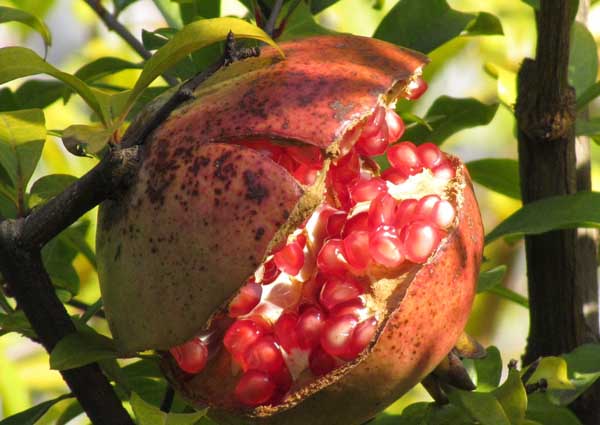
The history of pomegranate cultivation in China can be traced back to the Han Dynasty; according to Lu Gong's records, it was introduced from the Western Regions by Zhang Qian. It is cultivated in both northern and southern China, with larger planting areas in Jiangsu, Henan and other places, where some superior varieties have been developed. In traditional Chinese culture, the pomegranate is regarded as an auspicious symbol, seen as a sign of many offspring and abundant blessings.
The Growing Environment of Pomegranates
Pomegranates grow on mountains at an altitude of 300-1000 m. They prefer a warm, sunny environment and are drought-tolerant, cold-tolerant and tolerant of poor soil, but not tolerant of waterlogging or shade. They are not demanding about soil, but sandy loam with good drainage is best for cultivation.
Main Uses of Pomegranates
Pomegranates are valued both for their flowers and their fruit, and the fruit is edible. Small potted flowering pomegranates can be used to arrange groups of potted flowers or for indoor display, while large fruiting pomegranates can be planted in big pots as three-dimensional displays or as background material in floral decorations. Flowering pomegranates like light and tolerate drought, making them suitable flowers for balconies and rooftops. Old pomegranate trunks can be made into elegant stump bonsai. Pomegranates planted in the ground are suitable for planting in front of steps, in courtyards, beside pavilions and in wall corners.
Pomegranates have strong resistance to sulfur dioxide; each kilogram of dry leaves can purify 6.33 grams of sulfur dioxide without the leaves being harmed. They also have a certain resistance to chlorine gas. They are suitable for planting in factories with pollution sources and in arid zones.
Propagation Methods of Pomegranates
There are many propagation methods for pomegranates: seedling propagation, division, layering, grafting and cuttings are all possible, but cuttings are the most widely used.
1. Propagation by Cuttings
In the main pomegranate-producing areas, cuttings are the primary propagation method; hardwood cuttings can be taken in winter and spring, and softwood cuttings in summer and autumn.
① Selection of mother plants and cuttings: Mother plants should be pure in variety, vigorous in growth and healthy plants under 20 years old. Cuttings should be selected from vigorous branches at the top of the canopy and on the sunny side. For hardwood cuttings, 2-year-old branches are best; 1-year-old branches are too tender, grow poorly and bear fruit late. For softwood cuttings, choose well-developed, semi-lignified branches of the current year.
② Cutting time: Although cuttings can be taken in all four seasons, each region should combine this with its own actual conditions to ensure suitable temperature and moisture at the time of cutting. In the north, this is mostly done in spring and autumn, using lignified 1—2-year-old hardwood. South of the Yangtze River basin, in addition to hardwood cuttings, current-year branches are also used for softwood cuttings during the plum rain season or in early autumn.
③ Cutting methods: There are two types, long cuttings and short cuttings. In arid areas of the north and for direct planting in gardens, long cuttings are used. The cuttings are about 100 cm long. Linqiang County in Shaanxi Province uses the method of digging trenches 50-70 cm long and 30-50 cm deep, inserting 2—3 cuttings per hole. Deep insertion is required, with about 2/3 to 3/4 of the cutting going into the soil, then firming the soil. For large-scale seedling cultivation, short cuttings are mostly used. Hardwood cuttings are 15-20 cm long; softwood cuttings are 4—5 cm long and retain several small leaves at the top. For softwood cuttings, special attention must be paid to shading and moisture retention, with the temperature controlled between 18-33°C and humidity kept at about 90%. No matter which cutting method is used, the upper cut of the cutting should be flat, and the lower cut should be trimmed into a horse-ear shape. To ensure the survival rate when taking cuttings, it is essential to cut and insert them immediately. To promote early healing and rooting of the cuttings, growth hormones can also be used before insertion.
2. Propagation by Division
Pomegranates have strong root-suckering ability. In early spring when the buds are just beginning to sprout, vigorous root-sucker seedlings can be selected, dug up, divided and planted out. The method is simple and survival is easy.
3. Propagation by Layering
This can be done in spring and autumn. Before the buds sprout, root suckers are bent into the soil; after rooting through the summer, they are cut from the mother plant and can become seedlings in autumn. However, transplanting the following spring generally makes survival easier. Mound layering can also be used, which can produce more new plants.
4. Propagation by Grafting
The cut-grafting method is commonly used, mostly with 3—4-year-old sour pomegranate as the rootstock; this method is commonly used in Dongting Mountain, Wu County, Jiangsu Province. In spring when the buds are about to sprout, scions 10 cm long are taken from superior mother plants and grafted 10-15 cm from the base of the rootstock; after cut-grafting, about 5-6 years of cultivation are needed.
5. Propagation by Sowing
This is generally used when breeding new varieties or propagating dwarf flowering pomegranates in large quantities. Sowing can be done in winter or spring, mostly by dibbling or drilling. Winter sowing avoids the need to store seeds, but the seedbed must be covered to overwinter. If spring-sown seeds have already been stored in river sand over winter, they can be sown directly into the seedling plot. Dry-stored seeds should be soaked before sowing in warm water (one part boiling water to one part cold water) for 12 hours, or in cold water for 24 hours, and sown after the seeds have absorbed water and swollen. After sowing, cover with soil to a depth 3 times that of the seed, and seedlings will emerge in about half a month. As for tissue culture of pomegranates, it is a fast, good and economical shortcut, but it is still at the exploratory stage.
Cultivation Techniques of Pomegranates
Pomegranate cultivation mainly includes garden cultivation, fruit tree cultivation, bonsai and pot cultivation, and other methods.
1. Open-field Garden Cultivation
For open-field garden cultivation, choose a site with sufficient light and good drainage. They can be planted as specimens or in groups at the corner of a lawn. If planted at the outer edge of a bamboo grove or on the sunny side not far from a tree cluster, then when the new buds first open or the pomegranate flowers are in full bloom, the red flowers and green leaves set each other off beautifully, presenting a harmonious beauty of color. Dwarf flowering pomegranates can be used as hedges; in summer when the pomegranate flowers bloom profusely, they are especially elegant; if used to complement rockery, they are even more appropriate.