What lychee varieties are there? A complete guide to common varieties
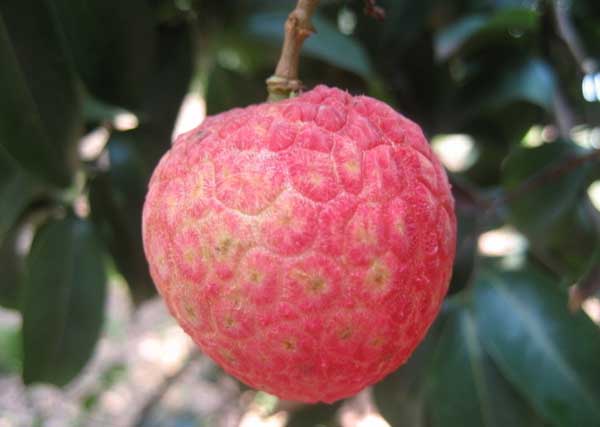
There are many lychee varieties in China. According to a survey in the early years after liberation: Guangdong had 82 varieties; Fujian had 41 varieties; the varieties in Guangxi, Sichuan, Yunnan, Guizhou, Taiwan, China and other provinces (regions) have no reliable statistics yet. Among them, Guiwei and Nuomici are excellent varieties and are also the choice for fresh eating; Guawei is an even more precious and hard-to-find variety. "Luogang Guiwei", "Bicun Nuomici" and "Zengcheng Guawei" are known as the "Three Heroes of Lychee". Huiyang Zhenlong Guiwei and Nuomici are even more delicious and sweet.
The following are the main common varieties:
1. Sanyuehong
Because it matures in late March of the lunar calendar, it is named Sanyuehong. It belongs to the earliest-maturing type. It is mainly produced in Xinhui, Zhongshan, Zengcheng in Guangdong, and Lingshan and other counties in Guangxi. The fruit is heart-shaped, wide at the top and pointed at the bottom; the are of unequal size and irregularly arranged; the suture line is not very obvious; the skin is thick and light red; the flesh is yellow-white, slightly tough, with a coarse texture, large stone, and a sour-sweet taste, leaving some residue after eating. Because it comes to market early, it is still welcomed by consumers.
2. Yuanzhi
Yuanzhi is also called Shuidong or Shuidong Heiye. It is distributed in the suburbs of Guangzhou and the counties of the Pearl River Delta. It is named because it is suitable for planting in areas with plenty of water and its leaves are long and pointed, similar to Heiye but thinner. The fruit is short oval, or lopsided heart-shaped, with one shoulder high and the other low; the are slightly flat and wide, and should be deep red; the flesh is soft, smooth and juicy, sweet with sourness, and slightly fragrant. It matures in late May or early June.
3. Heiye
The fruit is short oval, with a rounded or blunt top, and the fruit base is flat; the skin is dark red, the shell is relatively thin, the are flat and blunt, uniform in size and regularly arranged, and the cracks and suture line are obvious; the flesh is firm, crisp, sweet, fragrant and juicy, and most have large stones. It matures in mid-June. It is relatively resistant to storage.
4. Huaizhi
Huaizhi is also called Miye, Fenghua, Gufeng, Huaizhi (it is said that in ancient times a minister passed through Lingnan and put the lychees given by the villagers into his bosom, hence the name), and Huaizhi. It is the most widely cultivated and highest-yielding variety in Guangdong. It is suitable for both fresh eating and drying. The fruit is spherical or nearly round, with a flat stem end; the shell is thick and tough, dark red, with large that are slightly raised or nearly flat and irregularly arranged, occasionally with sharp spines near the stem end, dense but few; the flesh is milky white, soft, clear and juicy, sweet with sourness, and the stone is large and long, occasionally small. It matures in early July.
5. Guiwei
Guiwei is also called Guizhi, named because it contains the fragrance of osmanthus. It is one of the finest varieties, and the best is produced in the suburbs of Guangzhou and Lingshan County in Guangxi. Guiwei has two strains: Quanhong and Yatoulu. The fruit is spherical, the shell is light red, thin and crisp; the are raised, small and pointed, and there is a relatively deep circular groove on both sides from the stem shoulder around the top of the fruit; these two are the characteristics of Guiwei; toward yellow-white, soft and full, with a small stone, the taste is very sweet, and it matures in early July.
6. Nuomici
Nuomici is also called Mizhi, and is the most valuable variety in Guangdong. It is a famous Guangdong specialty fruit both at home and abroad. It is mainly produced in Luogang District in the suburbs of Guangzhou and Xintang Town in Zengcheng City, followed by Conghua, Dongfan and other counties. The fruit is heart-shaped or nearly round, and the crooked fruit stalk is a varietal characteristic; when first marketed it is yellow-waxy in color, and at peak season it is bright red; the are large and narrow, arranged longitudinally, sparse, and slightly convex, and the suture line is broad and obvious; the top of the fruit is full, and the stem end is slightly concave; the flesh is thick, the stone is small, and the flesh is yellow-white and semi-transparent, with soluble solids reaching 20%, extremely sweet, strongly fragrant, glutinous and tender-smooth, and of excellent quality. It is the variety most loved by consumers. It is most suitable for fresh eating and drying. It matures in early July. There are two strains: red-skin Danuo and white-skin Xiaonuo.
7. Yuanhong
Yuanhong is also called Zhouhe, and is mainly produced in Minhou County, Fuzhou City, Fujian. The fruit is heart-shaped, and the top of the fruit is full; the fruit stalk is long; the peel is purple-red, the are small, with small spines in the center, and the suture line is not obvious; the flesh is relatively thin, milky white, and the stones vary in size, with a sweet and sour taste. It matures in mid-July.
8. Lanzhu
Lanzhu is mainly produced in Longhai, Nanjing, Zhangzhou and other counties and cities in Fujian. There are two strains, red and green. The fruit is heart-shaped, and the top of the fruit is full; the fruit stalk is thin; the are medium-large and thornless; it should be relatively thin, and the stones vary in size, with large stones being the majority; the flesh is milky white, sweet and sour, and of medium quality. It matures in mid-July. Besides fresh eating, it is suitable for canning and drying.
9. Chenzi
Chenzi is the finest among Fujian lychees. When ripe, it gives off waves of delicate fragrance that refresh the heart. It is most famous in the Putian and Xianyou area. Cai Xiang. Lychee Manual. This variety had already been introduced to the United States at the beginning of this century, and is also cultivated quite a lot in southern Australia.
10. Guawei
Guawei is a rare treasure among the lychees of Zengcheng, Guangdong, and is also one of the famous Guangdong lychee varieties. In feudal times it was listed as a tribute. "Lingnan Lychee Manual" records: its fruit "has one side beside the stem protruding slightly higher, called the dragon head; the other side protruding lower, called the phoenix tail. When ripe, red and green are interspersed, with a green line running all the way through, hence the name." The fruit is as large as a chicken seal, and the stone is as small as a pea; the peel is dark red with green; the are flat, and the suture line is obvious; the flesh is thick and crisp, richly sweet and juicy, with a fresh fragrance when eaten, and an especially good flavor. It matures from late June to early July. At the 2002 Green Lychee Auction held in Zengcheng City, Guangdong Province, one lychee actually sold for a sky-high price of 555,000 yuan. This lychee was picked from the old Guawei tree in "Xiyuan", Zengcheng. The tree is already more than 400 years old and bears very few fruits each year. Its characteristic is that the shell color is four parts slightly green and six parts red, with a green line running vertically through the fruit body, and the flesh is crisp with a slight fragrance in the mouth; after peeling off the outer skin, wrapping it in paper does not wet the paper. It became the most expensive fruit in history.
11. Shuijingqiu
Shuijingqiu originates in Guangdong. The flesh is crisp and refreshingly sweet, the flesh color is transparent, and the stone is small. It is an excellent variety with a cultivation history of several hundred years. Chen Ding's "Lychee Talks" records: Shuijingqiu "white flowers, white shell, white flesh, from the stone, and the juice is like blood, sweet in taste, and its fragrance penetrates the heart and lungs."
12. Feizixiao
In Sichuan it is called Tuoti, and in Taiwan it is called Luhebao or Yuhebao. The characteristics of Feizixiao are that the peel is green-red, the fruit is large, the flesh color is like white wax, crisp and refreshingly sweet, and the stone is small. Legend has it that when Emperor Ming of Tang sent lychees a thousand li away to make Yang Guifei smile, they were Feizixiao. (A rider raises dust as the imperial concubine smiles, and no one knows it is the lychees arriving.)
13. Baitangying
Baitangying is also called Fengtangying (Dianbai). It is an early-maturing variety, mainly produced in Genzi Town, Gaozhou, Maoming City, and also sporadically cultivated in Yangjiao Town, Dianbai and other places. It has a cultivation history of about two to three hundred years.