What are the key cultivation techniques for pomelo trees?
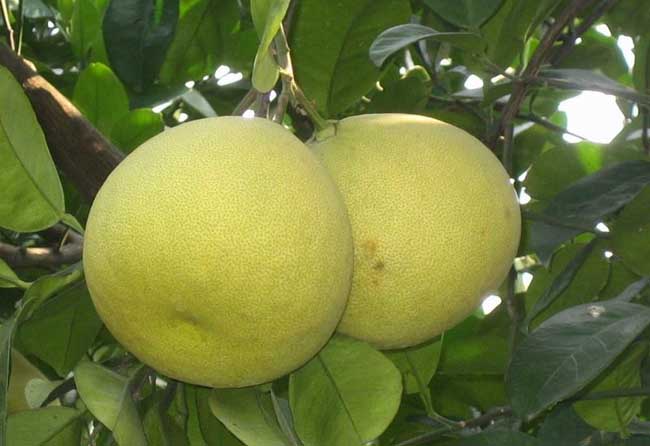
Pomelo, also known as Wendan, Xiangluan, Zhuluan, Neizi, Tiao, Leiyou, Luyou, Hugan, Choudeng, Chouyou, Pao, Bao, and Pao, is the mature fruit of the plant Citrus maxima of the Rutaceae family, produced in southern regions of China such as Fujian, Jiangxi, Guangdong, and Guangxi. Pomelo is fragrant, sweet-and-sour, cool and moistening, rich in nutrients, and highly valued medicinally. It is one of the fruits people love to eat, and is also recognized by the medical community as the fruit with the greatest therapeutic effect. Pomelo tea and pomelo peel both have practical value.
Biological Characteristics
1. Variety Classification
① Pomelo varieties whose pollen is fertile upon pollination, producing fruits with many seeds. Such as white sour pomelo, red sour pomelo, etc.
② Pomelo varieties whose pollen is incompatible upon pollination, with a very low fertilization rate, producing a small number of fruits with fewer seeds; the fruit-setting rate is only high when pollinated with pollen from a different variety (strain), but the fruits then have many seeds. Such as Shatian Pomelo (white-fleshed line), Zaohe Pomelo, Sangma Pomelo, Jinlan Pomelo, Zhaipo Pomelo, Cuntou Pomelo, Caijia Pomelo, Shitou Pomelo, Jincun Pomelo, Changshou Shatian Pomelo Duanshi Pomelo, Gulaoqian Shatian Pomelo, Sixian Pomelo, etc.
③ Pomelo varieties whose pollen is sterile upon pollination, with relatively strong parthenocarpic ability, producing seedless fruits, but with a lower fruit-setting rate and a tendency to split; pollination with pollen from a different variety significantly increases the fruit-setting rate and reduces fruit splitting, but the fruits then have many seeds. Such as Yuhuan flat-cone-round Wendan Pomelo, Guanxi Honey Pomelo, Dukou Pomelo, Duwei Wendan Pomelo, Liangping Pomelo, Yue Pomelo No. 5, Xishi Pomelo, etc.
④ Stamens degenerate, lacking pollen (male sterility), but with relatively strong parthenocarpic ability, producing seedless fruits; pollination with pollen from a different variety significantly increases the fruit-setting rate, but the fruits then have many seeds. Such as Maojuhong Pomelo, etc.
2. Growth Habits
Pomelo is an evergreen tree. Its leaves resemble those of mandarin and tangerine, mostly long elliptical or long ovate, while the winged petiole is heart-shaped; the fruit is mostly gourd-shaped, pear-shaped, or spherical, with the surface mostly yellow or orange, glossy with sunken dots, generally with a pungent odor, and the rind is relatively thick and can be peeled by hand. The fruit is larger than citrus, with a single weight often reaching over 1 kg and a diameter of 15-25 cm. Between the rind and the flesh there is a white spongy layer. The flesh is red or yellowish-white, with white being more common, rich in juice with a strong fragrance, sweet or sweet-and-sour, sometimes with a bitter taste, which mainly comes from the bioflavonoids it contains. Pomelo can be stored in a natural environment for months without spoiling. The segments number 12-15; in cultivation it is often bagged to make it seedless, while in the natural state a single fruit can have more than 100 seeds. Ordinary pomelos mature between October and November, while early-maturing varieties can be marketed in September and late-maturing varieties as late as January to February of the following year. The root system is relatively shallow, mostly concentrated at about 1 to 3 m.
① Root system. Root distribution: seedling trees have a tall and large canopy and well-developed taproots; grafted trees have well-developed lateral roots. The growth of new roots and the growth of new shoots proceed alternately, so there are several root-growth peaks in a year. The first root-growth peak occurs after the spring shoots stop growing and before the summer shoots sprout, and is the largest root growth of the year; the upper limit temperature for root growth is 37°C. If the temperature is too high, root growth is inhibited.
② Branches and shoots. Young pomelo trees grow vigorously and can produce 4 flushes of shoots in a year: spring, summer, autumn, and late autumn, with a large number of shoots and rapid canopy expansion. Pomelo trees enter the fruiting stage at 4-5 years old, and the canopy then has a large number of fruiting positions, which is an important reason for the high early yield of pomelo. After entering the full fruiting stage, they generally only produce spring shoots and do not produce summer shoots. New shoots that sprout from the Beginning of Spring to before the Beginning of Summer are called spring shoots. Spring shoots sprout neatly and concentratedly, in large numbers, with dense internodes, short, sturdy, and plump, 10-20 cm long, and are the main new shoots for bearing fruit that year and for creating and accumulating nutrients. Strong spring shoots can become the base branches for producing summer and autumn shoots, while moderately vigorous ones can develop into the fruiting mother branches of the following year; spring shoots developed from mixed buds develop into the fruiting branches of that year. The number and quality of spring shoots depend on the nutritional status of the tree. If the tree has accumulated sufficient nutrients in the previous year, the spring shoots will be numerous and of good quality, and the number and quality of spring shoots in turn determine the number and quality of the fruiting branches of that year and the fruiting mother branches of the coming year. Cultivating numerous, high-quality spring shoots is a prerequisite for achieving high and stable yields.
3. Flowering and Fruiting Habits
Seedling pomelo trees generally begin to bear fruit at 8-10 years, grafted trees at 4-5 years, and enter the full fruiting stage 1-2 years after first fruiting. Five-to-seven-year-old trees grafted on trifoliate orange rootstock yield 15-50 kg per tree, and 8-10-year-old trees can reach 50-100 kg.
① Fruiting mother branches. The spring shoots of pomelo are the main fruiting mother branches. Each node's leaf axil on a fruiting mother branch can differentiate flower buds and produce fruiting branches, with more fruiting branches produced from the top few nodes. According to surveys, fruiting branches produced from the first node account for 23.7%, and those produced from the first to fourth nodes account for 72.7%. Fruiting branches produced from the top few nodes have a large number of flower buds and a relatively high fruit-setting rate. Therefore, fruits are mostly concentrated on fruiting branches produced from the top few nodes of the fruiting mother branch, and pruning should avoid cutting back the fruiting mother branches. Surveys of the fruiting ability of fruiting mother branches of different lengths show that fruiting mother branches 10-20 cm long have the strongest fruiting ability, and the fruits they set account for 56.9% of the total.
② Fruiting branches. Pomelo flower buds are mixed buds, which bloom after the shoots sprout in spring. Fruiting branches can be divided into four types by morphology: inflorescence branches, leafless inflorescence branches, leafy single-flower branches, and leafless single-flower branches. Leafy single-flower branches, that is, fruiting branches with a single flower bud borne at the tip of a leafy spring shoot, bloom slightly later, have a high fruit-setting rate, and produce fruit of good quality, but are fewer in number. The fruit-setting rate of leafy fruiting branches is higher than that of leafless fruiting branches. Leafless fruiting branches are numerous but have a low fruit-setting rate. When tree vigor is strong, there are more leafy inflorescence branches and flowering branches; when tree vigor is weak, there are more leafless inflorescence branches. Therefore, cultivating strong tree vigor and good fruiting mother branches, striving to produce more leafy fruiting branches, especially more leafy single-flower branches, reducing the number of flower buds and nutrient consumption, and improving the fruit-setting rate are of great significance for achieving high and stable yields. Pomelo inner-canopy branches have strong fruiting ability, and inner-canopy branches under weaker light intensity can differentiate and develop normal flower buds and bloom and bear fruit. This is also one of the important factors in the good yielding ability of pomelo.
③ Flowering and fruiting. Pomelo flowers are solitary or in racemes. Flowering begins in late April and reaches full bloom in early May. After normal male and female stamens are pollinated and fertilized, fruits with seeds are produced; pomelo also has parthenocarpic ability, and an ovary that has not been pollinated or fertilized can also swell and develop into a seedless fruit. Physiological fruit drop: the physiological fruit drop of pomelo basically ends from mid-May to the end of June. Fruit drop in mid-May accounts for 17.8% of the total fruit drop, and that in late May accounts for 40.6%, which is the peak period of physiological fruit drop; fruit drop from mid-May to mid-June accounts for about 90% of the total flowers and fruits, and by early July physiological fruit drop has basically ended. Pomelo fruits mature around the Beginning of Winter.