A Detailed Guide to the Cultivation Techniques and Management Methods of Four-Season Jackfruit
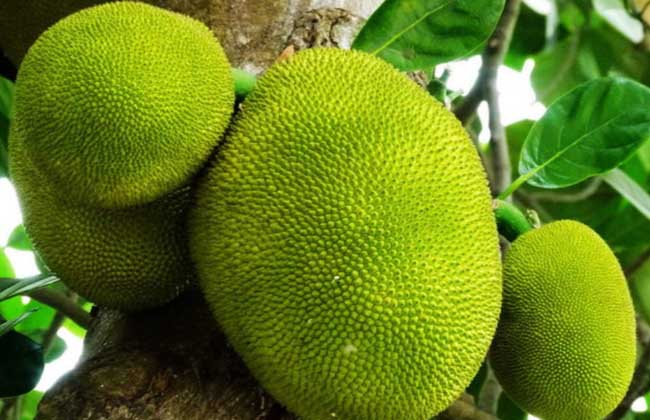
Four-season jackfruit is the latest variety introduced into China from Malaysia. It has the characteristic of flowering and fruiting multiple times a year, with early fruiting and high yield. Grafted seedlings begin to flower and fruit 2 to 3 years after planting. The fruit is oblong-elliptical and medium-sized, with firm bulbs, thick flesh, orange-yellow color, crisp texture, and a clean sweet taste with aroma. Ripe fruit has little latex. It is suitable for cultivation in the jackfruit-producing areas of Guangdong Province. Let us take a look at the cultivation techniques for four-season jackfruit!
Advantages of Growing Four-Season Jackfruit
Four-season jackfruit fruits early and yields heavily, producing fruit year-round. The fruit is oblong-elliptical and medium-sized, with an average single fruit weight of 10.2 kg, firm bulbs, thick flesh, orange-yellow color, crisp texture, and a clean sweet taste with aroma. The soluble solids content of fresh fruit is 21.38%, and vitamin C is 4.73 mg/100 g. Ripe fruit has little latex. Grafted seedlings begin to flower and fruit 2 to 3 years after planting. Three-year-old trees average 58.2 kg per tree, and five-year-old trees average 135.2 kg per tree, an increase of more than 80.0% over local jackfruit in general.
Growing Environment for Four-Season Jackfruit
Four-season jackfruit prefers lowland environments with high temperatures and high humidity, and favors a warm, humid tropical climate. It is not cold-tolerant. The annual average temperature of the planting site is required to be greater than 21°C, the average temperature of the coldest month greater than 13°C, and the absolute minimum temperature greater than 0°C. A ground surface temperature of 0°C makes it prone to freeze damage. It is not strict about soil, and can grow normally in deep, fertile, loose, well-drained acidic soil, as well as in slightly alkaline clay or sandy loam. Cultivation is best in low hills or flat land below 600 m elevation.
Four-Season Jackfruit Cultivation Techniques
1. Timely planting: Four-season jackfruit can be planted throughout the year, but spring planting (March to April) and autumn planting (September to November) are best. When planting, break up the soil in the planting hole finely, straighten and arrange the seedling roots, then press in fine soil in layers, keeping the root crown level with the ground surface. After planting, water thoroughly immediately to settle the roots, and cover the tree disc with plastic film.
2. Rational fertilization: For young four-season jackfruit trees, fertilization aims to promote shoot growth and rapid canopy formation. In addition to applying organic fertilizer as a base fertilizer in winter, apply quick-acting fertilizer before each new flush to promote and strengthen the shoots. For fruiting trees, after harvest, apply a heavy dose of organic fertilizer with a small amount of quick-acting fertilizer to restore tree vigor, improve leaf function, and promote flower bud differentiation. In early spring before budding and flower spike emergence, apply quick-acting fertilizer to promote new shoot growth and flower spike development. When the fruit is rapidly enlarging, apply a fruit-strengthening fertilizer to promote fruit development.
3. Water management: Four-season jackfruit growth requires adequate water, especially during the flowering period and fruit development period. If there is a long drought, young fruits drop or development stalls, the fruit is small and deformed, the bulbs are small and the flesh thin, and quality is poor. Therefore, if it is too dry during the flowering and fruiting periods, irrigation should be provided. However, the rainy season is prone to waterlogging, so drainage work should be done well to prevent standing water from rotting the roots.
4. Training and pruning: The fruiting parts of four-season jackfruit are on the trunk, main branches, and small secondary branches. When the trunk height reaches 1 m, cut back the trunk to promote branching. Remove crossing branches, densely growing branches, and overlapping branches as necessary. Generally, train 3 to 4 first-order branches and keep the canopy height at 3.5 m to form a reasonable tree structure. Pruning of fruiting trees is mainly winter pruning, chiefly removing dead branches, weak branches, overly dense branches, remaining fruiting branches, and male flower branches.
5. Promoting flowering and fruiting: If vegetative growth of four-season jackfruit after planting is too vigorous and affects flowering and fruiting, girdling or ring cutting can be done on the trunk and main branches so that more nutrients accumulate in the aboveground branches and trunk, promoting the emergence of fruiting branches to flower and fruit. Alternatively, scoring the trunk and main branches every 30 cm can also achieve the effect of promoting flowering and fruiting. The extent should be to wound the bark without damaging the xylem, and there is no need to wipe away the sap that flows out.
6. Fruit thinning and fruit retention: In the cultivation management of four-season jackfruit, fruit thinning is carried out, preferably retaining 3 to 5 fruits per square meter of canopy, evenly and reasonably distributed. The principle of fruit thinning is to remove overly dense fruits and deformed fruits. During the young fruit stage, spray insecticide + fungicide + foliar fertilizer once every 15 days. When the fruit has basically set its shape, spray insecticide + fungicide once every 30 days to prevent pest and disease damage and promote fruit enlargement.
7. Pest and disease control: Among the insect pests of four-season jackfruit, longhorn beetles and beetles are common and serious, damaging branches and trunks, causing gummosis, branch dieback, weakened trees, hollow trunks, and even rot and death. Adults can be captured and killed, eggs scraped off, or chlorpyrifos 600-fold solution used to coat the trunk and injected into insect holes. The main diseases include leaf spot, sooty mold, and soft rot of flowers and fruits, which can be controlled with 1000-fold carbendazim or 1500-fold chlorothalonil.