What are the cultivation techniques for wax apple? Explained clearly in one article
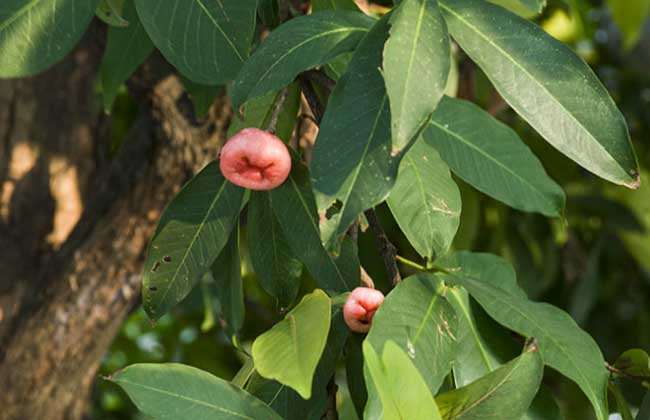
Wax apple, also known as bell fruit, lotus mist, and Lianwu, is a tree plant of the genus Syzygium in the Myrtaceae family. In Taiwan, China, it is hailed as the “king of fruits” and sells well in fruit markets, deeply favored by consumers. Besides being used as a fruit, it is also used in landscaping. Its lush trees, green branches and leaves, and abundant fruits have become a beautiful scenic line for beautifying the environment. Let us take a look at the cultivation techniques for wax apple!
Growth habits of wax apple
Wax apple is native to Malaysia and India. It was introduced to Taiwan, China in the 17th century. After the 1930s, it was introduced and cultivated in Hainan, Guangdong, Guangxi, Fujian, and Yunnan successively, but the cultivation amount is still relatively small. It has strong adaptability, grows easily and vigorously, prefers warmth, fears cold, and likes moist and fertile soil. It is not strict about soil conditions, and in cultivation, proper pruning and shaping are sufficient. The flowering period is from March to April, and the fruit matures from May to June.
Propagation techniques for wax apple
Wax apple is mainly propagated by air layering, carried out during the high-temperature and humid rainy season from May to September each year. Select a fully developed branch about 3 cm in diameter, first perform a ring bark removal of about 3 cm at the base, then wrap a mud ball mixed with moist soil and straw around the ringed bark area and its upper and lower edges, then wrap it with transparent adhesive tape, and tie the upper and lower ends tightly with nylon rope. After about 1 month, new roots grow from the upper end of the bark removal area. After about 3 months, many new roots have grown; cut below the rooting area to form an independent seedling. First heel it in a nursery for continued cultivation, and plant it in the field the following spring.
Cultivation techniques for wax apple
1. Planting time: The planting period for wax apple is generally better in spring and autumn. It should not be too late, and planting should be avoided during high temperatures, excessively low temperatures, or drought seasons. From March to May, with sufficient rainfall and relatively mild sunlight, it is very suitable for wax apple root activity and sprouting, and the survival rate of planting is high. From August to October, the climatic conditions during this period are still suitable for planting wax apple on hillside land, and the climatic conditions during this period are still suitable for wax apple rooting and sprouting, but high-temperature and drought weather is likely to occur during this period, so shade and drought-prevention work for planted seedlings should be done well.
2. Planting density: Wax apple grows fast and has a long lifespan. Planting density should be comprehensively considered and determined through specific analysis according to variety, terrain, soil, and climatic conditions. In the early stage, dense planting can be adopted at a spacing of 4×4 m between plants and rows, that is, 40 plants per mu, to ensure early-stage yield. After wax apple enters the full production period and the orchard begins to be shaded, thinning can be carried out, retaining about 20 plants per mu, to ensure the quality and yield of wax apple.
3. Planting method: Before planting wax apple, spread fine soil over the hole with base fertilizer to prevent the seedling roots from contacting the base fertilizer and causing root rot, which would affect the survival rate. Slightly pile the middle of the planting spot into a small mound, spread the seedling roots around the small mound, then hold the seedling upright by hand, pile on soil, and gently press with the foot so that the seedling roots fully contact the soil without pressing the soil too firmly. After planting, water promptly to settle the roots, and properly thin out some branches and leaves. Within one month after planting, check the survival of the seedlings promptly, and replant dead seedlings.
4. Shaping and pruning: Wax apple should adopt the natural round-headed shaping method. After planting, keep one main trunk, cut off the upper end at 60 cm above the ground, keep 3 to 4 new branches and let them grow naturally to become main branches. Every year after fruit harvest, thin out the branches, removing diseased and insect-damaged branches, dead branches, overly dense branches, and vigorous water sprouts. After pruning, protect the wounds promptly by applying the oil-based “wound healing and antiseptic membrane” to seal the wounds, preventing cracking and pathogen invasion.
5. Fertilizer and water management: Wax apple grows fast and has a high fertilizer demand. For 1- to 4-year-old trees, quick-acting fertilizers are generally the main type. In the early stage, apply more nitrogen and potassium fertilizers, and fertilize by digging a ring-shaped trench at the drip line of the canopy. Do not apply too much nitrogen fertilizer during the flower bud differentiation period. The fertilizer application in March to April during the flowering and fruiting period and in July at the end of fruit picking each accounts for 25% of the annual total, and the fertilizer application from September to October accounts for 50% of the annual total. After the small fruit stage, apply more phosphorus and potassium fertilizers. Manage water scientifically: from September to October, keep the orchard dry to facilitate flower bud differentiation; at other times, keep the soil moist to prevent flower and fruit drop.
6. Flower and fruit management: Wax apple has many flowers and a large fruit set, so branch-tip flower spikes should be thinned first. Keep 1 to 2 pairs of flower spikes on large branches. Thin out overly dense flower spikes. When the flower spikes are about 2 cm, bagging can be carried out to improve fruit quality and also prevent damage by fruit flies. To meet market demand, flower forcing and other treatments can be carried out to make wax apple transition from vegetative growth to reproductive growth. A common method is ring girdling and applying the cationic active agent “Flower Promoter No. 2” to transform growth functions into reproductive functions, promote flowering and preserve fruit, without harming tree vigor.
7. Cold protection measures: In addition to strengthening fertilizer management to make the tree vigorous and applying more potassium fertilizer to enhance cold resistance, wax apple can be sprayed weekly from December with 98% sodium naphthaleneacetate (SNA) and gibberellin (GA3) at 100,000 to 200,000 times dilution, and one day before and after the cold wave strikes, spray once each with high-concentration 98% sodium naphthaleneacetate at 40,000 to 50,000 times dilution. If frost occurs, spray groundwater in the deep night or the next morning to wash off the frost accumulated on the leaf surface.
8. Pest and disease control: Wax apple is particularly sensitive to pesticides, so highly toxic and extremely toxic pesticides should not be used. The main diseases are anthracnose and fruit rot, and the main pests are fruit flies, scarab beetles, and scale insects. Low-toxicity and high-efficiency pesticides such as mancozeb, carbendazim, thiophanate-methyl, and fenvalerate can be used together with New High Lipid Membrane for control, which can both enhance efficacy and reduce the amount of pesticide applied.