Can the fruit of the roseleaf raspberry be eaten? Analysis of its edible safety
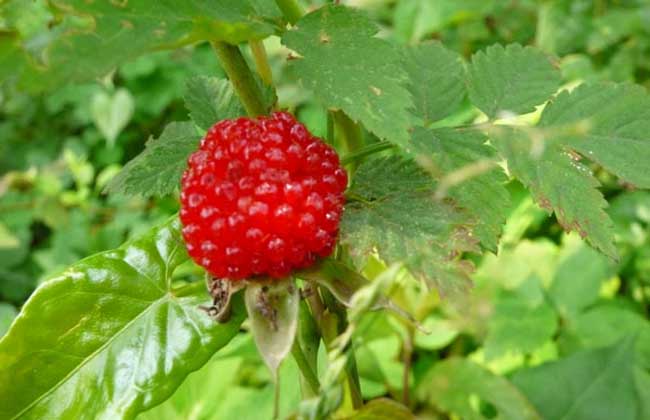
The roseleaf raspberry, also known as the rose bramble or Sanyuepao, is an erect or climbing shrub of the genus Rubus in the rose family (Rosaceae). Its branchlets are cylindrical and covered with soft hairs or nearly hairless, its leaflets are ovate-lanceolate or lanceolate, its pedicels bear sparse or dense soft hairs, its calyx is covered on the outside with soft hairs and glandular dots, its sepals are lanceolate or ovate-lanceolate, and its fruit is ovoid or oblong-ovoid. Now let us take a look at whether the fruit of the roseleaf raspberry can be eaten!
Can the fruit of the roseleaf raspberry be eaten?
The fruit of the roseleaf raspberry is edible, but it should not be eaten in large amounts; eating too much is not good either. In addition, the roseleaf raspberry, with its white flowers and red fruit, is bright and pleasing to the eye and fragrant. It can be planted in a semi-wild state in natural-style gardens or in courtyards with a strong natural landscape, and can also be planted as a hedge or along forest edges. Its roots and leaves can be used medicinally.
Where does the roseleaf raspberry come from?
In China, the roseleaf raspberry is mainly produced in places such as Jiangxi, Hunan, Anhui, Zhejiang, Fujian, Taiwan, China, Guangdong, Guangxi, Sichuan and Guizhou; abroad, it is distributed in places such as India, Myanmar, Thailand, Laos, Vietnam, Cambodia, Japan, Indonesia (Java), Oceania, Africa and Madagascar.
The growth habits of the roseleaf raspberry
The roseleaf raspberry grows in shaded spots in mountain mixed forests, on grassy slopes or in high-mountain humus soil, at altitudes of up to 2000 m. It likes warmth and tolerates shade. It prefers to grow on forest edges or hillsides rich in humus. Its fruit ripens in April to May, is nearly spherical in appearance, relatively large, dark red, and rich in red pigment. It is easy to cultivate, propagates quickly and produces a large amount of fruit, making it a convenient raw material for extracting natural plant pigments.