A detailed guide to winter jujube tree cultivation techniques, master all the key points of planting and management
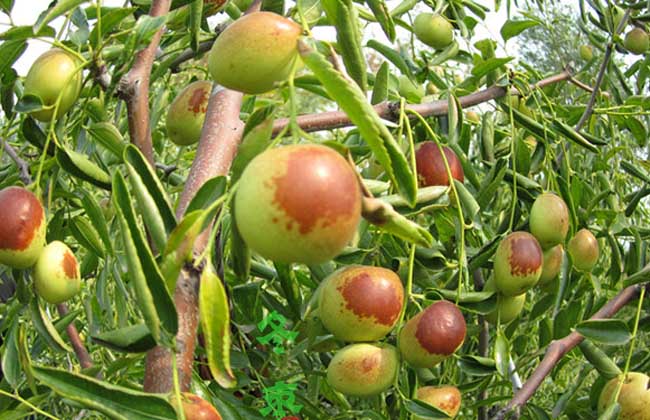
Winter jujube is an excellent late-maturing fresh-eating variety of the thornless jujube tree, also known as Miaoshangfu, Yanlaihong, apple jujube, etc. In recent years, market demand has exceeded supply, and it has extremely high economic value. Vigorously developing winter jujube production can yield relatively high economic, ecological and social benefits. Let us now take a look at winter jujube tree cultivation techniques!
Morphological characteristics of the winter jujube tree
1. Branches: A deciduous small tree, rarely a shrub, up to more than 10 m tall, bark brown or grayish brown, with long branches; short branches and budless branchlets are smoother than long branches, purplish red or grayish brown, zigzag-bent, with 2 stipular spines, the long spine up to 3 cm, thick and straight, the short spine curved downward, 4-6 mm long; short branches short and thick, oblong, produced from old branches; current-year branchlets green, drooping, solitary or 2-7 clustered on short branches.
2. Leaves: Papery, ovate, ovate-elliptic, or ovate-oblong, 3-7 cm long, 1.5-4 cm wide, apex obtuse or rounded, rarely acute, with a small mucro, base slightly asymmetrical, nearly rounded, margin with rounded serrations, dark green above, glabrous, light green below, glabrous or only somewhat sparsely puberulent along the veins, basal three-veined, petiole 1-6 mm long, or up to 1 cm on long branches, glabrous or sparsely puberulent, stipular spines slender, often deciduous later.
3. Flowers: Yellow-green, bisexual, 5-merous, glabrous, with short peduncles, solitary or 2-8 densely gathered into axillary cymes, pedicels 2-3 mm long, sepals ovate-triangular, petals obovate-rounded, base clawed, equal in length to the stamens, disk thick, fleshy, rounded, 5-lobed, lower part of the ovary hidden in the disk and adnate to it, 2-locular, each locule with 1 ovule, style 2-cleft.
4. Drupe: Drupe oblong or long ovoid, 2-3.5 cm long, 1.5-2 cm in diameter, red when mature, later turning red-purple, mesocarp fleshy, thick, sweet, stone apex acute, base acute or obtuse, 2-locular, with 1 or 2 seeds, fruit stalk 2-5 mm long, seeds flat-elliptic, about 1 cm long, 8 mm wide. Flowering period May-July, fruiting period August-September.
Winter jujube tree cultivation techniques
1. Site selection and orchard establishment: When establishing an orchard, choose high-quality virus-free seedlings that are robust in growth, have a well-developed root system and are free from pest and disease damage. The orchard site should preferably be one with fresh air, pure water, uncontaminated soil, flat terrain, open topography, sufficient sunlight, fertile soil, good drainage and irrigation conditions, soil free of harmful and toxic substances, soil minerals within the normal range, and no pesticide residues or contamination.
2. Timely planting: Winter jujube has strong adaptability, tolerates drought and poor soil, and has no strict requirements for fertilizer and water. Orchard establishment should use a dense-planting dwarfed cultivation method, generally 2 to 3 × 3 to 4 m, with 56 to 111 plants per mu, which has an obvious effect on increasing the early yield of young trees. Winter jujube has relatively high light requirements, so the row direction should preferably be north-south.
3. Fertilizer and water management: Winter jujube has a relatively high demand for phosphate fertilizer. When planting, apply 0.5 kg of superphosphate and 25 kg of organic fertilizer per plant. Apply chemical fertilizer once each in late May, late June to early July, and early August every year. In autumn, apply organic fertilizer in trenches, with 50 to 70 kg of farmyard manure and 0.5 to 1 kg of nitrogen and phosphorus fertilizer or the same amount of three-element compound fertilizer per plant. Irrigate thoroughly once each before bud break, before flowering, during the young fruit swelling stage and before overwintering; at other times, irrigate appropriately according to drought conditions; drain promptly during the rainy season and cultivate and weed promptly after rain. Plow and turn the tree plate in autumn.
4. Flower and fruit management: First, pinch the jujube heads at the early full-bloom stage, leaving 3 to 5 secondary branches for pinching according to the vigor of growth. Second, spray clean water, spraying clean water once every 1 to 3 days from the early flowering stage to the full-bloom stage, for a total of 3 to 5 sprays. Third, hormone treatment, spraying 1 to 2 times with 10 to 15 mg/L gibberellin at the early full-bloom stage. Fourth, ring-barking and ring-cutting: for young vigorous trees, perform trunk ring-cutting at the full-bloom stage; when the trunk diameter reaches more than 5 cm, perform ring-barking, with a ring-barking width of 0.5 to 1 cm. During the fruiting period, large trees can be ring-barked on the trunk, while young trees beginning to bear fruit are generally ring-barked on the main branches, so as to achieve both fruiting and tree maintenance without neglecting either. The cut should preferably heal in about 20 days, so as to retain nutrients on the tree and protect the fruit.
5. Training and pruning: The tree shape of winter jujube depends on the planting density. For 55-100 plants per mu, a small canopy and sparse-layered shape is suitable, maintaining ventilation and light penetration. The trunk height at planting should be 70 to 80 cm, and 5 to 6 main branches should be gradually developed year by year. During winter pruning and summer pruning, water sprouts should be removed promptly, extension branches should be cut back, and overly dense branches and weak slender branches should be thinned or cut back, so as to maintain tree vigor balance, keep the canopy ventilated and light-permeable, and promptly retract overly long fruiting branches. This allows local branches to be renewed and rejuvenated.
6. Disease and pest control: The main pests and diseases of jujube trees include spider mites, peach fruit moth, jujube looper, jujube rust, jujube fruit-shrinking disease, jujube witches' broom, etc. During the bud break and leaf expansion stage, spray 40% omethoate emulsifiable concentrate at 1000 times 1 to 2 times to control jujube looper; from late May to early June during the occurrence period of spider mites, spray 15% saomanjing emulsifiable concentrate at 2500 times 1 to 2 times; from mid-July to mid-August, spray 2 to 3 times with pyrethroid pesticides to control peach fruit moth and jujube looper. In July, August and September, spray a fungicide once every 15 to 20 days; choose 200 times Bordeaux mixture alternated with 800 times carbendazim solution or 1000 times thiophanate-methyl wettable powder to control jujube rust and fruit-shrinking disease. If jujube witches' broom is found, prune out diseased branches in mild cases, and remove them promptly in severe cases.
7. Harvesting and storage: Winter jujube is a fresh-eating variety and is mostly picked by hand. On the same tree, winter jujubes ripen at different times, so they can be harvested 2-3 times according to the situation. Harvesting in stages can not only increase yield but also improve quality. After harvest, cold storage is generally used for fresh-keeping storage; under low-temperature conditions, ethylene production in winter jujubes can be inhibited. The optimal cold storage temperature is about 1°C, and the relative humidity should be maintained at about 98%, to supply the market around New Year's Day and the Spring Festival.