Detailed Explanation of Carambola Tree Planting Techniques and Management Key Points
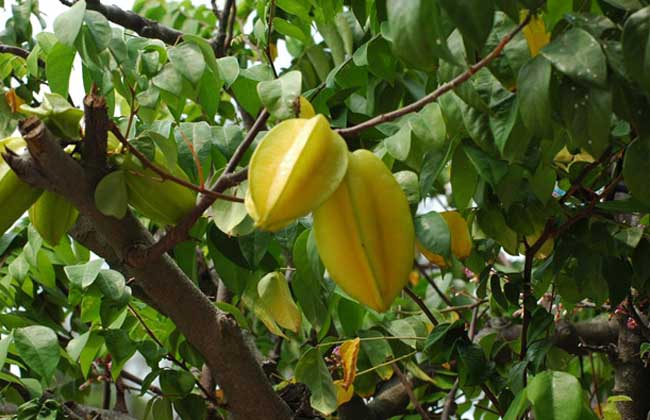
Carambola, also known as yangtao, wulianzi, and star fruit, is an evergreen small tree of the genus Averrhoa in the family Oxalidaceae. Its fruit has very high nutritional value. It is native to Malaysia and Indonesia and is now widely cultivated throughout the tropics. In China, it is cultivated in Guangdong, Guangxi, Fujian, Taiwan, China, Yunnan, and other places. Let us now take a look at carambola tree planting techniques!
Growth Habits of the Carambola Tree
The carambola tree prefers a hot and humid climate and is not cold-tolerant. It is best cultivated in loam with deep soil layers, loose and fertile texture, and rich in humus. It likes high temperatures and humidity, and fears frost damage and drought. Prolonged drought and dry hot winds cause flower and fruit drop. It prefers semi-shade and avoids strong sunlight, especially during the flowering and young fruit stages. It likes gentle breezes and fears typhoons; the fruit stalks are slender and weak, and typhoons cause massive flower and fruit drop. When the temperature is below 15°C, seedlings stop growing; below 10°C they suffer cold damage, affecting flower bud differentiation, fruit development, yield, and quality. Above 15°C, branches and shoots begin to grow. The flowering stage requires temperatures above 27°C. It has wide adaptability and can be planted in areas with annual rainfall of 1500-3000 mm. It is not demanding about soil and can grow in various soil types, but deep, fertile sandy loam is best, with a pH value between 5.5-6.5.
Cultivated Varieties of Carambola
1. Malaysian Sweet Carambola: The Malaysian sweet carambola plant is tall, grows quickly, and has a high fruiting rate. The flesh is crisp, fine-textured, juicy, and sweet. Individual fruit weighs 200-300 grams. The fruit is oblong-elliptical with 5 ribs. The ribs are thick, and the edible rate is 96%. It has excellent quality and stores and transports well.
2. American Red Carambola: The American red carambola is similar to the Malaysian carambola. The tree shape is cylindrical, the leaflets are slightly hard and crisp, the long leaves are pink, and the inflorescence is purplish-red. Individual fruit weighs 150-250 grams, and the fresh-eating quality is excellent.
3. Taiwan Honey Silk Carambola: Taiwan honey silk carambola can send out new shoots 5-6 times a year. During the hot and rainy season, new shoots grow without interruption, showing early fruiting and high yield. Individual fruit weighs 150-200 grams, and the flesh is tender, juicy, and lightly sweet.
Propagation Methods of the Carambola Tree
1. Grafting propagation: Carambola is most commonly propagated by patch budding, cut grafting, and cleft grafting. Spring (February to May) and autumn (September to October) are the most suitable periods for grafting. Grafted seedlings are used for planting to maintain the quality of the superior mother tree. Except in very cold weather, it can be planted year-round. The planting spacing is 3×4 m or 3×5 m, with 40-50 plants per mu. After the tree canopies meet, thinning can be carried out.
2. Layering propagation: Air layering propagation of carambola is commonly called ring-barking, marcotting, or the Chinese layering method. It was the first traditional asexual propagation and seedling-raising method adopted in China. This method has the characteristics of simple operation, fast seedling formation, early fruiting, and the ability to maintain the superior traits of the mother tree.
Planting Techniques for the Carambola Tree
1. Site selection and orchard establishment: If building an orchard on hilly land for carambola planting, it is best to choose a lower-middle slope facing south or southeast with a water source for irrigation, relatively good soil quality, and a gentle slope. For orchard establishment on flat land, drainage and irrigation ditches are generally required, with depth determined by the height of the groundwater level, and they should be gradually improved through yearly excavation.
2. Planting density: Carambola planting spacing can use 3×4 m, 3×5 m, or 4×4 m. Before planting, large planting holes should be dug and sufficient decomposed organic fertilizer applied as base fertilizer. In flatland orchards, planting holes should be 50 cm deep and 50 cm wide; for poor soil, they can be appropriately deepened and widened. In hilly orchards, planting holes should be 1 m deep and 1 m wide, and after planting, the holes still need to be expanded and the soil improved year by year.
Maintenance and Management of the Carambola Tree
1. Early shaping: The main goal for the carambola tree is to cultivate a rounded, compact canopy. After young trees are planted, cut the top at 40-50 cm above the ground. After shoots emerge, retain 3-4 evenly distributed main branches. When the main branches are 30-40 cm long, pinch the tips, leaving 2-3 buds per branch. Because carambola has strong shoot-sprouting and branch-forming ability, shaping should follow this principle. As the branch order increases, a high-yielding canopy can be formed from spring planting to the end of the following year. During the shaping process, bamboo stakes or thin strings can be used to secure weak branches to prevent them from drooping and to make the main branches more evenly distributed.
2. Pruning during the fruiting period: Pruning of carambola trees during the fruiting period should be light rather than heavy. Middle and lower branches should be retained as much as possible so they are arranged in layers, with evenly distributed branches and leaves and moderate density. For young and vigorous fruiting trees, dominant branches should be removed, and some nutrient branches in the upper canopy should be thinned to suppress growth. Attention should also be paid to shortening thumb-thick branches in different directions year by year to maintain strong tree vigor and ensure annual yield. For old and weak trees, branches in the upper canopy can be cultivated to shade the trunk, and vigorous water shoots can be fully used to fill gaps in the canopy and renew old branches.
3. Drainage and irrigation: The absorbing roots of carambola are relatively shallow and easily affected by external conditions. Therefore, during dry and hot seasons, irrigation should be carried out in time, and the tree disk should be covered with weeds to keep the soil constantly moist and lower soil temperature, so as to adapt to normal root growth. The carambola root system is not tolerant of waterlogging; prolonged soaking can cause root rot and leaf and fruit drop. Therefore, before the rainy season arrives, drainage ditches should be cleared to lower the groundwater level. Hilly orchards should be expanded and soil improved in time to prevent water accumulation.