What are the control methods for banana Fusarium wilt?
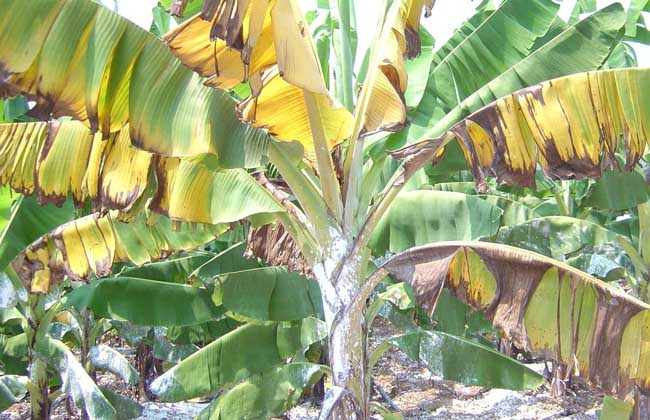
Banana Fusarium wilt is a devastating disease, a soil-borne disease caused by infection with Fusarium oxysporum f. sp. cubense. It occurs in banana-producing areas in several provinces of southern China. There are mainly race 1 and race 4. Race 1 mainly harms Fenjiao (apple banana), while race 4 harms both Fenjiao and banana. It generally reduces yield by more than 20%, and in severe fields it can even cause total crop failure. Let's take a look at the control methods for banana Fusarium wilt below!
Causes of the disease
Banana Fusarium wilt is a soil-borne vascular disease. Diseased banana seedlings and contaminated soil are the initial infection sources. After the pathogen invades the banana through the roots, it develops and spreads through the vascular bundle tissue toward the corm. The vascular bundle tissue at the infected site turns noticeably brown, and there are often phenomena such as inward longitudinal splitting at the base of the pseudostem and rotting of the corm. Factors such as high temperature and abundant rain, acidic soil, sandy loam, low fertility, heavy clay texture, poor drainage, poor permeability of the subsoil, and root injury from cultivation are conducive to disease occurrence. Susceptible spring-planted bananas generally begin to develop the disease in June to July, worsen in August to September, and enter the peak incidence period in October to November.
Symptoms
1. External symptoms: In the adult plant stage, diseased plants first show a distinctive yellow color on the lower leaves and outer leaf sheaths. It initially appears at the leaf margins, then gradually spreads toward the midrib, contrasting markedly with the dark green parts of the leaf. Some entire leaves also turn yellow. Infected leaves wither rapidly, turning from yellow to brown and then drying up. The last top leaf often emerges late or fails to emerge, and finally the diseased plant dies.
2. Internal symptoms: Because banana Fusarium wilt is a vascular bundle disease, the internal symptoms are very obvious. In the pith of the central cylinder and around it, there are yellow-red discolored vascular bundles in spot-like or line-like forms. The closer to the stem base, the darker the discoloration. The woody vessels of the roots turn reddish-brown and gradually become dark brown and dry up. The corm turns dark brown and gradually rots, with a special odor.
Control methods
1. Strictly restrict the introduction of banana seedlings and Manila hemp seedlings and the soil attached to them from diseased areas.
2. To ensure that banana plantations are free of Fusarium wilt, disease-free banana seedlings should be selected for planting. The basic method is to introduce seedlings from areas without banana Fusarium wilt. In addition, choose Fusarium wilt-resistant varieties whenever possible.
3. If scattered diseased plants are found in a banana plantation, immediately pull them out together with the roots, chop the diseased plants into pieces, put them into plastic bags, add lime, seal the bag opening, move them out and away from the banana plantation, and let them rot.
4. In order to eliminate the source of infection and cut off opportunities for spread, treating contaminated soil is a very important measure.
5. Apply more fertilizer, dig ditches for drainage, and enhance plant disease resistance. Where conditions permit, heavily diseased banana plantations on flat land can be flooded and left fallow for half a year or rotated with rice.
6. For lightly diseased plants, use a broad-spectrum fungicide diluted in 30 jin of water to drench the root and stem base, applying 2 to 3 times consecutively with an interval of 3 to 5 days, to promote root growth, strengthen the plants, and provide disease resistance.
7. In the middle and late stages of disease development, spray 41% polyalthia·pyrimethanil 800-fold solution, applying once every 3 to 7 days, or spray 38% oxadixyl-famoxadone 600-fold solution onto the backs of the basal leaves.
Note: The pathogen of banana Fusarium wilt can survive in the soil for more than 30 years, and no pesticide can eradicate it. Therefore, although some simple rice rotation or some organic matter and soil improvement methods are effective, they are only partial. Comprehensive control still needs to focus mainly on using disease-resistant or disease-tolerant varieties.