What are the control methods for watermelon leaf blight?
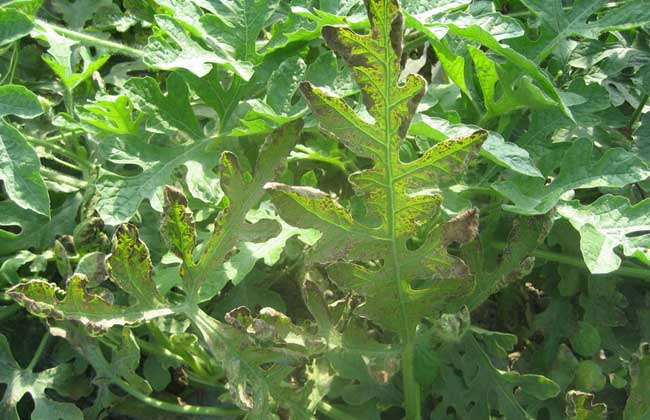
Leaf blight is one of the common diseases of watermelon, occurring mostly on open-field watermelons in summer and autumn, and it can also occur on spring-crop watermelons. The usual incidence rate is 10-30%, and in severely affected plots the proportion of diseased plants reaches over 80%, causing large numbers of leaves to wither and die and significantly affecting watermelon production. Besides harming watermelon, it also harms melon, cucumber, winter melon, pumpkin and many other cucurbit plants. Let's take a look at the control methods for watermelon leaf blight below!
Damage characteristics
Watermelon leaf blight mainly harms the leaves, and can also harm the stems, vines and fruit. When cotyledons of seedlings are affected, it mostly occurs at the leaf margins, initially as small water-soaked spots, which later expand into brown water-soaked round or semicircular spots; under high humidity conditions, it can affect the entire cotyledon, causing it to wither. When true leaves are affected, it mostly occurs at the leaf margins or between the veins, initially as small water-soaked spots, which under high humidity rapidly merge and seep through, causing the leaves to lose water and wilt green. In hot, dry weather, round brown spots 2-3 mm in diameter form; when the weather is humid, they can merge into large brown spots, the lesions become thin, and in severe cases cause leaf blight. When stems and vines are affected, slightly sunken light brown elliptical or spindle-shaped spots are produced. When fruit is affected, round sunken dark brown spots with slightly raised surroundings are produced, and in severe cases cause the fruit to rot.
Occurrence pattern
The pathogen of watermelon leaf blight is not strict about temperature; disease can occur at temperatures of 14-36°C and relative humidity above 80%. In the field, many rainy days and large rainfall amounts, with relative humidity above 90%, make it prone to epidemic or major outbreak. Wind and rain help spread the pathogen, causing the disease to occur widely. Continuous cropping, one-sided or heavy application of nitrogen fertilizer, and poor soil make the plants weak in disease resistance and lead to severe disease. Continuous sunny days and long sunshine hours inhibit the disease. Disease resistance differs among varieties; Jinzhong and Guannong are relatively susceptible. In recent years it has shown a trend of becoming increasingly serious, and attention should be paid to it in production.
Control methods
1. Establish disease-free seed production fields, and select disease-tolerant varieties suitable for local cultivation. Currently the more disease-resistant varieties include Zhengzhou No. 5, Zhengza No. 7, Xinong No. 8, Yueyou No. 2, Fuzhou watermelon, and Xin Hongbao.
2. After the watermelon harvest, take care to remove diseased residues, bury them deeply in a centralized place or burn them, and do not pile diseased residues at the edge of the field.
3. Adopt formula fertilization technology, apply compost fermented with enzyme bacteria, avoid one-sided or excessive application of nitrogen fertilizer, and begin spraying Huimanfeng liquid fertilizer before fruit set, 320 ml per mu diluted 500 times with water, to improve disease resistance.
4. Scientifically determine the sowing date. For open-field cultivation, sow when the average daily temperature is stably above 15°C and the soil temperature at a depth of 5 cm is stably above 12°C. If early sowing is desired, plastic film mulching can be used to reach the above temperatures before sowing.
5. For seeds that may carry the pathogen, soak the seeds in a 1000-fold solution of 75% chlorothalonil wettable powder or 50% iprodione wettable powder for 2 hours, rinse clean, then germinate and sow.
6. Where conditions permit, advocate rain-shelter cultivation. For open-field watermelon, special attention should be paid after rain to opening ditches for drainage to prevent moisture retention, which plays an important role in reducing the disease.
7. Adopt trellis cultivation, 1500 plants per mu, use single-vine pruning, remove the first female flower at the 6-7 leaf stage and retain 12-13 leaves, which not only increases yield and income but also reduces the disease.
8. Before the disease occurs and when no lesions are seen, begin spraying 50% procymidone wettable powder 1500-fold solution, or 50% iprodione wettable powder 1000-fold solution, 75% chlorothalonil wettable powder 600-fold solution, 70% mancozeb wettable powder or dry suspension powder 500-fold solution, or 80% Daconil wettable powder 600-fold solution, all of which are effective. Spray 60 liters of the prepared solution per mu, once every 7-10 days, for 3-4 consecutive treatments.