What are the control methods for watermelon Fusarium wilt?
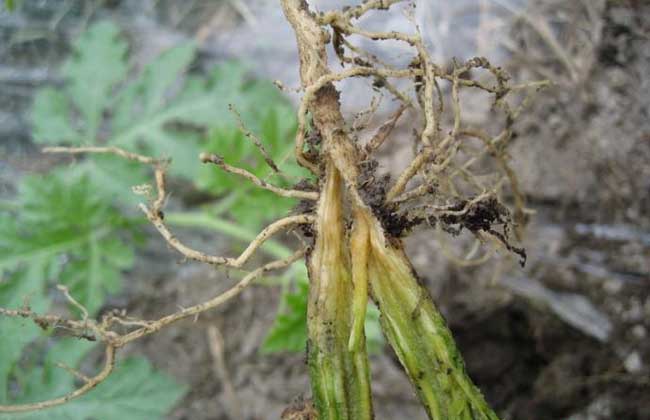
Watermelon Fusarium wilt, commonly known as "dead vine disease," can occur at all stages of watermelon growth, with the most severe incidence during the fruiting stage. The optimal temperature for the pathogen is 25-30°C; when soil temperature is below 23°C or above 34°C, the disease incidence is mild. When soil moisture content is high and humidity is great, the disease incidence is severe. Planting disease-resistant watermelon varieties is the preferred measure for controlling this disease. Let's take a look at the control methods for watermelon Fusarium wilt below!
Damage symptoms
When seedlings are affected, they show damping-off symptoms. After transplanting, the lower leaves wilt, followed by the entire plant's leaves all withering and dying. The stem base constricts, developing brown lesions, and sometimes the diseased area exudes an amber-colored gelatinous substance, on which white mold layers and pale pink viscous material (conidia) grow. The vascular bundles of the stem turn brown, sometimes developing longitudinal cracks. The roots turn brown and rot together with the stem.
Causes of occurrence
The watermelon Fusarium wilt pathogen mainly invades through root wounds or intercellular spaces at root hair tips. It first grows between and within the host's parenchyma cells, then enters the vascular bundles and develops within the vessels. The pathogen secretes pectinase and cellulase, decomposing and destroying cells, causing pectin-like substances to accumulate in the vessels, blocking them and affecting water transport, which causes plant wilting. It spreads through infected soil. With continuous cropping, there is a large amount of pathogen in the soil, and the diseased plant rate can reach about 70%. Diseased plant residues, diseased manure, and seeds can also transmit the disease.
Integrated control
The most effective method for controlling watermelon Fusarium wilt is grafting with root replacement, using highly resistant Cucurbitaceae crops such as bottle gourd or Xintuzuo as rootstock to graft watermelon varieties. As long as care is taken to completely sever the watermelon roots and prevent the graft union from contacting the soil when planting seedlings, watermelon Fusarium wilt can be effectively prevented. For own-rooted watermelon seedlings that have not been grafted, adhere to the plant protection policy of "prevention first, integrated control," and earnestly implement agricultural control, biological control, and other integrated control measures.
Agricultural control
1. Variety selection: Planting disease-resistant watermelon varieties is the preferred measure, such as selecting Xinong No. 8, Fengkang No. 8, and other varieties.
2. Grafting cultivation: The watermelon Fusarium wilt pathogen has difficulty infecting bottle gourd, calabash gourd, pumpkin, and others. Using these crops as rootstock for grafting and root replacement is a better approach to solving watermelon Fusarium wilt.
3. Paddy-upland rotation: Watermelon Fusarium wilt can survive in soil for 10 years, but in water it survives for only just over 130 days. Therefore, paddy-upland rotation is the best method for preventing Fusarium wilt.
4. Seed treatment: Soak seeds in a 2-4% bleaching powder solution for 30 minutes, then remove and rinse clean. This can kill Fusarium wilt pathogen and anthracnose pathogen on the seed surface.
5. Soil control: For seedling-raising nutrient soil, use pond soil, paddy field soil, or wall soil. Do not use soil from melon fields or vegetable gardens. Farmyard manure must be fully decomposed, and do not use farmyard manure containing diseased plant residues.