What are the control methods for watermelon gray mold?
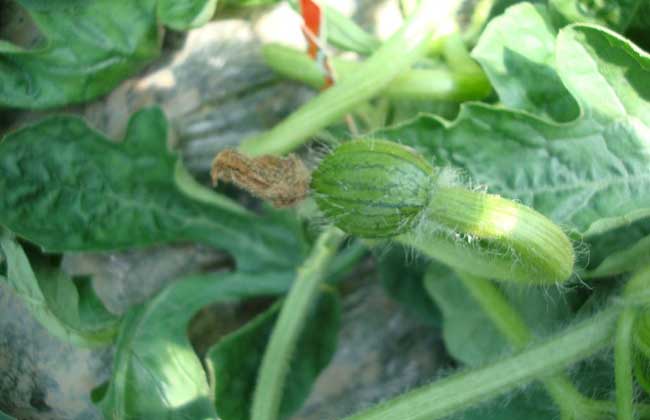
Watermelon gray mold occurs throughout the country. It is caused by infection with Botrytis cinerea of the genus Botrytis in the Deuteromycotina, and occurs severely in humid and rainy areas of the south, causing dead seedlings and rotten melons that reduce yield. Besides watermelon, it also harms many other vegetables such as cucumber, eggplant, tomato, and kidney bean. Let us take a look at the control methods for watermelon gray mold below!
Damage symptoms
Watermelon gray mold mainly harms leaves, stems, and fruit. Young leaves first show water-soaked dirty spots, which later expand into brown or ink-colored spots and are prone to perforation. On stems, elliptical or longitudinally elongated sunken black spots appear, with cracking in the middle. Young fruit first develops dark brown sunken spots, and later its development is hindered, forming deformed fruit. Fruit lesions are mostly scab-like, and some crack or rot into holes. The diseased parts secrete a translucent gelatinous substance, which later turns into amber lumps. When humidity is high, the surface of each diseased part is densely covered with sooty mold. Watermelon gray mold can be called a devastating disease of watermelon, with widespread damage that is difficult to eradicate, seriously affecting yield and quality, reducing yield by more than 50%, and even leading to total crop failure.
Occurrence pattern
The pathogen overwinters in the soil as mycelium and sclerotia with diseased residues. In spring of the following year, the mycelium produces conidia, and the sclerotia germinate to produce conidiomata and spread conidia, which are transmitted by airflow and rainwater, harming watermelon seedlings, flowers, and young fruit, causing primary infection, and producing mold on diseased parts, further producing large numbers of conidia, infecting watermelon again and expanding the spread. When temperatures drop in autumn, sclerotia are produced again and hide in the soil to overwinter. The suitable temperature for pathogen growth is 22-25°C, and the survival temperature is -2-33°C. The relative air humidity for conidia formation is 95%. Therefore, under conditions of high temperature and high humidity, the disease occurs more severely.
Chemical control
1. Biological agents: A 1% wuyiencin aqueous solution at 200 times dilution can be selected, spraying 20-30 kg per mu, once every about 7 days, for 2-3 consecutive sprays.
2. Chemical pesticides: In the early stage of disease onset, 50% procymidone or iprodione wettable powder at 1000-1500 times dilution, or 60% fangmeibao wettable powder at 500 times dilution, or 70% thiophanate-methyl wettable powder at 800 times dilution can be selected, spraying once every about 7 days, for 2-3 consecutive sprays. In addition, 40% shihuile suspension concentrate or 21% baijundi or 20% propiconazole emulsion can also be used, all with very good control effects.
Agricultural control
1. Crop rotation: Implement crop rotation and changing of crops for more than 3 years, and apply fully decomposed organic fertilizer.
2. Seedling soil disinfection: For each square meter of seedling bed or planting hole, pour 4-5 kg of 70% fenaminosulf technical powder at 1000 times dilution.
3. Greenhouse disinfection: Use baijunqing smoke agent or iprodione smoke agent to fumigate the greenhouse, using 0.25 kg of pesticide per greenhouse, fumigating once every 8-10 days, for 2-3 consecutive fumigations.