How to prevent and control watermelon powdery mildew? A full analysis of practical methods
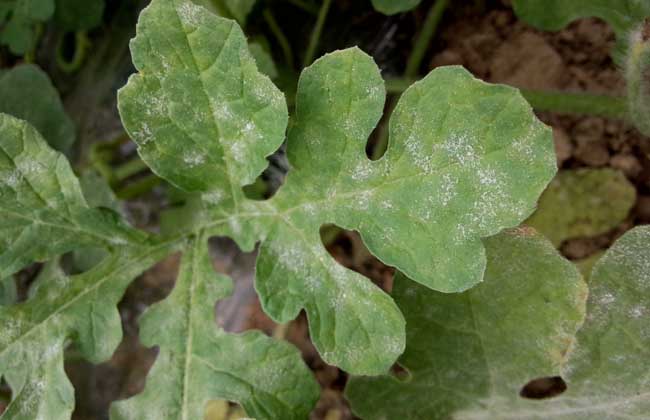
Powdery mildew is a common disease of watermelon and is distributed in all watermelon-producing areas across the country. It can occur on both spring and autumn watermelons in the south, but autumn watermelons are affected more severely. In the north, open-field watermelons develop the disease in summer, while in protected areas such as greenhouses and plastic tunnels it can occur year-round. It can infect plants throughout the entire growth period, but occurs most severely in the middle and late stages of growth. Let us take a look together at the prevention and control methods for watermelon powdery mildew!
Damage symptoms
Watermelon powdery mildew mainly damages leaves, followed by petioles and stems, and generally does not harm the fruit. In the early stage of the disease, white, nearly round, star-shaped small powdery spots appear on the leaf surface or underside, mostly on the leaf surface. When environmental conditions are suitable, the powdery spots rapidly expand and join together into large white powdery areas with indistinct edges, covered with white powdery mold. In severe cases, the entire leaf surface is covered with white powder. There is less white powder on petioles and stems. The disease gradually spreads from old leaves to new leaves. In the late stage of the disease, the white mold layer turns gray as the mycelium matures, and the diseased leaves turn yellow, wither and curl, but generally do not fall off. When environmental conditions are unfavorable for pathogen reproduction or the host ages, clusters of yellow-brown small granules appear on the lesions, which later turn black.
Occurrence conditions
The occurrence and epidemic of watermelon powdery mildew are closely related to temperature, humidity and cultivation management. In terms of cultivation management, fields with overly dense planting and poor ventilation and light transmission are prone to the disease. Excessive nitrogen fertilizer, leggy plant growth, soil water shortage and untimely irrigation lead to rapid disease development and severe conditions. Watermelon fields with excessive irrigation, increased humidity, low-lying terrain, poor drainage or close to protected areas such as greenhouses and tunnels also develop the disease severely. Different growth stages of watermelon have different resistance to powdery mildew; generally, the young leaves at the seedling stage or adult plant stage have strong disease resistance.
Prevention and control methods
1. Plant at a reasonable density and adopt the high-ridge, deep-ditch planting method, cover the ridges with plastic film, and focus on strengthening field management after the fruiting stage. Prune reasonably, remove severely diseased leaves and some old leaves in a timely manner to facilitate ventilation and light transmission, reduce field humidity, and reduce repeated infection by the pathogen.
2. Taking advantage of the characteristic that watermelon loves water but fears water, adopt a dry-wet alternating irrigation method. Pay attention to drainage after rain to prevent the melon field from being flooded and waterlogged. After continuous rainfall, spray pesticides as soon as the weather clears to prevent the disease from rapidly spreading in the melon field.
3. Do a good job in fertilization, mainly using organic fertilizer, adopting a fertilization method combining organic and inorganic fertilizers, and applying nitrogen, phosphorus and potassium in combination. For topdressing in the later stage of watermelon, compound fertilizer should be the main type, and urea should be applied as little as possible or not at all, so as to improve the disease resistance of the plants.
4. Strengthen cultivation management, pay attention to the combined application of nitrogen, phosphorus and potassium fertilizers, and prevent excessive application of nitrogen fertilizer. Cultivate robust plants. Pay attention to timely plant adjustment to prevent excessive density of leaves and vines, which affects ventilation and light transmission. Cut off diseased leaves in a timely manner and burn them to prevent spread.
5. The key to chemical control of watermelon powdery mildew is to apply pesticides well in the early stage of the disease. If the disease continues to develop after application. When spraying, ensure sufficient water volume, spray the underside of leaves, and spray the entire field evenly to prevent missed spraying.