What are the control methods for muskmelon Fusarium wilt?
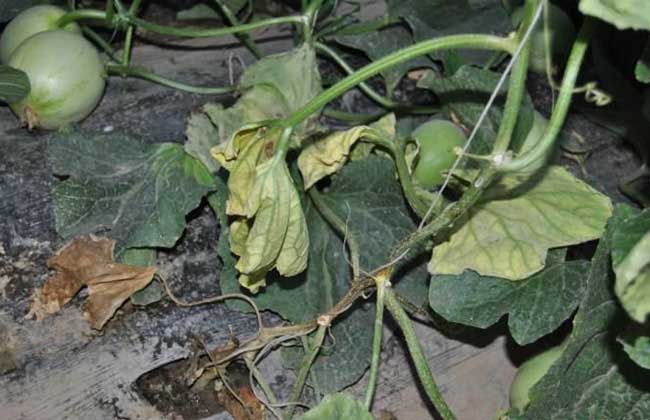
Muskmelon Fusarium wilt, also known as blight, is a plant disease caused by fungi or bacteria. It strikes suddenly, with symptoms including severe spotting, wilting, or death of leaves, flowers, fruits, stems, or the entire plant. The young, rapidly growing tissues of muskmelon are often attacked, and it can affect the flowers, leaves, buds, seedlings, twigs, stems, and growing tips of muskmelon. Let's take a look at the control methods for muskmelon Fusarium wilt below!
Damage symptoms
In the early stage of muskmelon Fusarium wilt, the plant's leaves gradually wilt from the base toward the top, most obviously at noon; at first they can recover in the morning and evening, but after a few days all the leaves of the plant wilt and droop and no longer recover. The base of the stem vine is slightly constricted, the epidermis is rough, and longitudinal cracks are common. When moist, the root and stem base become water-soaked and rotted, and white or pink mold-like growth often appears on the surface. The roots of diseased plants turn brown, are easy to pull up, the cortex separates easily from the xylem, and the vascular bundles turn brown. The peak period of the disease is from flowering to fruit set.
Conditions for disease occurrence
The optimum temperature for the development and infection of the muskmelon Fusarium wilt pathogen is 24-25°C, with a maximum of 34°C and a minimum of 4°C. At a soil temperature of 15°C the incubation period is 15 days, at 20°C it is 9-10 days, and at 25-30°C it is 4-6 days. The suitable pH is 4.5-6. Surveys show that aging seedlings, continuous cropping, undecomposed organic fertilizer, excessively dry soil, or acidic soil with a heavy texture are the main conditions causing the occurrence of this disease.
Control methods
1. Select good varieties: Choose disease-resistant (tolerant) varieties such as red-fleshed netted muskmelon, Snow White, and Suizhou large white muskmelon, as well as early-maturing varieties such as Elizabeth, Red Sweet Dew, Xinmi Za No. 7, Badi, Huangdanzi, and Green Pearl. At the same time, carry out crop rotation with non-cucurbit crops for more than 5 years, preferably paddy-upland rotation.
2. Soil conditioning: Applying compost fermented with enzyme bacteria or fully decomposed organic fertilizer, or adding 0.5% s-H additive (made from rice husks, bagasse, shrimp shell powder, etc. plus urea, superphosphate, and potassium nitrate) to the soil can reduce the occurrence of Fusarium wilt. For acidic soil, apply slaked lime at 100-150 kg per mu to adjust the soil pH to neutral.
3. Seed disinfection: For seed soaking, use a 150-fold dilution of 40% formalin for 30 minutes, then remove the seeds, rinse them clean with water, and then germinate and sow. You can also soak the seeds with 50% thiophanate-methyl or carbendazim wettable powder for 30-40 minutes. Treat the seeds with 40% seed dressing dual powder or 50% carbendazim wettable powder at 0.2-0.3% of the seed weight.
4. Chemical control: Use nutritional pot seedling raising. When transplanting, drench the holes with Shuangduo suspension concentrate (watermelon continuous cropping agent) and Shenqi Buxiu at 300-350-fold dilution, 0.5 kg per hole, using 1 kg of pesticide per mu. For direct seeding, drench with Shuangduo suspension concentrate at 600-700-fold dilution at sowing and when the muskmelon has 5-6 true leaves, drenching 0.5 kg of the prepared solution per hole, using 1 kg of pesticide twice per mu.