What are the control methods for apple powdery mildew?
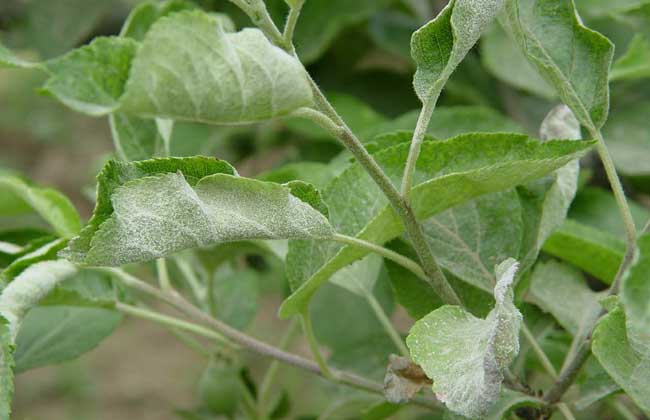
Apple powdery mildew occurs commonly in apple-producing areas in China. Besides damaging apples, it also damages pears, crabapples, Malus spectabilis, Malus prunifolia and Malus baccata, among others. It causes severe damage to Malus baccata seedlings, small apple types such as Malus prunifolia and Malus spectabilis, and apple varieties such as Wogeng, Zhu, Hongyu and Guoguang. Let us take a look at the control methods for apple powdery mildew below!
Conditions for disease occurrence
When winter buds sprout in spring, the overwintering mycelium produces conidia that spread through airflow and cause infection. The disease occurrence period is from April to September. Temperatures are relatively low in April and May, which is the peak period of powdery mildew occurrence. From June to August, the disease develops slowly or stalls, and when autumn shoots sprout in September, a second peak of disease occurrence begins. Warm, dry springs, rainy and cool summers, and clear autumns favor the occurrence and spread of this disease, while continuous rain inhibits the occurrence of powdery mildew. In orchards with high planting density, closed tree canopies, poor ventilation and light penetration, excessive nitrogen fertilizer application, and slender branches, the disease is severe. When pruning, if branch tips are not headed back, are left long, and a large amount of overwintering diseased buds is retained, the disease is severe.
Damage symptoms
1. Tender shoots: The growth of tender shoots is inhibited, internodes shorten, and the leaves growing on them become narrow and long or fail to open, becoming hard and brittle with leaf margins curling upward. In the early stage, the surface is covered with a white powdery substance, which gradually turns brown later. In severe cases, the entire shoot dies.
2. Leaves: Sparse white powder first appears on the underside of leaves. New leaves are slightly purple, shrunken and deformed. Later, the white powdery layer gradually spreads to both sides of the leaf. The color on the upper surface of the leaf is uneven in shade, and powdery disease spots form on the underside. Diseased leaves become narrow and long, with wavy, shrunken margins or uneven surfaces. In severe cases, diseased leaves gradually turn brown from the leaf tip or margin, and finally the entire leaf dries up and falls off.
3. Flowers: When apple flower organs are damaged, white powdery spots form at the calyx depression or pedicel depression. The sepals and pedicels become deformed, and petals become narrow and long and pale green. The pistils and stamens of damaged flowers lose their function, cannot pollinate or set fruit, and finally dry up and die.
4. Young fruit: Damage to young apple fruit mostly occurs near the calyx. White powdery spots form at the calyx depression, and the diseased part becomes hard. After the fruit grows larger, the white powder falls off, forming net-like rust spots, and the hardened tissue later forms cracks or fissures.
Control methods
1. During winter pruning, diseased shoots must be thoroughly removed. Check carefully in spring and summer, and promptly remove diseased shoots when found, seal them in plastic bags, take them out of the orchard, and burn them in a centralized manner or bury them deeply. Plant at a reasonable density, improve ventilation and light penetration conditions, and reduce the probability of disease occurrence. At the same time, appropriately control the amount of nitrogen fertilizer applied, pay attention to the combination of nitrogen, phosphorus and potassium, and increase the application of phosphorus and potassium fertilizers.
2. Before apple trees sprout, the orchard must be cleaned, using agents such as lime sulfur mixture, Guoguang octylamine, and thiophanate-methyl. Apply the first treatment at the pink bud stage of apple flowers and after petal fall, spraying 15% Guoguang triadimefon at 1000-1500 times dilution or Guoguang Baixiu at 1000-1500 times dilution.
3. Before apple tree buds break, in combination with the control of other diseases, spray 5 times Baume lime sulfur mixture, spray 1 time Baume lime sulfur mixture at the bud stage, and in spring at the early stage of disease occurrence spray 25% triadimefon wettable powder or 20% triadimefon emulsifiable concentrate at 2000 times dilution, or 12.5% tebuconazole at 2000 times dilution, once every 10-20 days, for a total of 3-4 times.
4. Spray “Guaguo Zhuangdiling” once each before apple flowering, at the young fruit stage, and at the fruit expansion stage. By thickening the nutrient transport vessels of the fruit tree and increasing the amount of nutrient transported, it improves the fruit expansion vitality and nutrient matching function, achieving the goals of protecting flowers, protecting fruit, strengthening fruit, and increasing fruit set.
5. Spray 15% triadimefon wettable powder at 3000-5000 times dilution or 15% triadimefon wettable powder at 1500-2000 times dilution. If powdery mildew occurs severely and the rate of diseased shoots reaches 15%, spray 15% triadimefon at 1000-1500 times dilution or 70% thiophanate-methyl at 1000 times dilution.