Where are the main production areas of the Russian olive fruit?
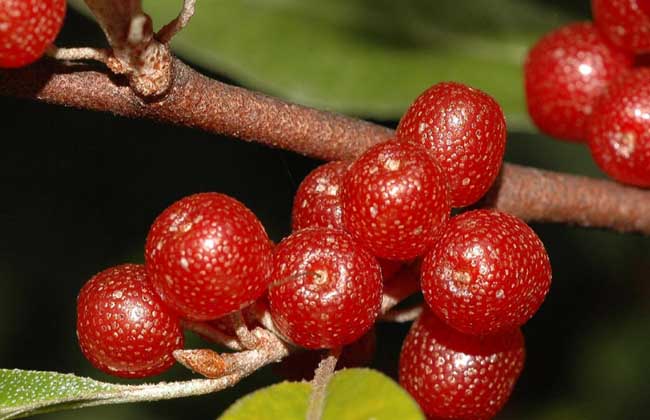
The scientific name of the Russian olive fruit is Elaeagnus pungens, also known as banchunzi, sweet mallet, que'er su, Russian olive, etc. It is the ripe fruit of Elaeagnus pungens, a plant in the family Elaeagnaceae and genus Elaeagnus. It is a perennial evergreen climbing shrub. The ripe fruit is bright red to purplish red. The fresh fruit is eaten raw. In the past, most were wild, but now some are cultivated. Cultivation can be done by sowing seeds or cuttings. Now let us take a look at where the Russian olive fruit is produced!
Where is the Russian olive fruit produced?
The Russian olive fruit is a specialty of the southwest region, and is widely distributed in Jiangsu, Zhejiang, Fujian, Anhui, Jiangxi, Hubei, Hunan, Guizhou, Guangdong, Guangxi and other places in China. It is generally used as a fruit for eating. There are two varieties, one is sweeter, and the other has slightly smaller fruit. The small-fruited type still grows wild on the mountains now.
Morphological characteristics of the Russian olive fruit
The Russian olive fruit has alternate simple leaves, rust-colored petioles, papery or nearly leathery leaves, elliptical, with the apex gradually pointed or bluntly pointed, the base broadly wedge-shaped, blunt, or rounded, and the margin entire. The flowers are brown, covered outside with brown scales, usually 1 to 3 clustered in the leaf axils. The perianth tube is cylindrical, with 4 lobes in the upper part; the lobes are broadly triangular, and the inner surface is densely covered with stellate short pubescence. There are 4 stamens, the filaments are extremely short, and the anthers are elliptical. The style is hairless and almost level with the perianth lobes. The fruit is large, long elliptical, with rust-colored scales, and the stone has obvious eight ribs. The flowering period is October to November, and the fruiting period is March of the following year.
Nutritional value of the Russian olive fruit
1. The fruit of the Russian olive is rich in nutrients. The edible rate is 73.3 to 91%. Every 100 grams of fresh fruit contains 2.45% crude protein, 2.8% crude fat, 5.1% total sugar, 90.6% water, 1.45% total acid, etc. The fruit is juicy and non-toxic. It can be eaten fresh or processed into fruit juice, soda, canned food, candied fruit and other foods. Because its fruit ripens relatively early, it can serve as a new variety for the off-season fruit market and as a raw material for the food industry.
2. The roots, fruit, and leaves of the Russian olive are used as medicine. It has the effects of relieving cough and calming wheezing, and astringing and stopping diarrhea. It mainly treats vomiting blood, coughing blood, sore and swollen throat, colds, infantile convulsions, sores and ringworm, etc. It can also treat asthma, deficiency cough, chronic bronchitis, enteritis, diarrhea, bruises and swelling, rheumatic pain, and jaundice.