Detailed Explanation of Akebia trifoliata Planting Techniques and Management Methods
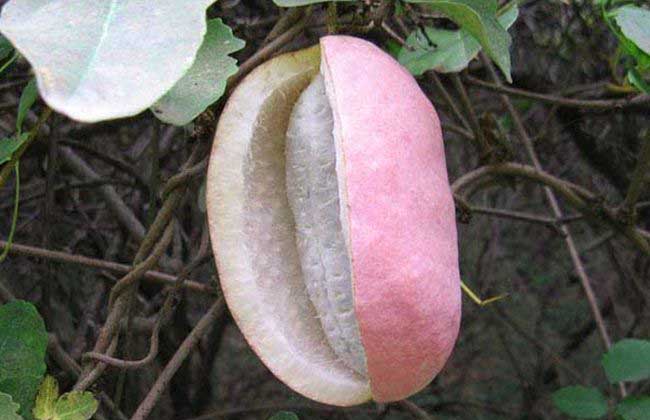
Akebia trifoliata is the fruit of Akebia trifoliata (three-leaf akebia) of the genus Akebia in the family Lardizabalaceae, also known as ox kidney fruit, dog kidney, August cracker, September cracker, etc. It gets its name because the fruit ripens and splits open in August. It is a pollution-free green food and is known as the "earth banana". It is now listed by relevant departments as a key development project and has extremely high cultivation value. Let us take a look at Akebia trifoliata planting techniques together!
Growth Habits of Akebia trifoliata
Akebia trifoliata prefers shady and moist conditions and is relatively cold-tolerant. It often grows in grass under forests on low-altitude hillsides. It grows well in slightly acidic yellow soil rich in humus and can also adapt to neutral soil. Its stems and vines often creep along the ground. Other communities and main associated plants include Liriodendron chinense, Cornus controversa, Toxicodendron vernicifluum, Cinnamomum bodinieri, Stachyurus chinensis, Viburnum chinshanense, Holboellia latifolia, Decaisnea insignis, Staphylea holocarpa, etc. It is distributed in Guizhou and Hunan, with the largest concentrations in Tongren, Guizhou, and the Tianzi Mountain Scenic Area in Zhangjiajie, Hunan. The fruit ripens and splits open in the eighth lunar month. Wild resources are abundant in mountain valleys and forest-edge shrublands such as Suoxiyu and Yangjiajie.
Propagation Techniques of Akebia trifoliata
1. Seed propagation: When the fruit of Akebia trifoliata matures from September to October, pick the fruit, eat the flesh, keep the seeds, and sow them in autumn in time. First rub and wash the seeds with alkaline water, rinse them clean with clear water, drain the water, dry them in the sun, store them in sand for 50-70 days around the 11th lunar month, and sow them in time in the prepared seedbed in early February of the following spring. Seed propagation is simple and easy, but the seedlings produced bear fruit late, generally only after 3 years. It is generally not used in production.
2. Layering propagation: The vines and stems of Akebia trifoliata have strong sprouting ability. Select 1-2 year old branches and vines and bury them in soil. They can take root after 1 month and can be propagated in all four seasons. Generally, they can bloom and bear fruit in the second year after planting.
3. Root division propagation: Root division propagation of Akebia trifoliata is carried out before sprouting in early spring. For a clump with multiple plants, divide it into several plants by hand from the roots. Without cutting the branches and vines, planting in the current year can bear fruit in the current year.
4. Cutting propagation: Akebia trifoliata can be propagated by cuttings in all four seasons. Select robust 1-2 year old branches and vines free of pests and diseases, cut them into 10 cm long cuttings, and insert them into a prepared seedbed. Pay attention to waterlogging, shading, and drought prevention. If conditions permit, use ABT No. 2 rooting powder to soak the branches and vines before cutting, and the survival rate can increase to 100%.
Seedling Stage Management of Akebia trifoliata
1. Planting time: Plant according to the root growth of seedlings obtained by different propagation methods. After planting, water thoroughly. For cutting seedlings and layering seedlings, field planting time should be in spring and winter. Spring planting should be before sprouting, and winter planting should be after leaf fall. For cutting and layering propagation seedlings, seedling lifting and transplanting can be carried out in December or early March of the following year. Seed-raised seedlings can be transplanted in all four seasons.
2. Planting techniques: At a point 15-20 cm perpendicular to the trellis line, dig a planting hole with a diameter of 30-40 cm and a depth of 25-30 cm. Mix the excavated soil with decomposed farmyard manure and backfill half of it into the hole. Build a steamed-bun-shaped soil mound at the bottom of the hole, place the seedling in the hole, spread the root system, and then backfill the remaining soil. The plant spacing and row spacing should be 90×130 cm for planting. Do not plant randomly; it must be standardized.
3. Seedling management: If cutting propagation is used, after the cutting seedlings sprout, since they have not yet rooted and cannot absorb water, they mainly rely on the water supply within the cuttings themselves. At this time, shading and watering should be done well to prevent the cutting seedlings from drying out due to leaf water evaporation. Especially in southern China from April to May, there is often a period of high-temperature weather, which is the stage with the highest mortality of cutting seedlings. At this time, spraying can be used to achieve the purpose of cooling and moisturizing. For layering propagation, external conditions generally have no obvious effect on it, and seedling stage management is relatively simple. Sexual propagation mainly uses seed raising, which is mainly carried out in greenhouses. Seedling management is relatively simple; regular watering is enough, and the operation is very simple. However, in high-temperature seasons, attention should be paid to ventilation to prevent seedling burn caused by excessively high temperatures.
4. Young seedling management: For seedlings obtained from seed propagation, management at the young seedling stage is mainly weeding. After seed propagation, cutting propagation, or layering propagation, a small amount of base fertilizer should be applied in the planting hole during transplanting, but the base fertilizer should be mixed evenly with the soil to prevent excessive concentration of fertilizer from affecting rooting of cutting seedlings and growth of young roots. After planting, the young seedling stage begins. This is the period of rapid growth for Akebia trifoliata, with relatively high water and fertilizer requirements. At this time, sufficient base fertilizer should be applied before sprouting, mainly farmyard manure, and compound fertilizer should also be applied, mainly nitrogen fertilizer and potassium fertilizer.
Field Management of Akebia trifoliata
1. Reasonable fertilization: Carry this out before sprouting in early March and during the mid-growth period of the plants from June to July (fruit expansion period). Generally, after planting, for the first topdressing, apply quick-acting nitrogen and potassium fertilizer on both sides of each plant within a range of 30 cm from the plant. Use a hoe or shovel to open shallow furrows, spread the fertilizer into the furrows, and immediately water lightly to deliver the fertilizer with water. Apply quick-acting phosphorus and potassium fertilizer as topdressing.
2. Reasonable irrigation: When Akebia trifoliata shows water shortage, artificial irrigation should be carried out. Before the summer rainy season arrives, the drainage ditches in the Akebia trifoliata planting area should be cleaned in time, and waterlogged areas should be drained promptly.